Suburban Family Still In Shock After They Hired Home Improvement Contractor Via HomeAdvisor, Only For The Contractor To Smash Up Their Property

Suburban Family Still In Shock After They Hired Home Improvement Contractor Via HomeAdvisor, Only For The Contractor To Smash Up Their Property

FOREST PARK, Ill. (CBS) — A suburban backyard was left in tatters with the garage and furniture hacked apart – and you won’t believe who was responsible.

As CBS 2’s Tim McNicholas reported, Jonathan Moody does not need video to remind him of May 15 – but there is video of what happened.

READ MORE: Chicago Police Officer Shot, Wounded In Calumet Heights; One Suspect Also Shot

“What are you doing?” his wife is heard yelling in horror as a man smashes the windows and siding on their garage – with their patio furniture already lying wrecked behind the man.

“It brings up just a lot of the trauma of that day,” Moody said.

He can’t forget that day, thanks to the missing window and cracked siding that greet him in his backyard each morning now.

“Especially for my wife, she’s had a really hard time with it,” Moody said. “She’s having trouble sleeping, she’s barricading the doors at night sometimes. We ended up going to therapy for trauma, and it’s just been really rough on her.”

The story starts in April, when the Moodys were looking for a contractor for improvements to their home in Forest Park. The search took them to HomeAdvisor.com, a website that claims to match homeowners with trusted local pros for any home project.

HomeAdvisor even boasts of an “extensive screening process to ensure every business in our network is reputable.”

“I felt like this was a great way to get a quality contractor to do this work,” Moody said.

But quality is far from what Moody got.

“While he was packing up his tools, he just started screaming and yelling – and broke all the patio furniture and threw it through the windows of the garage,” Moody said.

Moody said he was not satisfied with the work the contractor did before the rampage. Nonetheless, Moody had already paid the contractor in full, and has no idea why he did such a thing.

The couple asked us to hide the contractor’s identity, because they don’t want to anger him any further.

In a police report, an officer described the contractor as “physically violent,” “sweating profusely,” “frothing at the mouth,” and possibly “in a state of delirium” – so paramedics took him to a hospital.

“We really don’t want to give him any more reason to come back,” Moody said.

After the incident, Moody started to wonder about HomeAdvisor’s “extensive screening process.”

We did our own background check and found the contractor’s criminal history. He was found guilty of felony burglary in 2008.

Moody did some digging as well, and discovered another customer complained to HomeAdvisor about poor workmanship from the same contractor in April – before HomeAdvisor matched him within the Moodys.

READ MORE: Chicago Weather: Partly Cloudy And Breezy Overnight

That other customer is now suing the contractor.

“This all could have been avoided if they just did what they advertise that they do,” Moody said. “These contractors are coming into your home. This is a safety issue for each of the users of this platform, and I think they really need to take that seriously.”

HomeAdvisor and its parent company Angi would not agree to an interview.

A spokesperson told us in an email their screening process allows for certain felony convictions if they’re at least seven years old — including that 2008 burglary conviction.

As for the prior complaint? The company said they started to investigate it on April 29, and they suspended the contractor on May 3 – a day before Moody would pay for the project through the Angi app.

A suspension means no new work can begin, but already-scheduled projects like Moody’s are allowed to proceed.

And no one told the Moodys about that first complaint.

The Moodys kept their appointment, and on May 15, the “trusted local pro” wrapped up his work, grabbed his tools, and then went on that backyard rampage.

“It seems like they should have removed him, or at least suspended him from the service immediately when that happened,” Moody said, “and I think they should contact the other clients that he has – the other referrals that have been made – so that they know what to expect.”

HomeAdvisor says they finally booted the contractor from their platform for good after they saw the Moodys’ video. But by then, the Moodys’ backyard was already trashed.

“There like was a metal pole at one point that he started using to hack at the garage,” Moody said.

Now, Moody is in a months-long back and forth with HomeAdvisor.

The company offered to pay for the damage to the garage and for the shoddy work that needs to be redone, but they and Moody are thousands of dollars apart on what the dollar amount should be.

So for now, Moody said, “We really feel like we’ve lost a lot of our security living in this neighborhood – it doesn’t feel, like, safe anymore.”

And he is stuck with those daily reminders of a day he’d rather forget.

HomeAdvisor says they are disheartened by this incident, which they call rare. The company says their offer to the family went above and beyond the scope of the original project, but again, the Moodys disagree.

MORE NEWS: Massive Fire Destroys Home In Kildeer; Holiday Decorations Believed To Be To Blame

HomeAdvisor’s full statement is as follows:

“HomeAdvisor has a thorough screening process, including a criminal background check on the owner or principal of the business, which this particular pro passed due to his conviction falling outside of our 7-year lookback period. We provide our customers with options of vetted, qualified pros to complete the specific projects they need done in their homes. We also provide coverage for projects booked and paid through our platform. Ultimately, you’re hiring the pro for work you need done, and we provide an easier, better way to do so.

“We were as disheartened as you to hear about this incident and have worked hard to try to make it right over the past few months, but unfortunately the customer has declined our offers, which covered above and beyond the scope of original project. We take customer complaints very seriously and this situation was no different. This contractor has been removed from our network to ensure this doesn’t happen to anyone else.

“This was a rare instance, but we assure you that we did and will always do our part by screening the pros on our network, holding them and their work to high standards, and backing your projects when they’re booked and paid through our platform.”


Investors Snap Up Metaverse Real Estate in a Virtual Land Boom

Investors Snap Up Metaverse Real Estate in a Virtual Land Boom

Justin Bieber performed at a live concert this month, but the show wasn’t in a stadium or an arena. Like recent performances from Ariana Grande, the Weeknd and Travis Scott, this concert was held in the metaverse, the online world that stretches the corners of the internet into immersive, four-dimensional experiences.

Fans from all over the globe watched Mr. Bieber’s avatar sing songs from his hit album “Justice.” Investors were watching, too. Preparing for a digital land boom that appears just months away, they are snapping up concert venues, shopping malls and other properties in the metaverse.

Interest in this digital universe skyrocketed last month when Mark Zuckerberg announced that Facebook would be known as Meta, an effort to capitalize on the digital frontier. The global market for goods and services in the metaverse will soon be worth $1 trillion, according to the digital currency investor Grayscale.

The metaverse comprises multiple digital realms. Each is like a 3-D virtual city where avatars live, work and play. Anyone who has been exposed to popular video games like Fortnite, Animal Crossing and the Roblox universe has had a taste of what these realms look like. In each, elements including virtual reality, streaming video, mobile gaming, avatars and artificial intelligence are combined into immersive digital experiences.

But real estate investing in the metaverse still is highly speculative, and no one knows for sure whether this boom is the next big thing or the next big bubble.

Technologists believe the metaverse will grow into a fully functioning economy in a few short years and offer a synchronous digital experience that will be as integrated into our lives as email and social networking are today.

Money in these digital worlds is cryptocurrency, as finance in the metaverse is powered by the blockchain — a digitally distributed public ledger that eliminates the need for a third party, like a bank. Anyone entering a virtual world can buy or trade art, music and even homes as nonfungible tokens, or NFTs, which are blockchain-based collectibles that are digital representations of real-world items. The NFT serves as proof of ownership and is not interchangeable.

And in recent months, the volume of transactions for commercial real estate in the metaverse has ramped up.

In October, Tokens.com, a blockchain technology company focused on NFTs and metaverse real estate, acquired 50 percent of Metaverse Group, one of the world’s first virtual real estate companies, for about $1.7 million. Metaverse Group is based in Toronto but has virtual headquarters in a world called Decentraland in Crypto Valley, which is the metaverse’s answer to Silicon Valley. Decentraland also has districts for gambling, shopping, fashion and the arts.

“Rather than try to create a universe like Facebook, I said, ‘Why don’t we go in and buy the parcels of land in these metaverses, and then we can become the landlords?’” said Andrew Kiguel, a co-founder and the chief executive of Tokens.com.

Since that acquisition, Tokens.com has broken digital ground on a tower in Decentraland. Louis Vuitton, Gucci, Burberry and other luxury brands have already entered the metaverse via NFTs, a move that makes company executives optimistic that the Tokens.com tower will soon generate revenue from leases and advertising for brands like these.

For those wondering why a company would want to invest in a virtual office in the metaverse, Michael Gord, a co-founder of the Metaverse Group, said skeptics should look at the trends catalyzed by the pandemic.

“As more people participate, it’s where you’re going with friends, where you’re having experiences like conferences and concerts,” he said. “It’s inevitable that the metaverse will be the No. 1 social network in the world.”

The Metaverse Group has a real estate investment trust, and it plans to build a portfolio of properties in Decentraland as well as other realms including Somnium Space, Sandbox and Upland. The internet may be infinite, but virtual real estate is not — Decentraland, for example, is 90,000 parcels of land, each roughly 50 feet by 50 feet. Among investors, there’s a sense that there’s gold in those pixelated hills, Mr. Gord said.

“Imagine if you came to New York when it was farmland, and you had the option to get a block of SoHo,” he said. “If someone wants to buy a block of real estate in SoHo today, it’s priceless, it’s not on the market. That same experience is going to happen in the metaverse.”

Last week, Tokens.com closed an even larger land deal in Decentraland’s fashion district for roughly $2.5 million. The company, which says the real estate transaction was the largest in metaverse history, plans to develop the area into a virtual commerce hub for luxury fashion brands, à la Rodeo Drive or Fifth Avenue.

Mr. Kiguel estimates his portfolio in the metaverse is valued at up to 10 times more than its purchase price, and much of the reasoning will sound similar to anyone who has ever bought or sold real estate.

“It’s location, location, location,” he said. “A parcel of land in the downtown core, which has a lot of visitor traffic, is worth more than a parcel of land in the suburbs. There’s a scarcity value.”

Many of these digital realms appear as cartoonish, gummy-colored fantasy worlds, while others are digital applications of the planet we already know and love. SuperWorld, a virtual real estate platform mapped over the entire face of the globe, offers 64.8 billion plots of land — each for sale as an NFT. The Taj Mahal is available, as is, most likely, your childhood home. Owners can buy plots for reasons sentimental or savvy, but either way, once they buy the NFT, they get a share of any of the commerce that happens on that piece of property.

“You can buy locations that you love, whether it’s Central Park or the pyramids in Egypt,” said Hrish Lotlikar, a co-founder and the chief executive of SuperWorld. “What you’re buying is the virtual land that covers the earth at those locations.”

And as the metaverse seeps more deeply into the everyday consciousness of our universe, there’s a new realm where the divide between them gets rubbed away: the omniverse.

The real world and the online world merge into one hybrid universe, where the fungible and the nonfungible intersect at multiple points, said Justin Banon, a co-founder and the chief executive of Boson Protocol, which enables the sale of physical products in the metaverse as NFTs. Real estate in the metaverse will house the commerce that will drive this transformation.

“It’s already happening, and it’s just a question of degree,” he said. “But I think in five years, my daughter will not allow me to pick her up from school if I’m not wearing a pair of sneakers that don’t also have an NFT.”

In June, Boson Protocol bought a an entire block of the Vegas City gambling district of Decentraland. The space, the company says, will become a commerce point where products from the real world can be exchanged for NFTs; those same NFTs, acting as digital representations of physical products, can also be traded for items in brick-and-mortar stores.

“Everybody recognizes that we’re very early and these things are going to be modern-day antiques,” Mr. Banon said. “So buying at this stage is hugely lucrative.”

There are only a handful of digital realms where investors can buy and sell real estate, and all of them use their own cryptocurrency. Decentraland’s is called MANA, for instance. Decentraland also has a marketplace where people can browse NFTs, including plots of land for sale. “It’s almost like a multiple listings service,” Mr. Kiguel said.

Wave, an entertainment company that stages interactive concerts, including Mr. Bieber’s, earns a profit from virtual merchandise and brand sponsorships for the shows, which are held in neutral zones rather than a digital arena. The company is not yet monetizing real estate, but Adam Arrigo, a co-founder and the chief executive, said he was researching possibilities.

“These platforms like Decentraland and Sandbox are pioneers in credentialing these plots of lands, these storefronts,” he said. “Over the next few years, what we do is going to become a lot more mainstream.”

Four tips for investing in real estate from four leading global luxury

Four tips for investing in real estate from four leading global luxury

U.S. wealth is on the rise: the population of individuals with a net worth of more than $5 million grew by 17{d4d1dfc03659490934346f23c59135b993ced5bc8cc26281e129c43fe68630c9} from 2019–21, according to Coldwell Banker Global Luxury’s “A Look at Wealth” report. At the same time, wealth allocated to real estate surged to $3.6 trillion in 2021. With so many turning to real estate to diversify their investment portfolio, how does one cash in?

Thousands of Coldwell Banker Global Luxury specialists around the world are trusted advisors to clients looking to boost their real estate portfolio. I recently connected with four of them to find out their secrets. Jill Eber and Nathan Zeder are part of the renowned Jills Zeder Group in Miami who have far surpassed $1 billion in sales this year alone. Beverly Hills-based agent to the stars Joyce Rey caters to billionaires from around the world, having started the first U.S. company to specialize exclusively in multimillion-dollar homes in 1979, and Ed Feijo serves the titans of biotech, medicine, and universities in Cambridge, Massachusetts.

1. The Basics: Know Your Investment Goals

When first entering the investment market, Zeder encourages starting small: “Real estate is expensive, so make sure it’s something you’re comfortable doing.”

L-R: Nathan Zeder and Jill Eber

Eber says, before you get into the game, “know your ultimate objective when you choose to invest.” Consider what type of investment you want to make and prepare accordingly. Are you buying to flip, rent, or hold?

If your goal is to buy and rent out, be prepared to manage the property. Zeder and Eber emphasize that being a property owner is very different from flipping and selling; you must be prepared to deal with issues such as rental market changes, repairs, and breakdowns. Properties require maintenance, and if you’re not handy yourself, have a team of people there to help.

If you’re looking to flip, start small because expenses add up quickly. You may not be as concerned about inspections if the place is going to be torn down, but be aware of the potential costs.

If you plan to purchase a secondary home to hold and later sell, know that these purchases require more due diligence on the front end of the transaction, and an inspection is more vital. This is just one of the many areas where having an agent as a trusted advisor during the transaction is key.

2. Location, Location…Return on Investment

Feijo suggests prioritizing location if you plan to invest in a rental property; ensure it is always saleable and located where tenants will want to live.

L-R: Ed Feijo and Joyce Rey

Often, buying a property comes down to ROI. “Never give up a good opportunity, because you’ll never regret a good purchase,” Feijo advises.

Rey notes that the most sophisticated investors she’s worked with look for prime locations and quality construction, which makes her market exceptionally strong.

Eber concurs that desirable locations, waterfront views, and the feel of a home are most important to buyers. Proximity to schools, if that is desired, and walkability are also key factors. The investor looks at all of those elements, but the bottom line on the investment is most important, and location will always affect the ROI.

3. Prepare for the Luxury Migration

This has been the year of movement, so experts suggest being flexible when considering where to invest.

In California, Rey has seen a huge migration to the suburbs as people look for more land. Although she’s seen movement to other states, people have kept their California homes and added secondary homes in other states to their portfolios for tax reasons. As for where people are coming from, the market continues to be largely domestic, but Rey has started to see global buyers again. On an annual basis, the luxury market is composed of 20–25{d4d1dfc03659490934346f23c59135b993ced5bc8cc26281e129c43fe68630c9} foreign money.

Like most cities across the U.S., Cambridge is experiencing tight inventory. It’s a great secondary city, outside of Boston, where people feel they get more for their money. Feijo notes that he’s seen a lot of younger families moving to the area with buyers being mostly domestic. He sees the occasional international buyers whose children attend nearby universities such as Harvard or MIT.

Miami has always been a hotspot for investors for its multicultural, welcoming nature; unmatched location; and international stature. Zeder says there’s been a monumental uptick in movement from other parts of the country, including California and the Northeast, perhaps the most they’ve seen. He believes that as travel restrictions lift, there will be an influx of international buyers.

We’re seeing a wave of those choosing to invest in real estate rather than in the stock market, due to decreased volatility and overall stability. Additionally, Zeder’s international clients often invest in U.S. real estate because they see it as potentially a “safer bet” in the short and long term.

4. Find a Great Partner

Navigating the nuances of real estate investments can be difficult, so finding the right real estate expert to help guide you through the process is the final must.

With our expansive network of more than 90,000 knowledgeable agents, it’s easy. “Pick a great broker at Coldwell Banker,” Rey says. “Get professional advice and guidance from a knowledgeable real estate agent that you trust implicitly.”

If you’re ready to start investing, visit https://www.coldwellbanker.com/about.

Those named here are not licensed financial advisors. Seek the guidance of a licensed financial advisor when making personal finance decisions.

—

Michael Altneu is the vice president of luxury for Coldwell Banker Global Luxury.

Green home decor market set to blossom

Green home decor market set to blossom

Environmentally friendly furnitures are on display in Beijing on Sept 25, 2021. [Photo/IC]

Eco-friendly new buzzword in sector amid rising awareness by consumers

Zhang Yifeng, 32, has spent days finding environmentally friendly home decor items for his newly bought apartment.

“We are expecting a baby and we don’t expect newly-purchased home decor materials to harm the baby’s health. Our top picks were those environmentally friendly even though that means we have to pay a little bit more,” the Beijing-based accountant said.

For a long time, the home decor industry has been criticized due to potential pollution and high carbon emissions caused by product processing, and the use of materials that may compromise human health, like wooden products, painting supplies and cement.

With more green solutions being applied in the sector, however, the industry is becoming more eco-friendly, as more sustainable materials are being put on the shelves, propelled by the growing awareness among consumers on environmental protection and the country’s low-carbon pledges.

A report by Qianzhan Industrial Research Institute said green, environmentally friendly, energy-saving home decorations will be a major future development trend in the home decor market.

Data from research institute Zero Power Intelligence Group showed that the market size of China’s environmentally friendly home decor industry is growing rapidly and is likely to reach 259.66 billion yuan ($40.64 billion) in 2022.

The Qianzhan report said that with the improvement of people’s living standards and the increasing awareness of environmental protection, consumers have shown growing concern on how their lifestyles could impact the environment, and how the environment in turn could influence their health.

“Today more consumers are embracing the idea of environmentally friendly home decoration and willing to pay for such materials. The industry is also figuring out ways to lower the cost of developing eco-friendly materials, which in turn will reduce product prices and attract more consumers,” said Jae Li, founder and director of Circular China, a Shanghai-based environmental technology innovation company, during the recent Design China Beijing Expo.

A survey by news website 36Kr showed that 80 percent of consumers consider environmentally friendly the most important factor when deciding on wall painting supplies, wooden floors and furniture.

As a major consumer group for home decor, the post-80s and 90s generations are more willing to purchase non-formaldehyde home decor materials, which are considered less environmentally harmful, and are willing to pay more on those materials, the survey said.

Formaldehyde is a strong-smelling, colorless gas commonly used in painting materials and pressed-wood products like fiberboard. It can break down into harmful substances in the atmosphere and harm humans and animals alike.

Aside from formaldehyde, the home decor industry could impact the environment in various ways, Li said. “Home building and decorating create more carbon emissions than you could imagine-accounting for more than 40 percent in all industries’ total emission in China”.

Take the use of cement for instance. Production of one metric ton of cement could produce about 634 kilograms of carbon emissions, the Cement Big Data Research Institute said.

Production of cement in China reached 2.38 billion tons last year, allegedly emitting some 1.5 billion tons of carbon dioxide, which accounted for roughly 10 percent of total carbon emissions in the country, the institute said.

“There are tighter regulations on carbon-emissions of home decor concerning industries, such as construction materials. This has propelled innovations in eco-friendly products with lower costs,” Li said.

Bin Hui, deputy general manager of the Shanghai Environment and Energy Exchange, the designated platform of China’s carbon trading, said the construction materials industry is likely to be included into the carbon trading market next year.

“However, so far, the home decor industry is still confronted with many challenges, including the incomplete product varieties of environmentally friendly and energy-sufficient home decor materials. Going forward, more efforts are expected in related technology research and development,” Li said.

GARDEN COLUMN: Seasonal decorations | Home & Garden

GARDEN COLUMN: Seasonal decorations | Home & Garden

The weather has turned seasonably cold with the first frost being seen by most of us. For most of the holiday season, our thoughts tend to be inside with family and indoor plants, some of which are popular as part of our seasonal decorations. Poinsettias, cacti and amaryllis are just some of the plants that we find in the stores right now.

Poinsettias: The traditional Christmas poinsettia has been popular for decades with the bright red leaves still being the most popular color with shoppers. New colors such as variegated leaves or light-colored leaves dyed blue were a fad a few years ago and can still be found in florists or nurseries if you like them. If you kept your poinsettia from last year, you might find some red leaves starting to appear though nursery grown plants tend to be brighter with more flowers. Just as a note though, the red color is actually from bracts, or modified leaves around the small yellow flower that is in the middle. Once the color is set, the plant can be kept in shade or sun for the holiday season.

Christmas Cacti: There are a few different cacti on the market and all flower around this holiday season – one closer to Thanksgiving and one nearer Christmas/New Year. All are tender succulents rather than true cacti, so they can dry out quickly in your home. Water well in the sink and let it drain before putting back into the decorative container. These plants all survive well outside in summer and once the temperatures sink into the 40s and the daylength gets shorter, they produce bright red, white or salmon pink flowers. They do prefer full sun but will be fine for a few weeks in a partly sunny position. Keep the plant on the dry side but repeat the ‘water in the sink’ when the top of the soil is dry. For the rest of the year, keep the cacti in a sunny south facing window and place on your patio in late spring.

People are also reading…


GARDEN COLUMN: Spring bulbs: 50 is the magic number

Rosemary Topiary: These delightful plants are closely cropped to form a pyramid or other formal shape. The plant containers tend to be full of roots and difficult to water, but without water they go brown and die in days. The best remedy is to remove the outer pretty covering, leaving just the root ball and water like the succulents – in the sink. If the roots are too dense, take a knife and make a few slits in the root ball so that water can penetrate into the center as well as the outside. The rosemary is the same as a culinary rosemary but resist trimming the stems for your kitchen for a while – the nurseries use chemicals to keep away bugs and fugal issues and to keep the plant looking healthy. These chemicals are not safe to ingest. If your rosemary does survive the holidays, keep it slightly moist and in a cool room until spring when it can be planted in the garden. Give the plant at least a year to minimize contamination before using in your culinary dishes.

Amarylis: The amaryllis bulb is a popular hostess gift for seasonal parties and come in box or container. Read the instructions to prompt the amaryllis to produce a flower stalk. Once the stalk begins, it grows rapidly and finally produces the beautiful flowers a few weeks later. The bulb can be put into the garden for summer, then placed in a dark location until the leaves die and the plant is fully dormant. Give the bulb about a month of dormancy then bring back into the home and water well.


GARDEN COLUMN: Fall attraction in the garden

We have such a long growing season that winter flowers indoors are not required to last months, but for the holiday season they are certainly an addition to your decorations.

Wishing everyone a Happy, Healthy Thanksgiving and holiday season.


TheTandD.com: $5 for 5 months

Kate Copsey is a garden author, writer and speaker now living in eastern Orangeburg County. Her book “The Downsized Veggie Garden” is available from bookstores everywhere as well as her webpage www.katecopsey.com.

Vertical Focus | Home Improvement

Vertical Focus | Home Improvement

Tags: Retail, Materials Handling, Demand Planning

Vertical Focus | Home Improvement

Pre-Orders Build Up Home Improvement Inventory

Many manufacturers have discontinued their less-popular products or increased prices across product categories as ships wait off the California coast, truck drivers face long wait times, and rail yards remain backed up.

AAA Distributor, however, has all its kitchen cabinetry, shower doors, vanities, and flooring products ready to ship from its 120,000-square-foot warehouse in Philadelphia.

The home improvement store placed pre-orders to avoid running out of goods during the pandemic, and the strategy paid off. It started to receive containers in early 2021 and accumulated more than twice its 2020 inventory. The inventory arrived just in time to meet increased demand for summer home improvements.

AAA Distributor is now able to ship all kitchen and bath products within 48 hours. It also launched a new website, where all the products can be purchased and shipped directly to customers’ job sites.

The Home Depot Nails Down Same-Day Delivery

Do-it-yourself retailer The Home Depot’s online sales almost doubled in 2020, and it is investing $1.2 billion in its supply chain. As part of that investment, the company will expand its e-commerce delivery services and offer same-day or next-day delivery to 90{d4d1dfc03659490934346f23c59135b993ced5bc8cc26281e129c43fe68630c9} of the U.S. population by using Walmart’s GoLocal delivery service.

The Home Depot will launch the service at select stores in New Mexico, Texas, and Arkansas, before expanding to other markets by the end of 2021. Walmart will deliver smaller items that can fit into a car, such as tools, paint, and other supplies, for The Home Depot.

Walmart launched GoLocal in August 2021 as a byproduct of its e-commerce infrastructure and network of stores across the United States.

Patio Contractors Play Catch Up

Installing new patios was a big trend during the pandemic, as consumers built out their yards for at-home activities such as gardening, cooking, entertaining, and swimming. At the same time, restaurants and bars installed outdoor seating areas to allow for social distancing and keep their businesses open.

As a result, the demand for pavers—a popular hardscaping product used in outdoor installations—jumped nearly 7{d4d1dfc03659490934346f23c59135b993ced5bc8cc26281e129c43fe68630c9} in 2020, and many projects were delayed due to labor shortages, long wait times, and supply chain slowdowns, says a Freedonia Group analysis.

While supply chain challenges have persisted through 2021, they continue to become less of a factor, allowing more delayed projects to be completed. Near-term sales of pavers will remain elevated as pent-up demand for large-scale hardscaping installations is fulfilled, the report says. However, growth will moderate through 2025, with most of the gains stemming from price increases.

Construction Will Cost You

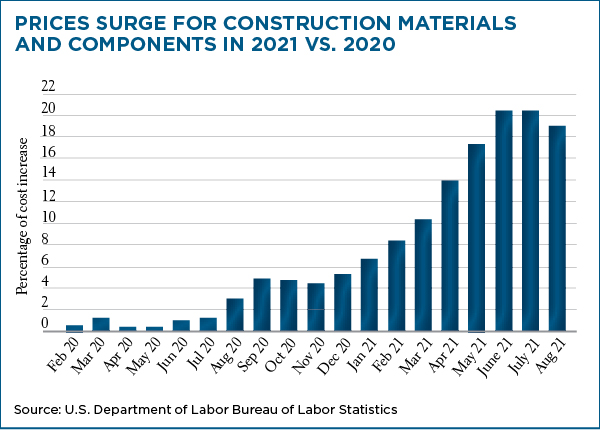
The cost of raw materials for U.S. firms is rising at its fastest rate in 40 years, with some of the higher costs making their way to consumers, says a Fitch Ratings analysis. Costs of construction materials and components have increased at a double-digit year-over-year rate since March 2020 (see chart).

The high demand for building materials persists due to new home construction and remodeling combined with government infrastructure and commercial construction spending, the report says. However, supply chain challenges in the building materials sector are taking longer than expected to normalize, hampering companies’ ability to benefit from that demand.

Production capacity was constrained early on in the pandemic due to labor shortages, facility closures, and social distancing protocols. Port congestion and adverse weather events have exacerbated these challenges. As a result, building materials companies look to price increases, surcharges, and capacity expansion to compensate. Still, 2021 revenue growth remains within expectations, due largely to higher pricing, the report says.

Ikea Constructs a Plan

Swedish home furnishings retailer Ikea expects container shortages and port congestion to remain an issue through mid-2022, as consumers working from home continue to renovate. Here are four ways Ikea plans to pick up the pieces:

1. Focus its product offering on its most popular products.

2. Take other measures to get products shipped to its stores, such as renting its own containers and finding alternative routes on trains.

3. Absorb costs to accommodate price spikes for transportation and raw materials rather than passing them on to consumers.

4. Make products even more affordable and get a bigger share of revenue from its lower-price products.

Paint Demand Spills Over

Producer prices for paint and coating rose 10.6{d4d1dfc03659490934346f23c59135b993ced5bc8cc26281e129c43fe68630c9} in August 2021 from the previous year—the biggest annual jump since January 2009—as consumers change up their wall colors.

The deep freeze in the South has slowed production of petroleum, a critical ingredient for paint, and store owners have struggled to keep product on the shelves. Demand, however, isn’t slowing down. The following home projects have been the most popular during the pandemic, adding to the supply chain strain, a HomeAdvisor report says:

1. Interior painting

2. Bathroom renovations

3. Flooring

4. Landscaping

5. Kitchen renovations

6. Exterior painting (tie)

7. Smart home devices (tie)

8. Roofing

9. Fencing

10. Deck or porch