Inflation moderated in Oct, but it really is not likely the Federal Reserve will minimize fees instantly.
Greater interest prices usually are not that large a deal, Ahmed Seirafi, a authentic-estate investor, reported.
Seirafi mentioned he thought housing price ranges would drop in the up coming six months.
Growing curiosity costs have spooked would-be actual-estate traders, bringing down dwelling rates and cooling the pink-warm housing market place. Even even though many years-higher inflation is ultimately exhibiting symptoms of moderation, the Federal Reserve is not likely to begin slicing desire prices in the speedy foreseeable future.
The in the vicinity of-phrase macroeconomic outlook may possibly not look really beneficial for true-estate traders, but Ahmed Seirafi — a veteran investor who has over two decades of business experience — is just not fearful.
The 48-12 months-aged Seirafi retains a 178-unit true-estate portfolio distribute throughout three qualities in Texas and his household state of California. His portfolio — which is composed of two retail place of work structures and a single multifamily apartment sophisticated — is really worth about $50 million, in accordance to documents considered by Insider.
Seirafi is also in the middle of setting up a 300-device progress in Anna, Texas, that he will hold 60{d4d1dfc03659490934346f23c59135b993ced5bc8cc26281e129c43fe68630c9} equity in. Upon completion, Seirafi estimated the mixed price of his jobs could be value everywhere from $400 million to $450 million.
Will not try to time the actual-estate industry
With so a great deal on the line, it’d be simple to understand if Seirafi was a minimal more trepidatious about the potential of the housing current market as rising curiosity costs brought selling prices down. But he stays unfazed.
“Everyone’s so involved about curiosity costs, but I do not care if the desire charge is 50{d4d1dfc03659490934346f23c59135b993ced5bc8cc26281e129c43fe68630c9}, as prolonged as I am earning money on the property,” Seirafi informed Insider in a modern interview. “To me, it’s all about dollars movement and funds-on-funds returns.”
For that exact same purpose, Seirafi also thinks that trying to time the market is futile.
“Everyone’s searching for the grand-slam household run that wins the Planet Sequence,” he said. “They’re all trying to time the industry and their investments and when they are getting and when they’re promoting, but you are going to hardly ever time it correctly.
“As prolonged as your expense is producing income, is perfectly-positioned, and you have enough cushion there for any kind of adjust in the current market, it can be a superior investment.”
Seirafi reported he experienced observed achievements by focusing on guarding his investments and acquiring “genuinely fantastic offers that make feeling,” fairly than the “best discounts” that additional opportunistic investors may search for out.
Housing rates are because of for a correction
For the reason that Seirafi won’t choose increasing desire prices into much too substantially consideration, he is not that worried about a dearth of financial commitment options. On the contrary, he mentioned he considered it is critical for new genuine-estate traders to get into the sector quicker alternatively than later on.
“There’s extra possibility than there has been in the past 10 decades,” he mentioned. “I think persons can surely get in on investing, specially in the future 6 months.”
Even though you will find a great deal of qualities on the industry appropriate now, he’s not looking at any wonderful deals just nevertheless. But he’s optimistic because he thinks that rates are thanks to appear down as sellers master to adjust their lofty price tag anticipations to the industry realities.
“They are heading to have to allow go of that sale value and lower the price on no matter what they’re promoting because as fascination rates go up, the rate has to go down in purchase to get the form of return to justify the larger fascination amount,” he mentioned. “So people today are holding on to the substantial rate, but they are going to have to permit loose of that grip extremely quickly.”
But when housing costs lastly accurate, Seirafi stated the landscape for true-estate investing could be much bleaker, specially for investors who usually are not seasoned, are highly leveraged, or don’t have the understanding or talent established to manage and run their attributes.
“In the previous ten years, the the vast majority of the results in the market place has been brought on by the current market and not by innovative and expert real-estate practitioners,” he said. “You could be dead in the middle of the road and you could be making cash in the previous 10 yrs.”
As a additional-ordinary housing cycle materializes, Seirafi believes these inexperienced buyers would not be ready to only ride the wave to accomplishment again and might be in threat of shedding their houses, he mentioned.
“People individuals who shed their property are the kinds who will offer the opportunity for individuals like me to take advantage,” he included. “People who have the practical experience in the real-estate field are likely to choose gain of all those who received into the small business but do not have the encounter on how to run and function by cycles.”
To assist investors prevent getting rid of their investments, Seirafi offered numerous parts of information, including investing with a syndication, not getting on also substantially personal debt, going against the status quo, and carefully scheduling for the prolonged term, in its place of chasing the hottest craze.
“Will not chase the sizzle for the reason that most persons do — they want the cool matter, the incredibly hot factor, and which is what will get men and women in hassle,” he mentioned. “They chase the sizzle and not the steak.”
About 30{d4d1dfc03659490934346f23c59135b993ced5bc8cc26281e129c43fe68630c9} of acquire agreements in Jacksonville had been canceled in Oct. It was the second straight month that Jacksonville had the most in the state.
Northeast Florida experienced a large pandemic-fueled growth in housing costs final 12 months and many thanks to low home finance loan prices and thousands of people today flocking to the condition. But dwelling obtain cancellations and other metrics exhibit which is no more time the circumstance.
Jacksonville saw the major 12 months-more than-year boosts in the share of households for sale with value drops past thirty day period, according to Redfin details.
Northeast Florida Affiliation of Realtors (NEFAR) President Mark Rosener said discounts slipping by has a lot to do with new property development and mounting home finance loan fees.
“A good deal of these people went beneath deal 9 months ago, a year back, when curiosity charges are really diverse right now than they were then. And so their payment that they had been on the lookout at nine months back is not the very same,” Rosener reported.
Rosener reported general, he’s witnessed a slowdown in the housing marketplace regionally in recent months.
“So a person of the cautions that I’ve finished about the past few of months is evaluating this year’s stats, to 2021, and to 2020, simply because people two several years were being atypical. It was these kinds of a nuts sector, we understood it would not be sustained,” he stated.
Rosener claimed the housing market place is beginning to search like it did back in 2019 when matters were being far more “normal.” He mentioned which is superior for prospective buyers and sellers.
“Today, homes are remaining on the marketplace a minor little bit lengthier. There is additional to select from. So from a buyer standpoint, there’s some advantages there,” Rosener stated. “From a seller’s standpoint, it’s fewer demanding. Even from a seller’s level of watch, a a number of present condition, it is tense.”
Hunting at NEFAR info for 6 Northeast Florida counties, the median revenue cost for a one-loved ones home was nevertheless 14.5{d4d1dfc03659490934346f23c59135b993ced5bc8cc26281e129c43fe68630c9} larger than final October at extra than $383,000, but properties are turning out to be more affordable for customers.
Rosener explained it’s still a “seller’s market” but items could stabilize by the stop of up coming year.
“Typically, serious estate economists will say, a five to six-month offer is a balanced industry. It is neither a seller’s or a buyer’s market place. At the moment, we’re in about 3 thirty day period provide, which would point out that we’re nevertheless in a seller’s sector, but all items are relative. This seller’s marketplace is very, quite distinct than it was back again in April, March, February of this yr and all of very last 12 months,” he explained. “Probably by the end of 2023 we will be in a balanced current market.”
Inflation is starting to cool, and Redfin reported potential buyers may return to the current market if the trend proceeds.
Copyright 2022 by WJXT Information4JAX – All rights reserved.
Add tech business layoffs to the listing of headwinds dealing with the Bay Location housing marketplace.
Soaring mortgage rates, economic downturn fears and a volatile inventory market place have all tamped down residence profits and rates in new months from record-setting pandemic highs.
Now, moving into the customarily slow winter authentic estate year, escalating uncertainty in the region’s top marketplace is offering would-be purchasers a further reason for pause.
“We have shoppers who have been in and out of looking at shopping for,” stated Silicon Valley real estate agent Mary Pope-Useful. “One of them is effective at … Fb, and they reported. ‘I didn’t get laid off, but it does not appear like a good time to make a large order.’”
Presently, there are symptoms an unstable tech industry may well be dragging down property rates. In Oct, the median expense of present one-family members residences in the Bay Location was down 2{d4d1dfc03659490934346f23c59135b993ced5bc8cc26281e129c43fe68630c9} from the identical time in 2021, to a nevertheless-expensive $1.2 million, according to facts released this week from the California Association of Realtors.
That drop was even steeper in tech-hefty San Francisco and San Mateo counties. Rates in San Francisco fell 7{d4d1dfc03659490934346f23c59135b993ced5bc8cc26281e129c43fe68630c9} to $1.7 million, whilst San Mateo dwelling costs tumbled 10{d4d1dfc03659490934346f23c59135b993ced5bc8cc26281e129c43fe68630c9} to $1.9 million.
In the region’s other Silicon Valley county, Santa Clara, rates have been flat yr-over-12 months at $1.6 million — but had been down 4.4{d4d1dfc03659490934346f23c59135b993ced5bc8cc26281e129c43fe68630c9} from the thirty day period just before.
Oscar Wei, deputy main economist with the Affiliation of Realtors, said the influence of tech layoffs in the Bay Space must be strongest in the coming winter season months when homebuying commonly slows.
“When you glimpse at revenue action in advance of the close of the yr, it is probable likely to be somewhat slower than what we earlier considered,” Wei said.
But he expects high home finance loan charges to go on currently being the most sizeable issue impacting property selling prices — which regardless of current declines are still up in the Bay Spot as a great deal as 30{d4d1dfc03659490934346f23c59135b993ced5bc8cc26281e129c43fe68630c9} from just right before the pandemic.
Final thirty day period, home finance loan charges soared over 7{d4d1dfc03659490934346f23c59135b993ced5bc8cc26281e129c43fe68630c9} for the initially time in far more than 20 yrs, a lot more than double the historic-reduced 3{d4d1dfc03659490934346f23c59135b993ced5bc8cc26281e129c43fe68630c9} common fee in 2021.
The rising rates came as a final result of the Federal Reserve raising the expense of borrowing to slow inflation. For many potential buyers, that is intended that even as dwelling price ranges have softened, the real price of homeownership for most buyers has gotten a great deal much more high priced.
This 7 days, there was a little bit of aid: The regular level on a 30-year-fixed house loan fell to 6.6{d4d1dfc03659490934346f23c59135b993ced5bc8cc26281e129c43fe68630c9} — the major fall considering that 1981 — as inflation commences to cool.
Even so, the regular monthly payment on a $1 million home in the Bay Area is at the moment $6,422, in accordance to a Realtor.com calculator. This time previous calendar year, when charges were at just over 3{d4d1dfc03659490934346f23c59135b993ced5bc8cc26281e129c43fe68630c9}, the every month payment on a residence that price tag would have been $4,708.
(Month-to-month payment estimates include things like house taxes and insurance coverage and assume a 20{d4d1dfc03659490934346f23c59135b993ced5bc8cc26281e129c43fe68630c9} down payment.)
Now, turmoil in the tech marketplace is adding a new problem. Even in advance of Facebook, Twitter and Amazon just lately declared enormous layoffs, tech firms had been shedding hundreds of regional positions as earnings fell and a economic downturn appeared additional likely.
Whilst quite a few of people very qualified staff may find jobs in other industries, the moves “could ship a sign to everybody” that the financial state and housing industry “are vulnerable because it will lead to a broader slowdown,” stated Stephen Levy, director of the Palo Alto-centered Heart for Continuing Research of the California Economy.
Levy famous a popular freeze in tech selecting could also awesome housing costs.
“To the extent that new tech staff members were being a source of desire for bidding up selling prices, that is possible to disappear for a though,” he explained.
Pope-Handy reported prospective homebuyers in the tech industry also are feeling the ups and downs of the inventory current market. As a final result, numerous have been reluctant to money out their sizable investment portfolios to invest in a property.
But Pope-Handy mentioned an additional tech craze essentially could spur demand from customers for properties: Tech firms, notably Elon Musk’s recently acquired Twitter, are setting up to limit employees’ selections for remote do the job, forcing them to move back again to the Bay Area for their work.
“Whenever we see the current market flip down for a bit,” she reported, “it doesn’t remain down without end.”
America’s house prices could plunge as a great deal as 20{d4d1dfc03659490934346f23c59135b993ced5bc8cc26281e129c43fe68630c9} due to the sharp rise in mortgage loan rates in 2022, which are greatly rising household ownership costs and “enhance the odds of a significant household cost correction,” in accordance to investigation from the Federal Reserve Financial institution of Dallas.
To be sure, the potential for the nation’s properties to drop as a great deal as a single-fifth of their price represents a “pessimistic state of affairs,” Dallas Fed economist Enrique Martinez-García noted in a report on Tuesday. But other economists have signaled equivalent fears, with Pantheon Macroeconomics Chief Economist Ian Shepherdson before this yr predicting a identical slump in household costs.
The pandemic made an unconventional elixir for the authentic estate sector, with record-small home finance loan fees and operate-from-home orders whipping up a surge in desire for home possession. At the peak of the industry, some customers even waived classic contingencies such as inspections and supplied tens of 1000’s of pounds in excess of asking price ranges in get to get their bids — a “concern of missing out” mentality that fed into a “bubble,” Martínez-García reported.
A steep drop in housing selling prices would probable have a ripple influence on the broader financial state as effectively as further undermine the real estate sector. If residence prices dropped 15{d4d1dfc03659490934346f23c59135b993ced5bc8cc26281e129c43fe68630c9} to 20{d4d1dfc03659490934346f23c59135b993ced5bc8cc26281e129c43fe68630c9}, beneath Martínez-García’s pessimistic situation, personalized intake could fall by .5 to .7 a share point, he believed.
“These kinds of a negative prosperity effect on aggregate desire would further more restrain housing demand from customers, deepening the selling price correction and setting in movement a unfavorable suggestions loop,” he cautioned.
Large home loan premiums generate down household income
02:09
Home loan charges have jumped from about 3{d4d1dfc03659490934346f23c59135b993ced5bc8cc26281e129c43fe68630c9} in January to about 7{d4d1dfc03659490934346f23c59135b993ced5bc8cc26281e129c43fe68630c9} currently, moving in tandem with the Federal Reserve’s 6 amount hikes this yr. The central lender would like to tame the maximum inflation in 40 yrs by raising the charge of borrowing, which ought to temper demand from businesses and buyers.
Preferably, the Fed will “cautiously thread the needle of bringing inflation down with out placing off a downward property-cost spiral — a substantial housing offer-off that could irritate an economic downturn,” Martínez-García wrote.
Household charges rose a overall of about 61{d4d1dfc03659490934346f23c59135b993ced5bc8cc26281e129c43fe68630c9} among 2013 and 2022, following altering for inflation — a soar that outpaced the preceding housing bubble from 1998 to 2007, in accordance to his calculations.
Higher home finance loan costs must decrease the chance that the present-day “increase” in property price ranges will keep on, Martínez-García included.
Demand rises for adjustable-rate mortgages
04:15
For now, housing charges are nevertheless rising. The national median price tag for an current single-family dwelling rose 8.6{d4d1dfc03659490934346f23c59135b993ced5bc8cc26281e129c43fe68630c9} in the third quarter, reaching $398,500, according to the Nationwide Association of Realtors. Continue to, the charge of selling price increases is slowing, offered that home costs jumped 14.2{d4d1dfc03659490934346f23c59135b993ced5bc8cc26281e129c43fe68630c9} in the second quarter, the industry group said previously this thirty day period.
Extra purchasers are having priced out of the market place since of the mixture of growing property rates and bigger mortgage loan prices. The median revenue now essential to purchase a usual dwelling is now $88,300, or about $40,000 much more than was needed prior to the pandemic in 2019, NAR claimed.
The industry is specially tough at the second for very first-time consumers. Mainly because of the spike in mortgage rates, a purchaser of a common starter residence value about $340,000 who set 10{d4d1dfc03659490934346f23c59135b993ced5bc8cc26281e129c43fe68630c9} down would encounter a every month mortgage payment of $1,808 — about $600 far more than a yr ago, in accordance to the group’s calculations.
NAR Main Economist Lawrence Yun predicted previously this thirty day period that residence revenue will slip by 7{d4d1dfc03659490934346f23c59135b993ced5bc8cc26281e129c43fe68630c9} future 12 months as far more people are priced out of the market, but explained he expects the median residence value will increase 1{d4d1dfc03659490934346f23c59135b993ced5bc8cc26281e129c43fe68630c9}. One particular cause he would not anticipate price ranges to slide: Stock continues to be limited, which means that customers are nevertheless competing for attractive attributes.
A household enhancement contractor operates on a residence in Cambridge, Massachusetts.
Suzanne Kreiter | The Boston World | Getty Illustrations or photos
As the U.S. housing marketplace falls challenging from its pandemic-pushed highs, house enhancement vendors like Dwelling Depot and Lowe’s really don’t appear to be to be sensation the very same agony. In fact, they’re faring improved than expected.
When homebuilding and home reworking are integrally linked, the industry forces guiding each and every can be diverse, and that is what is happening now.
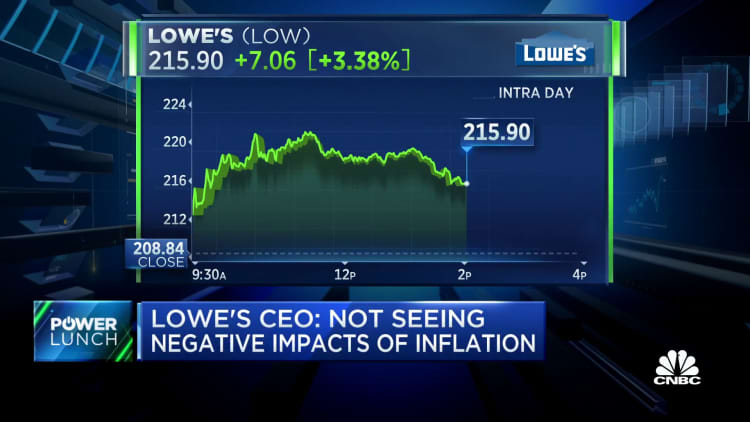
House Depot and Lowe’s documented sturdy quarterly earnings Tuesday and Wednesday, respectively. Lowe’s stock rose 3{d4d1dfc03659490934346f23c59135b993ced5bc8cc26281e129c43fe68630c9} Wednesday. Executives at both corporations spoke bullishly about the prospects for their organization in 2023. This comes as residence sales, charges and building are all weakening appreciably thanks to a massive soar in home finance loan prices.
Residence Depot financial main Richard McPhail pointed to an “boost in place” mentality among recent owners, who may have required to offer but adjusted their minds due to the fact they could no longer command top dollar.
“All we can do at this place is repeat what our shoppers are telling us,” McPhail stated. “There is a dynamic we do not see a lot in the marketplace. With climbing house loan costs, homeowners are keeping in place.”
With increasing mortgage fees, homeowners are being in place.
Richard McPhail
Residence Depot CFO
Home costs are nevertheless 11.4{d4d1dfc03659490934346f23c59135b993ced5bc8cc26281e129c43fe68630c9} better in Oct than they were being in Oct 2021, in accordance to CoreLogic, but that yearly comparison has been shrinking for quite a few months. Costs are falling thirty day period-to-month at a considerably speedier pace than standard seasonal tendencies.
However, the unparalleled operate-up in home costs throughout the 1st years of the pandemic, fueled by file reduced property finance loan fees and a drive for lots of People in america to shift to more substantial houses in suburban locations, gave householders sizeable amounts of equity. Charges jumped extra than 40{d4d1dfc03659490934346f23c59135b993ced5bc8cc26281e129c43fe68630c9} in just two several years.
By the close of the initially quarter of this 12 months, prior to the steep runup in home loan premiums prompted the housing sector to falter, house owners experienced a collective $11 trillion dollars in so-identified as tappable equity, according to Black Knight. That is the quantity a borrower can get out of their home while nevertheless leaving 20{d4d1dfc03659490934346f23c59135b993ced5bc8cc26281e129c43fe68630c9} equity in it. That fairness grew by an unparalleled $1.2 trillion in the to start with quarter of this yr by itself. For every property owner, it quantities to about $207,000 in tappable equity.
That equity is aspect of a three-pronged driver of property advancement, in accordance to the CEO of Lowe’s, Marvin Ellison. He pointed to dwelling price tag appreciation, the age of the U.S. housing stock — which is roughly 40 several years outdated, the oldest considering the fact that Globe War II — as perfectly as significant levels of personalized disposable earnings.
“So when you seem at all people elements, individuals matters bode properly for house improvement, and we come to feel genuinely fantastic about our present-day tendencies,” explained Ellison in an interview Wednesday on CNBC’s “Squawk Box.”
The NAHB, nonetheless, is forecasting that the remodeling sector will fare the best between the household construction submarkets during this existing housing contraction.
“The development level for advancement investing will gradual because of to declines for existing property income,” said Robert Dietz, NAHB’s chief economist. “However, an aging housing inventory, function from household developments and a decline for domestic mobility all favor transforming investing.”
Dietz also factors to the “curiosity fee lock-in results,” meaning folks will not want to offer a dwelling where they may possibly be spending a 2.75{d4d1dfc03659490934346f23c59135b993ced5bc8cc26281e129c43fe68630c9} property finance loan fascination price and trade up to another home wherever the price would probably be all-around 7{d4d1dfc03659490934346f23c59135b993ced5bc8cc26281e129c43fe68630c9} currently.
Harvard’s Joint Center for Housing predicts that the annual gains in home advancement and maintenance shelling out will drop “sharply” by the center of future year, but only to a 6.5{d4d1dfc03659490934346f23c59135b993ced5bc8cc26281e129c43fe68630c9} development amount from an unusually superior 16{d4d1dfc03659490934346f23c59135b993ced5bc8cc26281e129c43fe68630c9} rate.
“Housing and reworking markets are without doubt slowing from the exceptionally high and unsustainable growth costs that adopted in the wake of the pandemic-induced economic downturn,” states Carlos Martín, venture director of the Reworking Futures Plan at the Middle. “Paying for dwelling advancements will carry on to face headwinds from declining dwelling income, mounting interest fees and the increasing charges of contractor labor and building components.”
Regardless of inflation in just about every thing in the financial system, consumers do feel to want to commit far more on their homes. Both equally Lowe’s and Household Depot showed a drop in the number of sales but a soar in the dollar amount of money of all those gross sales. That led to their increases in profits.
“There is inflation in the market and elasticity, but not to the degree that we predicted, and the shopper reveals us they are resilient,” reported Home Depot’s McPhail.
A new study of nearly 4,000 home owners by Houzz, a house improvement and structure web-site, discovered that only 1{d4d1dfc03659490934346f23c59135b993ced5bc8cc26281e129c43fe68630c9} of owners documented acquiring canceled a house improvement job in 2022. In the meantime, 37{d4d1dfc03659490934346f23c59135b993ced5bc8cc26281e129c43fe68630c9} accomplished a undertaking in 2022 and just about a single-quarter mentioned they were being setting up to start off a home enhancement challenge in the next 12 months.
“Moreover, much more than fifty percent of the owners we surveyed have no intention of marketing or relocating out of their existing residences in the following 20 a long time or ever,” said Maritime Sargsyan, Houzz personnel economist.
In a matter of months, the pandemic housing boom has turned into a rapidly spreading bust. Incredibly, recent reporting shows that home prices are now falling faster than they did during the run-up to the 2008 financial crisis.
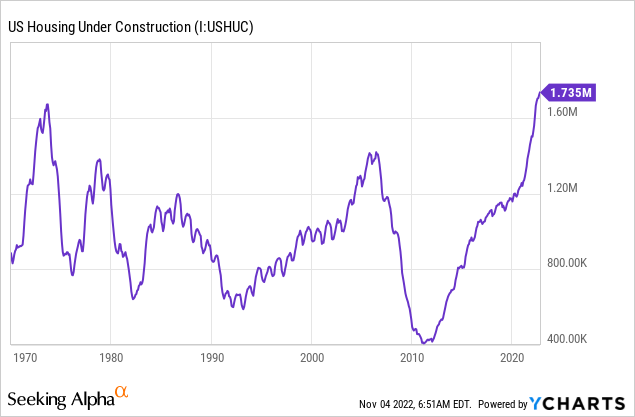
Decreased demand comes just as a tsunami of new supply is about to hit the market, with over 1.7 million privately owned homes currently under construction. This smashes the all-time record set in 2006.
The housing market was very overheated for a couple of years after the pandemic, as demand increased and rates were low. The market needs to get back into a balance between supply and demand (emphasis mine).
–Jerome Powell, Nov. 2 FOMC Meeting.
The developing crash in housing prices has profound implications for anyone looking to buy a house, as well as for investors in housing stocks. The iShares Home Construction ETF (BATS:ITB) is down a bit more than 30{d4d1dfc03659490934346f23c59135b993ced5bc8cc26281e129c43fe68630c9} for the year, but if the situation on the ground is as bad as it appears, then it might be headed a lot lower. ITB is the worst of the worst when it comes to this kind of interest rate shock, because homebuilders borrow a lot of money to build, and in turn, they sell to their customers who borrow a lot of money to buy. This crash has been a long time coming as prices got further and further from fair value. Now that huge declines are rolling down the tracks, there’s not much that can stop it. If you already own a house with a low mortgage rate and didn’t buy it during the bubble, then no worries. But if you’re looking to buy a house now, think twice!
A Tidal Wave Of Housing Supply Is Coming
1.7 million homes are presently under construction in the US, the highest level ever. The peak in 2006 was around 1.4 million homes in various stages of construction. This obscures the fact that the US population was growing by nearly 3 million people per year in 2006, whereas the population now is only growing by somewhere between 500,000 and 1 million people per year.
At the average of roughly 2.5 people per household, that implies a need for nearly 1.2 million housing units built in 2006, but only 400,000 units in 2022 if we assume we gained a million people in population. There are reasons to believe that population growth could be even lower going forward, as declining inflation-adjusted wages and declining life expectancy (coronavirus, opiates, general malaise, etc.) take their toll. With mortgages over 7{d4d1dfc03659490934346f23c59135b993ced5bc8cc26281e129c43fe68630c9} now and population growth flatlining, who is going to buy all of these homes?
Of course, there’s a continual toll of obsolescence for homes (mostly homes in rural areas and the Rust Belt where people abandon them and move to greener pastures). This is thought to be about 300,000 homes per year. All-in, demographics imply the need for around 700,000 housing starts per year. We’re adding about twice as many houses as demographics imply we need to the construction pipeline on an annualized basis.
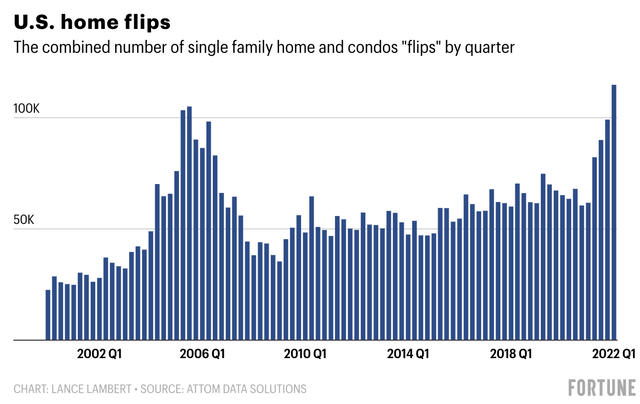
By contrast to the changing demographic picture, house flipping has been at an all-time high, with investors often selling to other investors.
Flip or Flop? (Fortune)
The Rental Market Is Reversing
Interestingly, a much higher percentage of units under construction than in the last cycle are multifamily units, either as condos for sale or apartments for rent (about 50{d4d1dfc03659490934346f23c59135b993ced5bc8cc26281e129c43fe68630c9}). Rents went crazy during COVID, but there’s actually a simple explanation for why they did, and why things may be about to reverse.
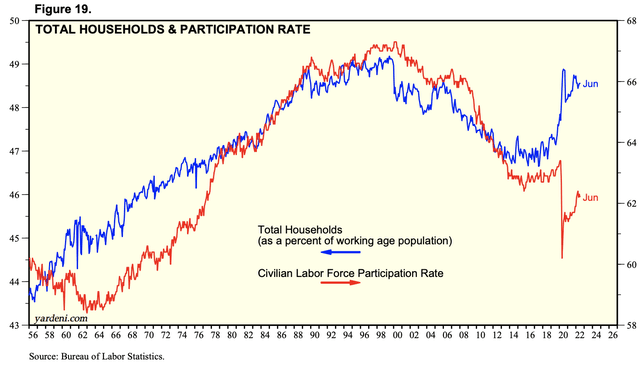
The eviction and foreclosure moratoriums allowed millions of people to live rent-free, massively choking the supply of housing while they were in effect. As I’ve written previously, the pandemic was the first time in the post-WW II era when fewer people worked but more people were occupying housing. Not normal! This is bound to revert to the mean, either millions more people are going to have to start working, or they’re not going to be able to pay rent/mortgage payments. In the vast majority of cases, people with insufficient income to support their current housing situation will just ride out their current leases and then not renew. They’ll move in with family, get roommates, or move to cheaper accommodation until supply and demand are balanced. When this data is updated next, I expect to see a lot of demand destruction.
Labor Force Participation Vs. Occupied Housing (Yardeni Research)
2. Price-fixing in the rental market. What’s not widely known is the effect that software used by large landlords may have had on the pandemic rental market. A recent class-action lawsuit alleges that a ubiquitous leasing software called YieldStar allowed large landlords to effectively form a cartel by letting a common algorithm set rental and lease renewal prices for all users. The software essentially used an algorithm to automatically coordinate pricing with thousands of other landlords, largely to avoid competing on price. Of course, the founder of YieldStar previously was forced to settle a case with the Justice Department for creating illegal price-fixing software for airlines. You can’t make this stuff up!
The evidence presented in the lawsuit is quite damning, and the fact that the main class action is being filed in Southern California means that this has the potential to be one of the largest class action payouts in US history. It’s very fashionable for people and politicians to blame rising prices on “greedy corporations,” and in many cases, it’s off-base. Here though, there’s evidence that using this software truly gave large landlords sufficient control over certain rental markets to extract monopolistic profits from tenants.
However, the theory will tell you that the free market will eventually respond to this sort of oligopoly, which is why we’re now seeing a huge boom in multifamily construction to cover for this artificial shortage. With some antitrust enforcement and letting the free market work, rents shouldactuallyfall over the next few years, which will help cool runaway inflation, albeit not nearly enough to bring inflation back to 2{d4d1dfc03659490934346f23c59135b993ced5bc8cc26281e129c43fe68630c9} by itself. In fact, asking rents have already begun falling.
The Demographic-Driven Housing Shortage Was Mostly A Myth
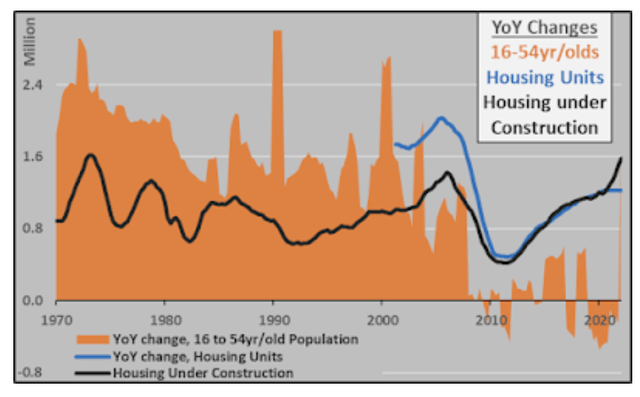
Though prices have skyrocketed, housing units per capita exceed the levels seen in 2008 in many markets. This doesn’t mean that housing isn’t scarce due to booming demand or too expensive, but what it does mean is that supply has easily kept up with demographics, albeit not speculative demand from investors, flippers, and second/third homeowners. The big spikes here below every 10 years are from one-off census adjustments, but the data shows that the US population aged 16-54 is actually falling.
Demographic Problems With Housing (Economica)
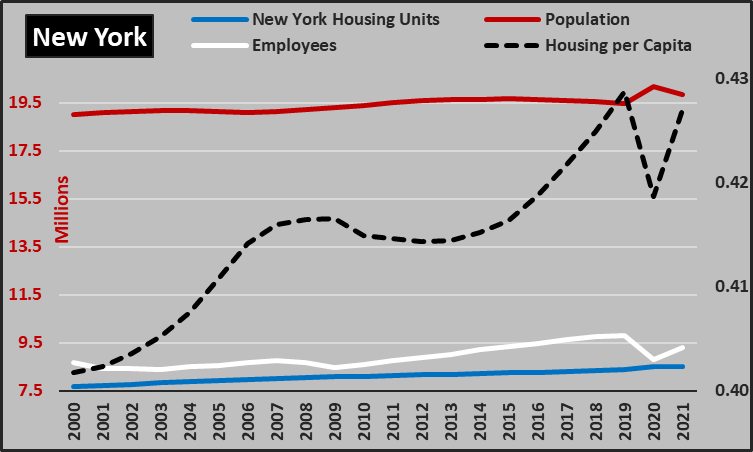
We see this when comparing the housing stock to the population. For example, construction in New York has continually increased the amount of housing stock available per capita (again note that the jagged lines in 2021 are from a census adjustment). This is the free market at work.
New York Housing Market (Economica)
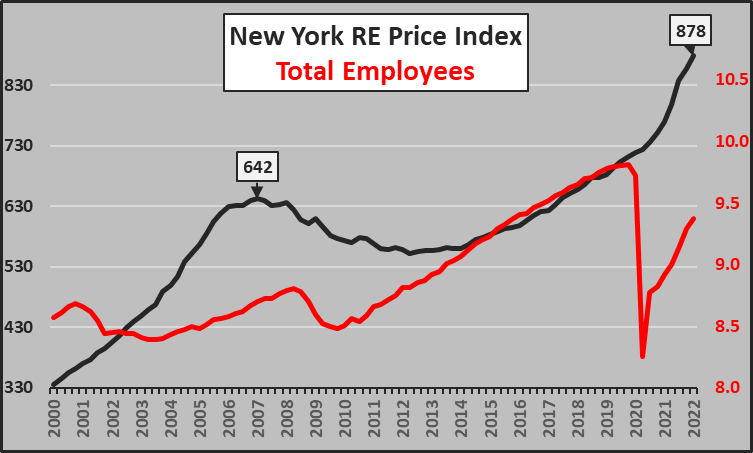
However, prices have surged, even while employment remains well below pre-pandemic levels. This is not the free market since 2019, instead, it was from interest rate suppression. Now that rates are skyrocketing, this is a huge shoe to drop.
New York Housing Market (Economica)
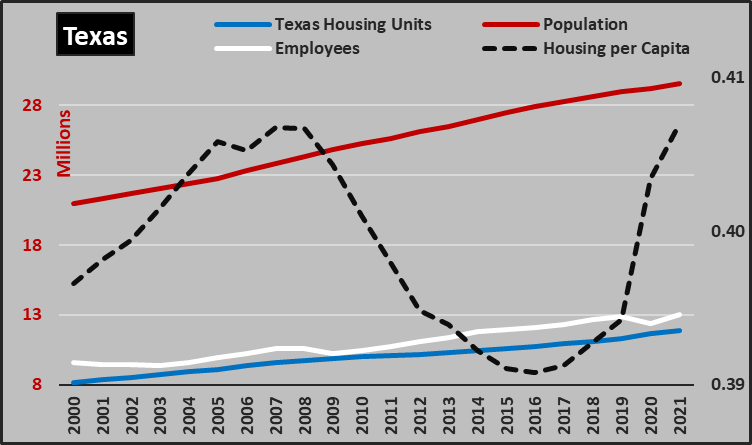
Texas also is an extremely interesting housing market to look at, because a lot of people are moving there, fueling the narrative that prices should automatically surge. But contrary to popular belief, construction in Texas has kept pace with migration trends, yet prices have skyrocketed. The most recent real-time data from Realtor.com shows that the Texas market is now among the leaders of the deepening housing market correction that started on the West Coast.
Texas Housing Market (Economica)
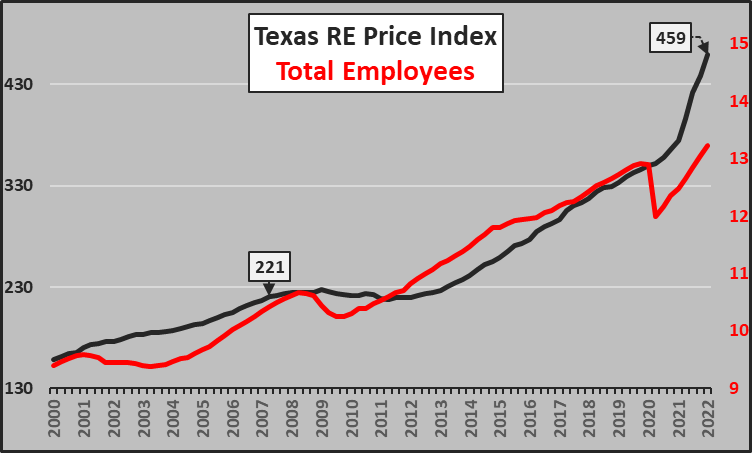
Surely prices should rise in line with supply and demand, but the degree of price rises while construction keeps pace with demographics should not happen. Note that while employment superficially looks better in Texas than in New York, median salaries are much lower while housing prices have surged far more.
Texas Housing Market (Economica)
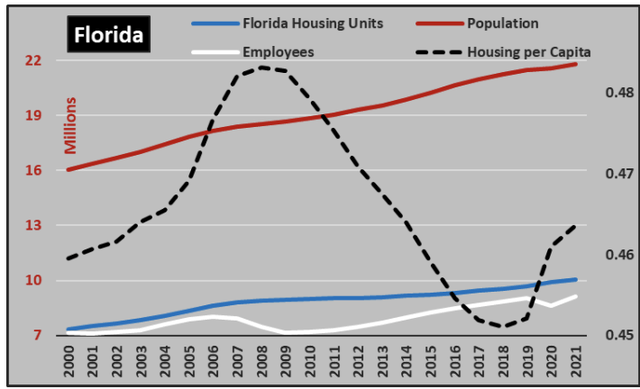
Construction hasn’t yet kept pace with migration in all markets. The author of the Economica blog noted that states like Florida, Nevada, and Washington had underlying demographic demand that could soak up homes if prices were to fall from their presently overvalued state. Still though, as hot as the real estate market is, Florida’s median income has increased something like 5{d4d1dfc03659490934346f23c59135b993ced5bc8cc26281e129c43fe68630c9} post-pandemic, while housing prices increased about 60{d4d1dfc03659490934346f23c59135b993ced5bc8cc26281e129c43fe68630c9}. Debt, debt, and more debt! Florida’s housing per capita has actually increased since bottoming in 2018 though when prices were almost half of where they are now. Also, a disproportionate amount of new housing supply will be coming online in sunbelt markets like Florida.
Florida Housing Market (Economica)
Demographic reality (i.e. wages) doesn’t square with the enormous boom in home prices, which is why many economists believe home prices are substantially overvalued. What’s really at play here is that housing prices have done nothing but go up because interest rates have done nothing but go down, fueling round after round of speculative buying.
But with an ongoing construction boom well in excess of population growth, the question is who will live in all these homes – five years from now, 10 years from now, and 30 years from now? 2008 showed that even markets with good long-term fundamentals tend to see crashes just the same because they receive a disproportionate amount of speculative investment flows. Tarrant County, in the Dallas-Fort Worth metro area, saw 52{d4d1dfc03659490934346f23c59135b993ced5bc8cc26281e129c43fe68630c9} of all home sales go to investors in 2021! That’s the height of insanity.
These figures imply that in a county with over 2 million people, less than half of homebuyers actually intended to live in the houses they were buying. This is after in the last 10 years, median income in Texas rose 29{d4d1dfc03659490934346f23c59135b993ced5bc8cc26281e129c43fe68630c9}, while the median mortgage payment on a new home purchase rose 280{d4d1dfc03659490934346f23c59135b993ced5bc8cc26281e129c43fe68630c9}. Home price gains of this magnitude are created by borrowing, not actual wealth. And while this article focuses on the US, I’d be remiss not to mention the other enormous housing bubbles globally, chiefly in Canada, Australia, and New Zealand.
The 20th Century housing market was boosted by steady population growth and a steady pace of urbanization, so prices went up. But with the process of urbanization complete in Western countries and population growth effectively at zero, continually adding supply should continually lower prices. This already has happened in parts of Europe where prices are well below 2007 inflation-adjusted peaks. In the long run, this can actually be a good thing because it means consumers get more for less, but it’s bad if you went all-in on housing with debt too early.
And Mortgage Demand Is Tanking
In the 2000s housing market bubble, America and much of the world had a cultural moment where real estate was praised as the only real way to build wealth. And after the 2008 crash, many of these same people got disillusioned and decided the juice of being a homeowner wasn’t worth the squeeze. From late 2019 to early 2022, a similar frenzy took hold. Now, demand is truly tanking again.
With mortgage rates over 7{d4d1dfc03659490934346f23c59135b993ced5bc8cc26281e129c43fe68630c9} and prices up substantially since the pandemic, this is perhaps the worst time to buy a house in our lifetimes. This comes 10 years after the best time to buy a house in our lifetimes, and likely 2-3 years before a similar time may come again. Mortgage applications are down 42{d4d1dfc03659490934346f23c59135b993ced5bc8cc26281e129c43fe68630c9} year over year. That’s simply stunning, considering how people were getting into bidding wars mere months ago.
There’s a famous economics paper from 2007 called Housing IS The Business Cycle. In it, the author argues that by setting interest rates to manage inflation and unemployment, the Federal Reserve had inadvertently inflated a housing bubble and would be forced to cause a housing bust to keep inflation from spiraling out of control. Instead, the argument is that the Fed should start hiking rates earlier in the business cycle to keep the housing market from becoming speculative chaos. Does this sound familiar at all? The key idea here: The later the Fed is in hiking interest rates (or doing quantitative tightening) during the boom, the less ability they have to help during the inevitable downturn.
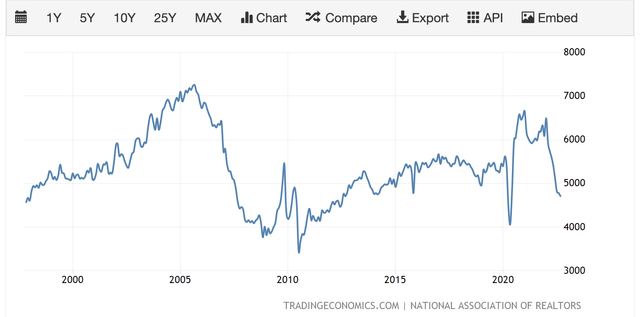
Notably, the paper was written in the middle of the 2000s crash at a point where buyers and sellers were in a similar standoff to today where sellers refused to sell and buyers could not or would not buy, so there also was a very interesting (wrong) prediction in the paper that prices would not crash but transactions would grind to a halt. Of course, prices went on shortly after to crash the most since the Great Depression. Here we are again, with leading indicators for future sales falling off a cliff.
US Existing Home Sales (Trading Economics)
One reason for this is – if I sell a house to buy another one, that’s not net housing supply. But if someone passes away and their kids put the house up for sale, or if a couple gets divorced and rents, or if investors sell because they realize that they’re not going to make money- that’s net supply. Unemployment is a huge driver of net supply over time, so if the unemployment rate begins to rise in the US, foreclosures and short sales hitting the market could have an unprecedented impact on the state of speculative demand.
The Fed May Need The Housing Market To Fall
The key difference between 2007 and now is that the Fed was far more behind the curve this time. In contrast to 2007-2008 when the government actively tried to help stabilize the housing market, the Fed is likely unable or unwilling to put a floor under housing prices, because they’re overpriced and they can’t waste money fighting the market. To this point, in light of the amount of arbitrary redistribution of wealth that the current housing boom has created, the housing market crashing from dizzying heights may be an intended feature of Fed policy, not a bug.
This isn’t my lifelong crusade. If housing prices fall 30{d4d1dfc03659490934346f23c59135b993ced5bc8cc26281e129c43fe68630c9} and you can get a mortgage under 5{d4d1dfc03659490934346f23c59135b993ced5bc8cc26281e129c43fe68630c9} (i.e. to historical norms vs. wages), I’d tell you that buying a house is a solid long-term investment. Similarly, if the stock market retreats to a more attractive valuation, you should buy it. If someone bought a house in 2017 and ends up being breakeven in price appreciation seven years later after the market crashes, that’s fine because they bought at fair prices and saved rent along the way in a similar fashion to investors getting dividends. But if someone bought a house in 2021 or 2022 for far above the house’s fundamental value, they’re in a ton of trouble, especially new construction buyers who locked in purchase prices at signing but had to wait to lock bank financing at completion (when mortgages soared from 3{d4d1dfc03659490934346f23c59135b993ced5bc8cc26281e129c43fe68630c9} to 7{d4d1dfc03659490934346f23c59135b993ced5bc8cc26281e129c43fe68630c9} or more). New buyers likely had no idea what they were getting into.
Buyers who are taking sellers’ asking prices right now are dramatically overpaying based on market fundamentals. This is why so few people are buying homes right now compared with the recent past, and why so many homebuyers are canceling their contracts with builders. Like it or not, the 21st Century real estate market has been a wild carnival ride – redistributing years and years of salary income to winners from losers. If you make a bad decision regarding housing, it can negate the earnings from a six-figure salary for a decade or longer. The market is speaking right now if you’re willing to listen, and what it’s telling you is that the unhealthy US housing market is in a twice-in-a-lifetime amount of trouble. Investors in housing-sensitive stocks like homebuilders should pay attention to the macro picture with the real estate market and consider selling their positions as well.
Bottom Line
Will this housing market crash outdo 2008? It’s yet to be seen. A key reason behind the 2008 housing crash was a rise in the rate of unemployment. If unemployment stays relatively low, then home prices may just grind downward. But if unemployment rises to 6{d4d1dfc03659490934346f23c59135b993ced5bc8cc26281e129c43fe68630c9}, 7{d4d1dfc03659490934346f23c59135b993ced5bc8cc26281e129c43fe68630c9}, or more, millions of motivated sellers will hit the market with relatively few takers due to the changing demographic reality of America and the amount of demand that was already pulled forward during the pandemic. And in 2008, houses were objectively cheap, drawing capital in from institutional investors. If home prices were to fall something 10{d4d1dfc03659490934346f23c59135b993ced5bc8cc26281e129c43fe68630c9}-20{d4d1dfc03659490934346f23c59135b993ced5bc8cc26281e129c43fe68630c9} from here, valuations would still be higher than fundamentals suggest they should be. Those declines would only take us back to 2021 prices, with rates dramatically higher. For these reasons, it’s very possible for this crash in housing prices to exceed 2008’s in magnitude.