Economists have been contacting for a housing crash for quite a few months. Some even predicted that residence price ranges would drop by as substantially as 30{d4d1dfc03659490934346f23c59135b993ced5bc8cc26281e129c43fe68630c9} in 2023. Whilst these statements are understandable considering that mounting mortgage premiums have priced a lot of would-be potential buyers out of the market place, it appears that a distinctive state of affairs is beginning to perform out.
Ideal-selling writer and serious estate fund supervisor Grant Cardone agrees that the housing current market is in problems, but details out that buyers will make adequate demand from customers to retain the industry from crashing.
“Banks never have confidence in borrowers, and all those they do trust will have to shell out. This will shift house owners to the sidelines and bit by bit decrease property selling prices,” Cardone claimed. “Investors will stage in to pick up solitary-family members properties at lower costs with considerably less competitors. That getting mentioned, there will be no housing crash! Traders, like myself, will help you save the working day and stage in to acquire the households, place renters in position and appreciate them for the hard cash circulation, not the kitchens and cabinets.”
Cardone’s actual estate expense organization Cardone Money has elevated about $1 billion from accredited and nonaccredited traders throughout 22 resources due to the fact its inception in 2016. The company’s actual estate portfolio is valued at roughly $4 billion and is composed of virtually 12,000 apartment models throughout 36 attributes and in excess of 500,000 sq. toes of professional place of work house.
Cardone isn’t the only significant trader who sees an possibility in the recent housing marketplace. J.P. Morgan declared in November that it strategies to get $1 billion well worth of single-household rentals. Other institutional buyers like BlackRock Inc. and Norges Bank improved their positions in solitary-relatives housing real estate financial commitment trusts (REITs) Invitation Houses and American Residences 4 Hire all through the final quarter.
Amazon Founder Jeff Bezos even staked a claim in the one-family rental industry by investing in the seed and collection A rounds of the investment system Arrived Homes, which makes it possible for retail investors to obtain shares of unique rental houses with as small as $100. The platform has presently funded over 200 houses worth additional than $75 million.
There is also a expanding demand from customers from international traders for U.S. true estate. Chad Gallagher, co-founder of the residence administration organization House 365, informed Benzinga very last thirty day period that his company has viewed a significant uptick in overseas buyers from economically risky nations looking for residence management products and services for their purchases of multifamily houses.
“U.S. authentic estate truly has a greater cap fee than most countries. For instance, the typical one-relatives dwelling in Israel expenses five times what a identical property below would price tag,” he stated. “So investing in a rental home in nations around the world like that and building them income-move optimistic doesn’t do the job for them.”
Right right after the Super Bowl is an unofficial start out of the spring housing market place, one particular of the busiest situations for true estate brokers and present-day and opportunity purchasers.
Agents are normally searching for strategies to be more economical and connect with home buyers and sellers. They try to determine out how best to use their means and which tools to pull out of their device belts.
1 new device developing in reputation across fields is the chatbot ChatGPT, which makes use of artificial intelligence to answer to prompts in a conversational way. It has produced headlines for carrying out this kind of feats as passing a Wharton professor’s MBA test.
» Read through Extra: ChatGPT: What you want to know about the AI chatbot
Michael Severns, principal listing professional and broker of history at a Redfin business office centered in Wayne, shared how he employs ChatGPT.
Preserving time and taking part in to strengths
Exhibiting houses to purchasers and negotiating on their behalf are time-consuming responsibilities for real estate brokers. At the exact same time, agents also have to constantly operate to make connections and establish potential customers to provide in new shoppers.
“I’m inherently lazy, so I attempt to discover the best way to do things,” Severns mentioned. “This resource is excellent for someone like me.”
He takes advantage of ChatGPT to make social media and site posts. And he has a further app that schedules his social media posts across his accounts.
He posts on Medium.com and asks the chatbot to act as an editor. It cleans up his creating and helps make his reviews far more succinct. He can even check with it to add some humor into a site article.
“I’m not that wonderful of a author,” he reported. “That’s why I like ChatGPT.”
He lately posted about 10 matters likely consumers really should check when they tour a property. He fed ChatGPT a checklist he gives to purchasers and asked it to act as a real estate agent and demonstrate why the 10 items on the list are so important.
He feeds ChatGPT industry news and asks it to rephrase the information and facts from the level of see of a genuine estate agent.
“The capabilities and the factors it can do are phenomenal,” he said.
It is a single way he stays in entrance of probable residence buyers and sellers. In concerning scheduled posts, he throws in some individual kinds — and these days, posts about the Eagles — to additional link with people.
Being up-to-day
Severns works by using ChatGPT to retain track of the matters of the working day.
He asks it concerns this kind of as “What are 10 social media publish subjects I really should do as a authentic estate agent?”
Relating to diverse demographics
Severns is 45 and acknowledges that he does not know every little thing the youngest property consumers are into. He claimed synthetic intelligence will help him connect with unique demographics.
“I can say, ‘Act as an advertiser and rewrite this write-up to have interaction with 18- to 35-year-olds,’ and it will do that,” he said.
Combining tech with expertise
ChatGPT is much from best. At times the chatbot gives Severns erroneous details, so he tends to make confident to double-look at what ChatGPT comes up with.
He does not have the chatbot do all the things. Descriptions of homes in listings, for instance, are created by a “really phenomenal” listing coordinator at Redfin, he said.
He has talked to other genuine estate brokers who are afraid of the technological know-how and really don’t want to learn to use it, but Severns claimed he’s savoring the perks.
“It’s just an additional instrument that we can use in our toolbox,” he stated.
The quantity of U.S. homes that are involved in gardening has proven a extraordinary enhance just about every year given that 2018.
It’s no shock that throughout COVID the selection of gardeners greater. It helps make feeling. Persons were stuck at house and bored — and the yard beckoned us. It would seem that upward trend will proceed in 2023 as we see the value of groceries receiving more highly-priced.
There are lots of reasons to garden: training, enjoyment, more healthy food stuff amid them. But as the overall economy has worsened and inflation raises, 76{d4d1dfc03659490934346f23c59135b993ced5bc8cc26281e129c43fe68630c9} of gardeners say they program to enlarge their foods gardens this calendar year to conserve on foodstuff fees. This is a normal reaction when men and women are stressing about food insecurity or struggling with their household budgets.
Will a meals backyard produce enough food to feed a household?
In uncertain occasions, quite a few folks say, “I’ll plant a backyard garden to feed my family.” That is probably not realistic. A vegetable backyard basically can’t deliver all the foods you need.
Grown ups will need about 2,000 energy per day, but the body can only procedure 6 lbs of food each day, so on common you need 335 energy for each pound of foodstuff. Nevertheless, most greens deliver only all over 50-100 calories a pound. The average food items backyard in The usa only creates about 20{d4d1dfc03659490934346f23c59135b993ced5bc8cc26281e129c43fe68630c9} of the energy folks want.
There are some increased calorie veggies — potatoes, parsnips, leeks, kale, winter squash and garlic — that have 250-350 energy a pound. But let’s confront it, no one particular desires to take in these veggies for breakfast, lunch and dinner, each and every day. Persons even now will need carbs, protein and fats in their eating plan, which cannot usually be grown in a dwelling yard.
You can deliver far more foods for your family if you understand to can, freeze or dry some of your summer season harvest. You also can expand and retail outlet some extended-keeping types like winter season squash. This will allow you to have saved foods throughout the wintertime months.
You can also improve a winter back garden to have new lettuce and other salad greens, radishes, kale, mustard, carrots, beets and turnips. It’s a deal with to have clean veggies in cold weather conditions. Which is also when keep-bought produce is most high priced, so you can help save a large amount at the sign up in the course of the cold months.
But what if you really don’t like vegetables?
If you hated greens as a kid, maybe you just hated the way your mother cooked them! My mom created the worst, slimy, most disgusting eggplant, squash and rhubarb. Nevertheless nowadays I like them all. Not remarkably, I never use any of Mom’s recipes.
You can also try escalating a single new vegetable each individual 12 months. Get on the world wide web and seem for attention-grabbing recipes. You could possibly come to like some of people very long-hated veggies. Then again, you may hate them eternally. In that circumstance, admit defeat and increase the items you do like. Nearly anything else is just a waste of time and yard house.
Continue to, will a food stuff back garden truly preserve dollars?
The regular home with a food stuff backyard will shell out $70 a year for seeds and back garden materials, but will enjoy $600 value of food items. That is a $530 return on your financial investment. With foods prices skyrocketing, you can anticipate even higher returns in 2023. If you choose to develop your garden, because you’ve already compensated the original charges for equipment, irrigation and other provides, your return will be even bigger. Normally, the far more many years you backyard garden, the extra income you will conserve.
• Call WSU Extension Master Gardeners by telephone at 509-574-1604 or e-mail gardener@co.yakima.wa.us.
We’ve read with interest on your advice columns, and we especially appreciate the effort and detail put into the responses.
My wife and I are in a bit of a dilemma.
We live in a 3-room HDB flat in Clementi Ridges which we bought for close to $400k. Our MOP is up in April this year. We’re in our mid-30s and together we make $15,000 gross a month, with no debts other than our HDB loan. We don’t plan to have kids.
Our goal is to have a retirement nest egg; the question is how best to go about building it. We’re not sure if our next move should be to:
(1) Upgrade to a freehold condo – we’re only interested in one located in Districts 9, 10, 11, 20, or 21;
(2) Save up to buy an additional investment property; or
(3) Upgrade to a larger HDB through resale/2nd BTO.
Sincerely hoping you could share some insights to help in our decision-making. Thank you very much!
1) Outstanding loan – $238,000
2) CPF used plus accrued interest – $128,000 from me + $36,000 from my wife
Hi there!
Thanks for reaching out to us!
It’s always good to start the retirement planning process early, as there is a lot you can do to build that nest egg from now till then. With so many possible pathways to take, it can be difficult to decide on the best option.
We will do our best to shed some light on the possibilities and hopefully, it will make your decision-making process a little easier. Let’s start by looking at affordability.
Affordability
These are some of the recent 3-room transactions for Clementi Ridges:
Date
Block
Level
Size (sqm)
Price
Oct 2022
312B
19 to 21
69
$615,000
Sep 2022
312A
19 to 21
69
$660,000
Sep 2022
312B
16 to 18
69
$660,000
Aug 2022
312A
13 to 15
69
$608,000
Jul 2022
312A
13 to 15
69
$565,000
Jul 2022
312A
13 to 15
69
$638,000
Jul 2022
312A
22 to 24
69
$642,800
Source: HDB
We will use the average selling price of $626,971 for calculation purposes.
Description
Amount
Selling price
$626,971
Outstanding loan
$238,000
CPF used plus accrued interest
$164,000
Cash proceeds
$224,971
Affordability (For a private property)
Description
Amount
Maximum loan based on a fixed monthly income of $15K and ages 35
$1,728,055 (30 years tenure)
CPF funds
$164,000
Cash
$224,971
Maximum affordability based on CPF and cash of $388,971
$1,555,884
BSD based on $1,555,884
$46,835
Estimated affordability
$1,509,049
Due to the available amount of CPF and cash that make up the 25per cent downpayment, you will not be able to take the maximum loan
Affordability (For an HDB)
Description
Amount
Maximum loan based on a fixed monthly income of $15K and ages 35
$852,536 (25 years tenure)
CPF funds
$164,000
Cash
$224,971
Total loan + CPF + Cash
$1,241,507
BSD based on
$34,260
Estimated affordability
$1,207,247
Option 1: Upgrade to a freehold condo in D9, 10, 11, 20 or 21
With a budget of $1.5 million, you’ll most likely be looking at a 1 + Study or a two-bedder in these locations. As you do not plan to have children, this should suffice but as most of these units are rather compact, it may take some getting used to from a 3-room HDB flat which is typically bigger in comparison.
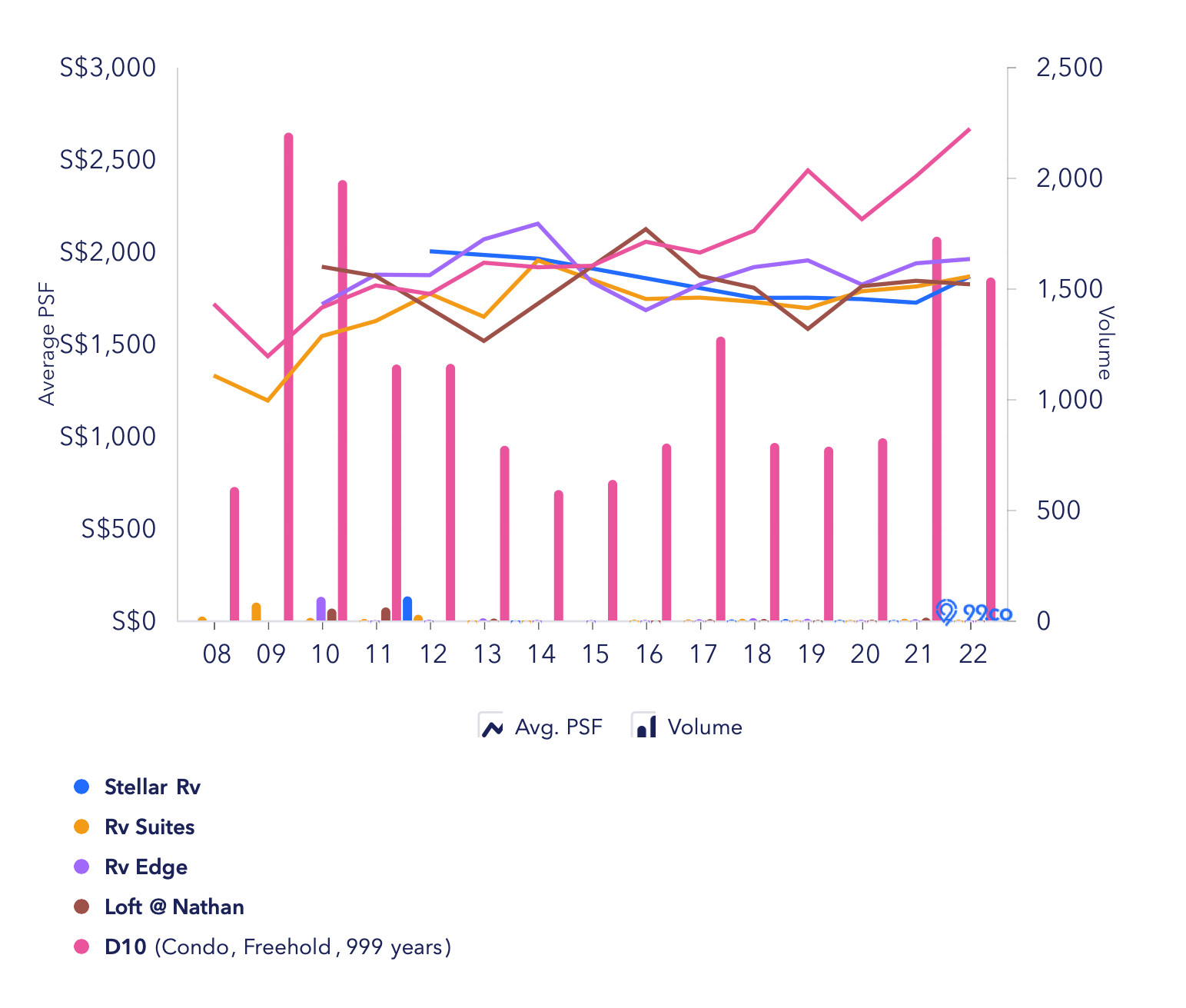
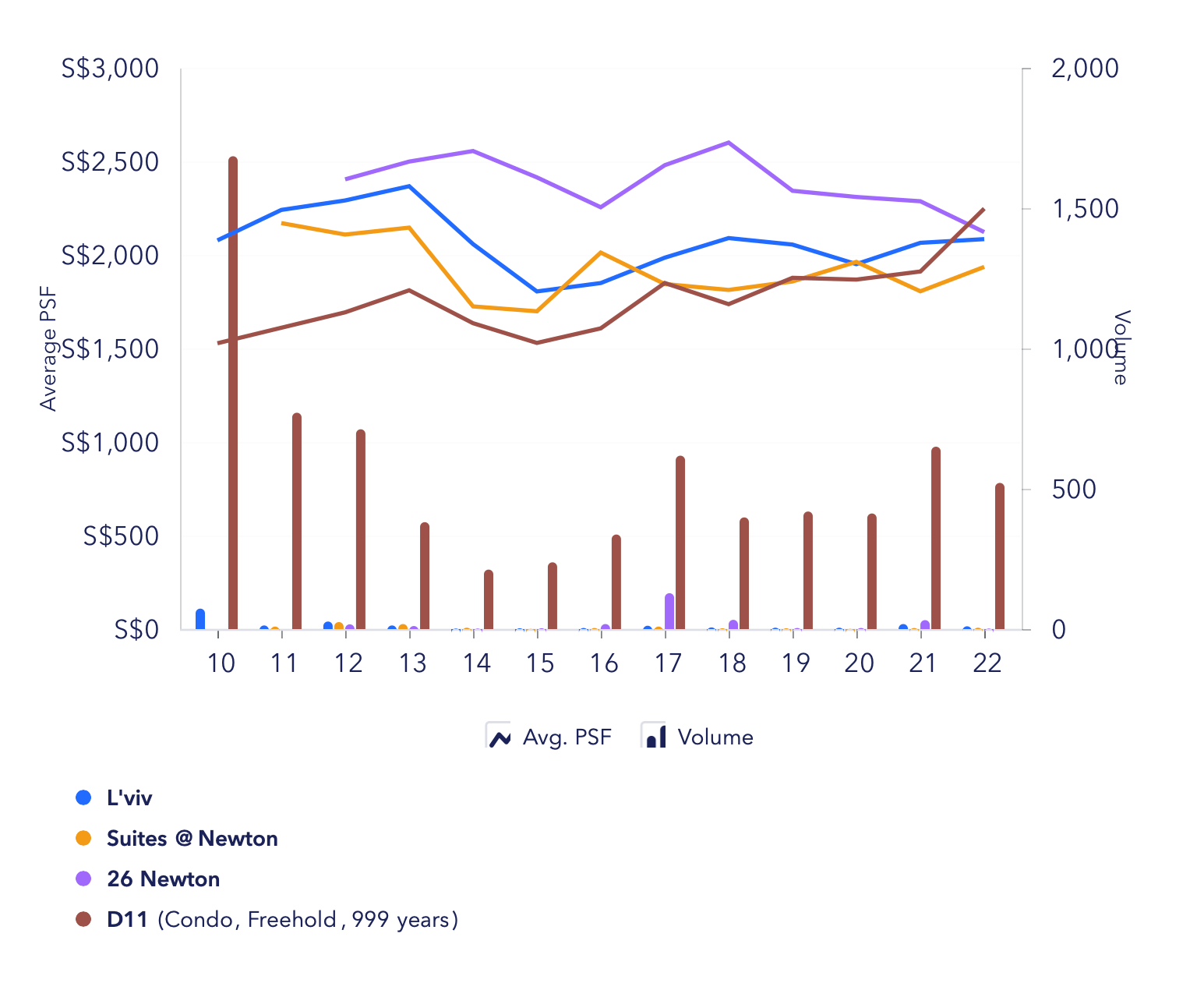
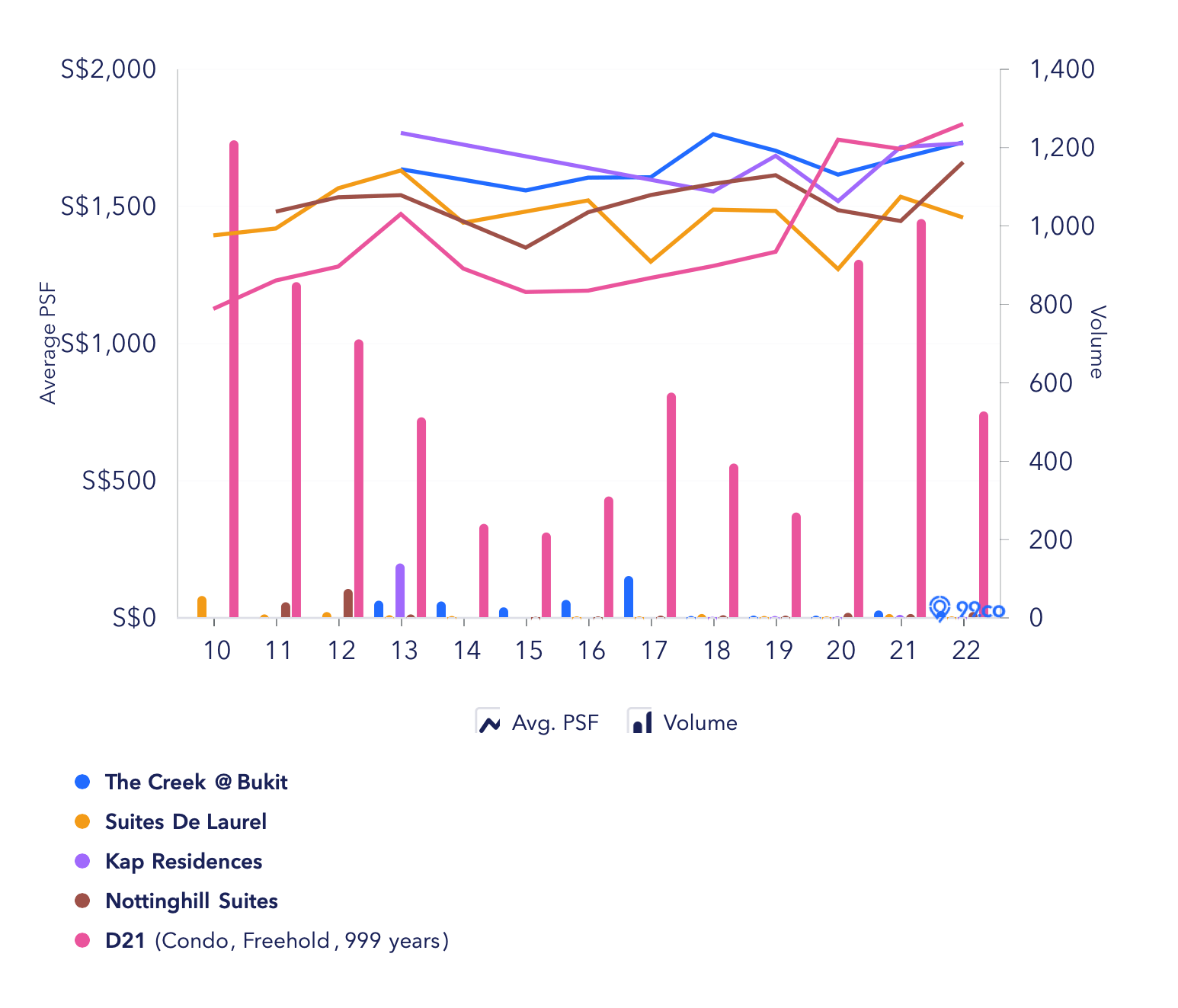
If you were to do a quick search online, you’ll see that the current pickings are rather slim, and the majority of the developments that fall within this price range are boutique projects.
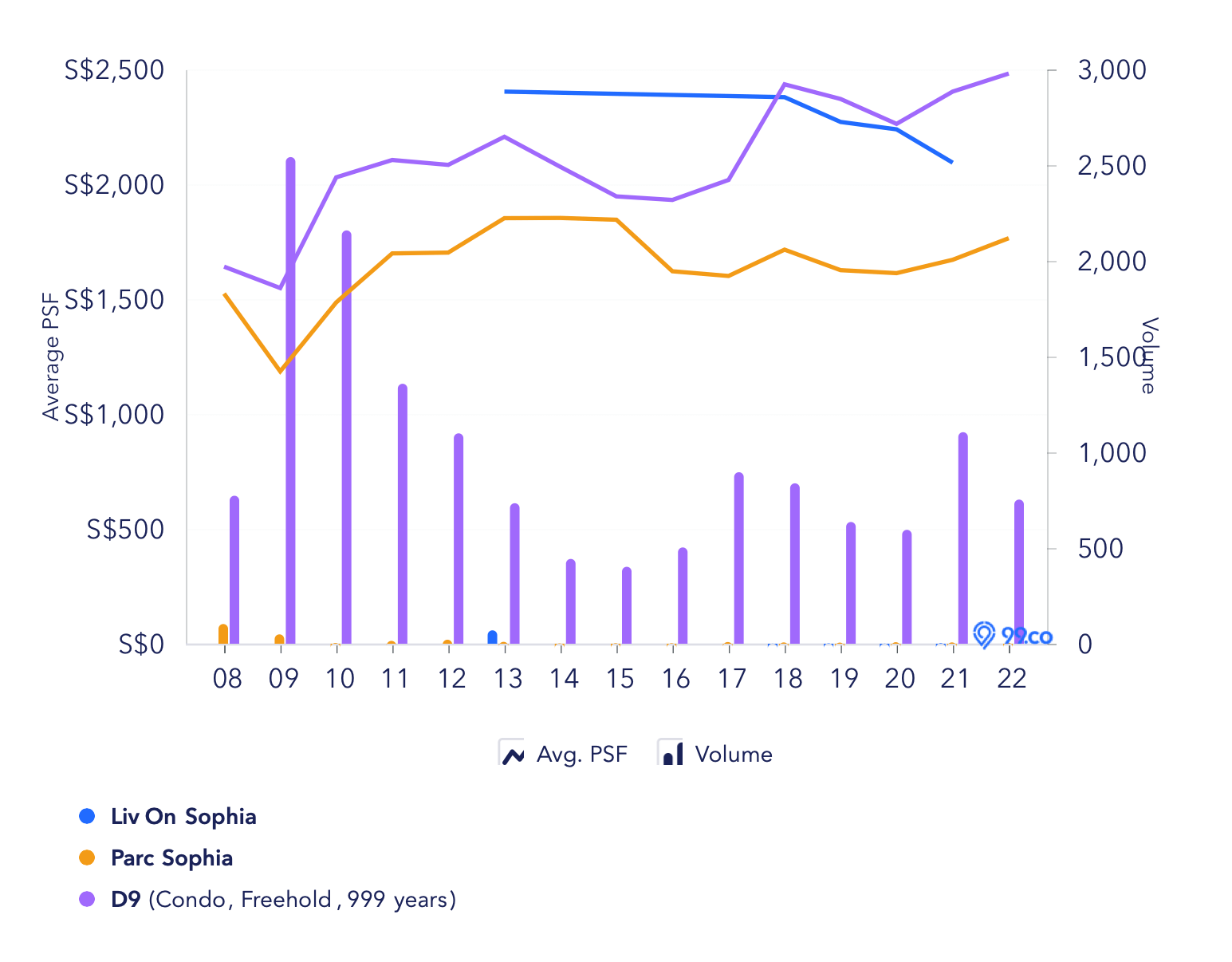
District 9 District 10 District 11 District 21
The developments shown above are those with available units that match your affordability. You’ll notice that after the launch, their transaction volumes are generally low, resulting in the trend lines appearing somewhat volatile. This is a usual concern with boutique developments because if the turnover rates are low, it is difficult for prices to move since banks value a property based on recent transactions. You can see from the graphs that prices are relatively stagnant for most of the projects, as compared to other freehold condos in the same district.
Also, many of these developments are made up of predominantly one and two- bedders which are catered more towards investors since the barriers to entry are lower. This is another issue as investors usually go wherever the money is, so if they find a better investment opportunity, they are less hesitant to let go of their units (even at a loss). This differs from genuine homeowners, who may be emotionally attached to their properties. It is advisable to get a development with a good unit mix, which caters to both homeowners as well as investors as prices are generally more protected.
Compared to an HDB flat, these projects are usually a better potential store of value. This is especially so in the long run as there is no lease decay issue. But if you’re looking for capital appreciation in the short to medium term, these may not be the best options.
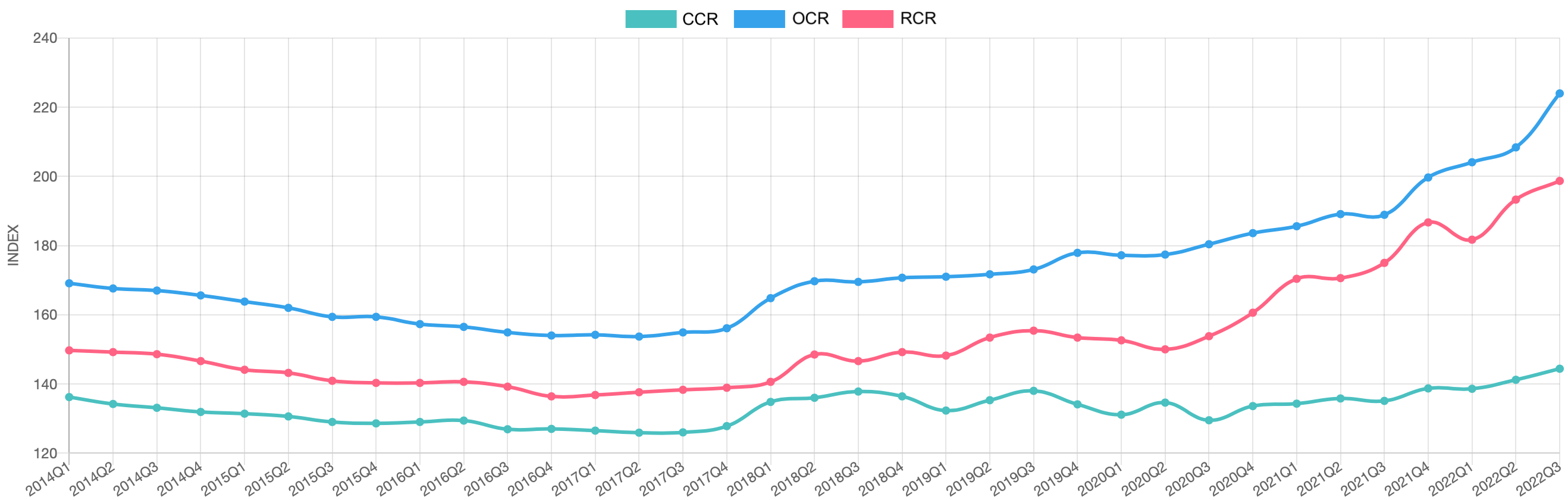
That being said, we do believe there is potential for growth in the CCR provided you select the right properties.
Property Price Index (PPI) of non-landed residential properties in the different regions
Price Indices
Q1 2021
Q2 2021
Q3 2021
Q4 2021
2021
Q1 2022
Q2 2022
Q3 2022
Q4 2022
2022 (Flash)
QoQper cent change
QoQper cent change
QoQper cent change
QoQper cent change
YoY per cent change
QoQper cent change
QoQper cent change
QoQper cent change
QoQper cent change
YoY per cent change
Overall PPI
3.3
0.8
1.1
5.0
10.6
0.7
3.5
3.8
0.2
8.4
Landed
6.7
-0.3
2.6
3.9
13.3
4.2
2.9
1.6
0.5
9.5
Non-landed
2.5
1.1
0.7
5.3
9.8
-0.3
3.6
4.4
0.1
8.0
CCR
0.5
1.1
-0.5
2.7
3.8
-0.1
1.9
2.3
0.5
4.6
RCR
6.1
0.1
2.6
6.7
16.3
-2.7
6.4
2.8
2.6
9.2
OCR
1.1
1.9
-0.1
5.7
8.8
2.2
2.1
7.5
-2.6
9.3
Source: URA, Propnex Research
Drawing from the Property Price Index (PPI) in the different regions, we can see that prices in the RCR and OCR have appreciated significantly more than in the CCR in recent years. We do expect that prices in the CCR will eventually right themselves and the growth rate will catch up. We have recently also written a piece about the narrowing gap between prices of new RCR and CCR projects, which you can read here.
If CCR prices pick up can we expect prices of these boutique developments to pick up too?
Option 2: Save up to buy an additional investment property
Given that you currently own a flat, which we assume is under both your names, and have an outstanding housing loan, there are several things to take into consideration when purchasing a second property.
Loan-To-Value ratio (LTV)
When purchasing your first property, depending on your income, you may be eligible to loan up to a maximum of 75 per cent of the property value (for a bank loan). However, if you’re purchasing a second property while still repaying an existing mortgage loan for the first one, the LTV drops to 45 per cent of the property value.
Higher downpayment
As the LTV for a second property is reduced, naturally the downpayment increases. The downpayment is split into two portions; minimally 25 per cent needs to be paid in cash and the remaining 30 per cent can be paid using your CPF should you have sufficient funds.
Additional Buyer Stamp Duty (ABSD)
The current ABSD rate for Singaporeans buying a second property is 17 per cent which is on top of the regular BSD. Do note that when purchasing a private property, the stamp duty has to be paid in cash first, as this has to be done within 14 days after you have exercised the Option to Purchase (which isn’t enough time to apply for the withdrawal from CPF), and if you have sufficient funds in your CPF to pay for it, the cash will be reimbursed to you afterward.
CPF requirements
When buying a second property, you will need to set aside the following before you can utilise your CPF funds for the purchase:
The latest Basic Retirement Sum (BRS) if you have at least one property bought using CPF or the property that you are buying can cover you till age 95*
The latest Full Retirement Sum (FRS) if you do not have any property that can cover you till age 95
* If you subsequently sell the property that can cover you till age 95, you will need to set aside the FRS instead.
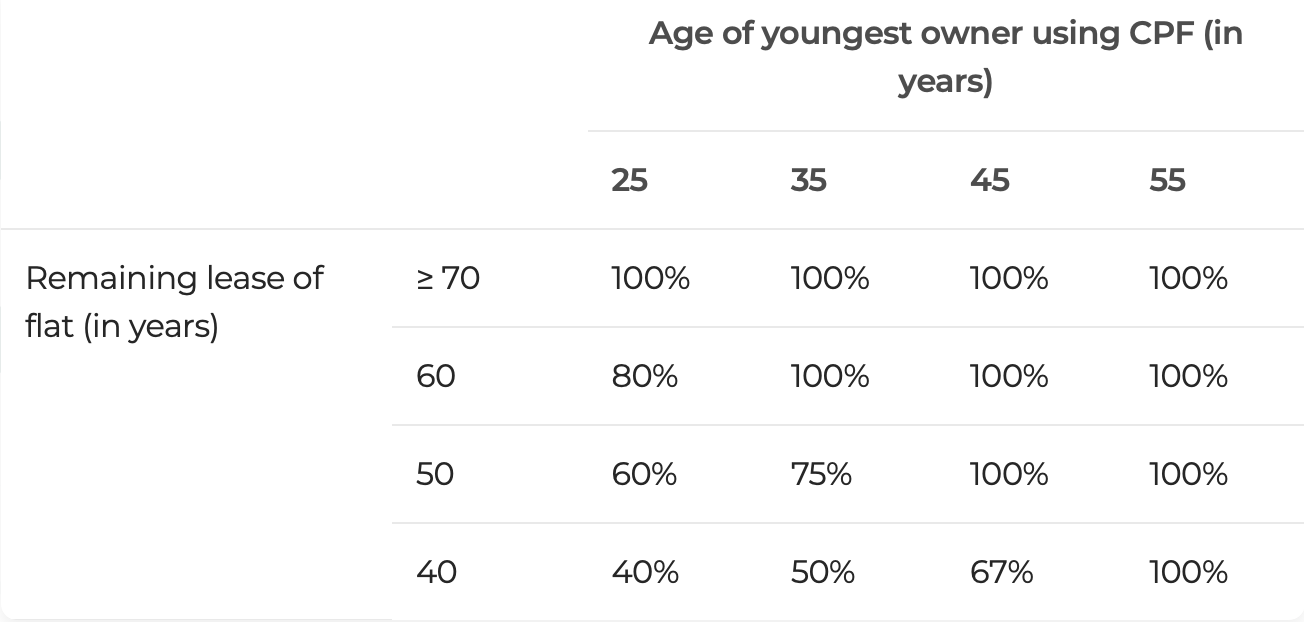
Also, the maximum amount of CPF that can be used for your second property depends on whether the remaining lease of this property can cover the youngest owner up to the age of 95.
Source: CPF
Let’s say you were to purchase a second property at $1 million for the sake of simple calculations:
Description
Amount
Purchase price
$1,000,000
25per cent cash downpayment
$250,000
30per cent CPF/cash downpayment
$300,000
BSD
$24,600
ABSD of 17per cent
$170,000
As we can see from the calculations above, the cash outlay required in order to purchase a second property is pretty substantial and it will likely take a long time to save up.
We’ve written a detailed piece on the merits of paying for the ABSD for an investment property, but in short, it’s not what we’d typically recommend.
Option 3: Upgrade to a larger flat (resale/BTO)
Being able to buy a BTO is a Singaporean privilege, and since we have two chances at it, most individuals/households will try for the second time if they are eligible. Of course, it’s much tougher the second time around given that only two to five per cent of BTO launches are set aside for second-timers. Also, the income ceiling to apply for a BTO is $14,000 which your household has unfortunately (or fortunately) exceeded so you are no longer eligible.
As you’ve mentioned you’re looking to build your retirement nest, buying a flat may not be the best investment choice. It is no doubt a good stepping stone for buyers looking to upgrade since you’d likely make some profits if you bought a BTO, or if you purchased a resale and managed to gain from the CPF Housing Grants.
Source: Edgeprop
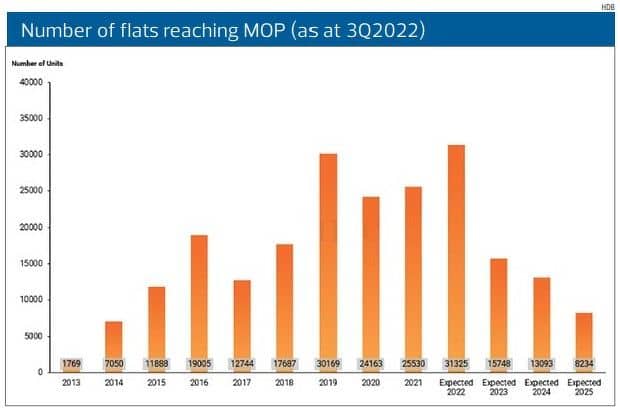
Given the reduced supply of newer MOP flats coming onto the resale market in the next couple of years, prices of HDB prices could still hold up in the short term. But even so, it is public housing after all; prices are regulated by the government in order to keep them affordable for the masses.
Alternative option
We’ve said this many times before, but a freehold property does not necessarily mean it’s better than a leasehold, and there are many other factors that contribute to the performance of a property besides its tenure. Perhaps instead of looking at freehold options in the districts you’ve identified, you can look at leasehold options instead, which will give you more choices to choose from. And if you were to open up to other locations, you’d have even more options.
These are some available 99-year leasehold units on the market that is within your affordability:
Project
District
Completion year
Unit type
Size
Asking price
Sophia Hills
09
2018
2b2b
689
$1,482,000
The Panorama
20
2019
2b2b
797
$1,488,888
Thomson Impressions
20
2019
2b2b
764
$1,500,000
Sky Vue
20
2017
2b2b
678
$1,380,000
Daintree Residences
21
2023
2b2b
679
$1,399,999
These projects are picked out based on the fact that they are in your preferred districts, and for their age, so they may or may not be the most suitable for you. We would suggest you consult with an agent for further analysis.
In the ideal situation, you’ll stay in this property for the short to medium term and if it does appreciate well over the next few year, you can then upgrade again; perhaps to a bigger unit or a freehold development, which you can then live in for the longer term. You can eventually cash out for your retirement while you right size to a smaller unit.
Conclusion
Let’s do a quick recap of the options:
For the first option of buying a freehold condominium in District 9, 10, 11, 20, or 21, your choices are rather limited and the available developments are mostly boutique projects (which as mentioned, we do have some concerns over). You will have to pick carefully, as a freehold property definitely doesn’t always mean it will be a good investment.
The second option of saving up to purchase a second property for investment will require a huge cash outlay, which may take a considerable amount of time to save up for.
As for the last option of upgrading to a bigger HDB, unfortunately, your household is no longer eligible to apply for a second BTO due to your income. Regardless, buying an HDB is not the best investment tool given that it is after all a regulated market.
We will suggest looking at some younger leasehold developments that still have the potential for growth which will open you up to more choices. You can stay in this property while you wait for it to appreciate and from there, move on to a bigger unit or a freehold development where you can stay for the long term. As you’re only in your mid-30s, you’re able to maximise the loan tenure. We get that moving might be a pain, but it’s inevitable if you wish to cash out on your property which will go towards building your retirement nest.
ALSO READ: We make $15k per month and live in a 4-room HDB flat. Should we upgrade to a condo now once interest rates drop?
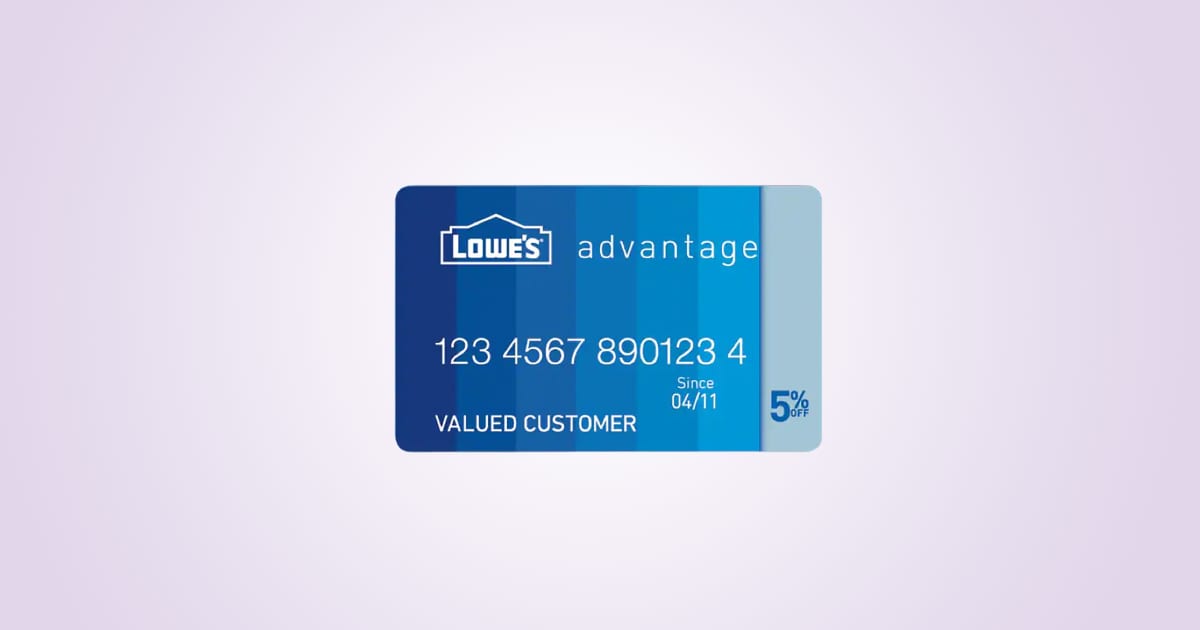
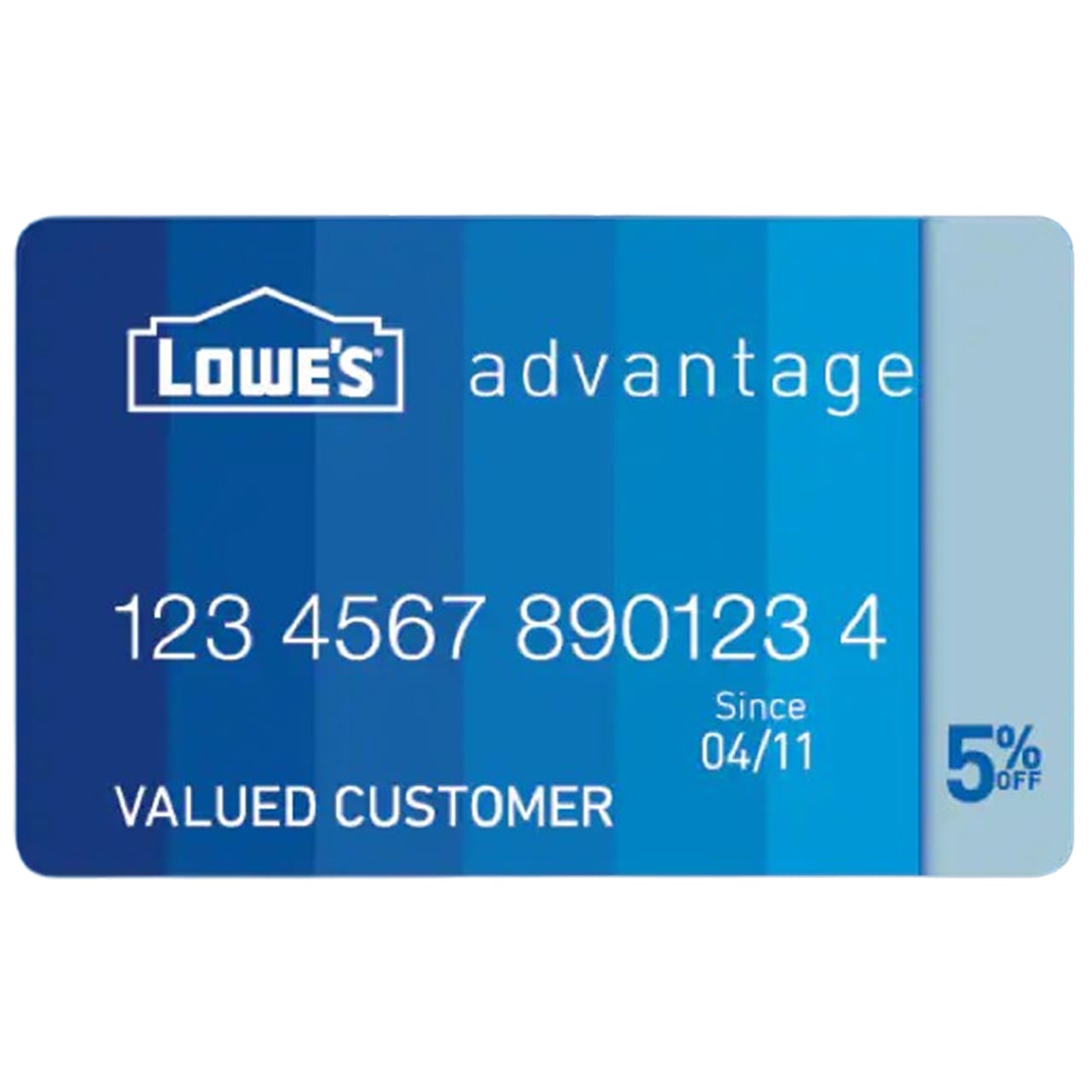
The Lowe’s Advantage Card, issued by Synchrony Lender, is a no-yearly-charge credit card that might aid you preserve on dwelling advancement. You can only use this closed-loop card at Lowe’s the place it presents a generous 5{d4d1dfc03659490934346f23c59135b993ced5bc8cc26281e129c43fe68630c9} price cut on most items. (Shut-loop implies you can only use it at Lowe’s).
There are also two exclusive funding options offered to cardholders: a deferred interest give on buys of $299 or more and installment financing on purchases of at the very least $2,000. You may possibly come across extra funding alternatives offered on a minimal-time foundation.
Lowe’s Gain Card
Base rewards amount: None
Bonus rewards: 5{d4d1dfc03659490934346f23c59135b993ced5bc8cc26281e129c43fe68630c9} off at Lowe’s shops and Lowes.com
Indicator-up reward: 20{d4d1dfc03659490934346f23c59135b993ced5bc8cc26281e129c43fe68630c9} off when you open an account (up to $100 lower price) via Jan. 31, 2023
The Lowe’s Advantage Card’s probable to deliver higher-benefit personal savings and option of financing provides have secured this card a position on our listing of the Greatest Shop Cards of 2022.
Are the costs truly worth the rewards?
The Lowe’s card presents generous discounts if you approach to shop large for a house improvement task. Let’s believe your residence renovation job has a spending plan of $15,000. You expend it at Lowe’s with the store’s credit rating card and get 5{d4d1dfc03659490934346f23c59135b993ced5bc8cc26281e129c43fe68630c9} off the full sum. In overall, you are going to hold $750 in your pocket.
No other card from a big bank delivers these significant unlimited rewards or reductions at residence improvement stores—including the Lowe’s Edge Card’s competitor, the Home Depot Customer Credit rating Card. The Home Depot Card offers no ongoing savings and only a single particular funding possibility: 6 months of deferred desire on purchases of $299 or additional.
That mentioned, if you are searching for a {d4d1dfc03659490934346f23c59135b993ced5bc8cc26281e129c43fe68630c9} APR supply to pay out off a order more than time with no paying desire, the Lowe’s Gain Card isn’t the most effective alternative. With the card’s deferred curiosity present, you get 6 months without curiosity costs. If you really do not pay out off the stability in total during that period, you are going to be strike with the normal APR of 26.99{d4d1dfc03659490934346f23c59135b993ced5bc8cc26281e129c43fe68630c9} which will apply to the entire buy volume.
Installment funding will come with 84 mounted month-to-month payments at 7.99{d4d1dfc03659490934346f23c59135b993ced5bc8cc26281e129c43fe68630c9} APR, which can get high priced above this sort of a very long expression.
If you are looking to finance your dwelling project at far better terms, appear into getting a credit history card with a {d4d1dfc03659490934346f23c59135b993ced5bc8cc26281e129c43fe68630c9} APR introductory offer. Some of the ideal {d4d1dfc03659490934346f23c59135b993ced5bc8cc26281e129c43fe68630c9} APR playing cards at the moment offer you up to 21 months of no fascination.
Some others even get paid rewards: for occasion, the Wells Fargo Active Money, our leading decide for the Very best Income Back Credit history Playing cards of 2022, earns 2{d4d1dfc03659490934346f23c59135b993ced5bc8cc26281e129c43fe68630c9} back on all purchases and supplies 15 months of no interest on new purchases. At the time the intro zero-desire provide expires, the card’s normal ongoing APR kicks in and applies to the remaining equilibrium.
Card details you may well miss
At Obtain Facet from WSJ, we judge retail store credit score playing cards mostly by the potential worth of rewards and savings they can provide. But there are commonly other details to take into consideration just before having a card, this sort of as supplemental benefits and added benefits it comes with.
The Lowe’s Benefit Card, nonetheless, is a bare-bones retail store credit history card and does not have considerably to offer in addition to the 5{d4d1dfc03659490934346f23c59135b993ced5bc8cc26281e129c43fe68630c9} discount and unique funding alternatives.
It’s however a very good notion to ensure you know the terms of the positive aspects this card does present. Although the 5{d4d1dfc03659490934346f23c59135b993ced5bc8cc26281e129c43fe68630c9} price reduction applies to most products at Lowe’s, there are exceptions. For illustration, you won’t be ready to use the price cut on gift playing cards, merchandise from pick quality makes, shipping and delivery and assembly fees, and much more.
Most essential, you can’t stack this low cost on major of most other offers—including funding. If you want to equally help save on your buy and pay it off in excess of time, the Lowe’s Gain Card could not be the way to go.
Who gains most from this card?
If you often devote at residence advancement suppliers or are organizing a house renovation, the Lowe’s Edge Card can be an superb option. The 5{d4d1dfc03659490934346f23c59135b993ced5bc8cc26281e129c43fe68630c9} discount on most merchandise at Lowe’s is difficult to defeat and can save you hundreds of dollars on highly-priced initiatives.
If you don’t like carrying multiple cards, seem into open up-loop retailer cards. For occasion, if you have a Key membership, the Amazon Prime Rewards Visa Signature may well be a fantastic alternate. Although Amazon doesn’t have the same collection, you can still uncover many products you might want for your undertaking, from equipment to home furnishings to even paint. The Amazon Key Card earns 5{d4d1dfc03659490934346f23c59135b993ced5bc8cc26281e129c43fe68630c9} again at Amazon and Complete Meals and 2{d4d1dfc03659490934346f23c59135b993ced5bc8cc26281e129c43fe68630c9} again at dining places, gas stations, and drugstores, producing it a reliable hard cash back card.
Furthermore, you may well want to seem into a distinct card if you are hoping to fork out for your obtain over time and prevent interest without the need of sacrificing price savings. For example, for lesser assignments, you can use the Bank of America® Tailored Dollars Benefits credit history card. This cash back card provides 3{d4d1dfc03659490934346f23c59135b993ced5bc8cc26281e129c43fe68630c9} again on a classification of your selection (solutions involve house improvement and furnishings) and 2{d4d1dfc03659490934346f23c59135b993ced5bc8cc26281e129c43fe68630c9} back again on grocery outlets and wholesale golf equipment. There’s a quarterly cap of $2,500 in combined paying out in these groups. You also get {d4d1dfc03659490934346f23c59135b993ced5bc8cc26281e129c43fe68630c9} intro APR on buys for 18 months, soon after which the ongoing APR kicks in.
The tips, tips or rankings expressed in this short article are all those of the Get Facet from WSJ editorial group, and have not been reviewed or endorsed by our professional partners.
Florida households can save thousands of dollars on air conditioning, heating, appliance, and vehicle upgrades by taking advantage of green energy incentives within the Inflation Reduction Act signed this week by President Joe Biden.
One of the most valuable green energy incentives in the legislation is a 10-year extension of a federal tax credit that reduces the cost of installing a rooftop solar system by 30{d4d1dfc03659490934346f23c59135b993ced5bc8cc26281e129c43fe68630c9}.
According to the Biden Administration, more than 1.1 million Florida households will use the credit to install rooftop solar systems over the next decade. In a report on net metering released in July, Florida’s Public Service Commission estimated that 130,913 rooftop systems were in place at the end of 2021.
The act also extends a $7,500 tax credit for electric and other green energy vehicles, but imposes new North American assembly rules that immediately disqualified some previously eligible models.
On top of the tax credit savings, Americans who take advantage of all upgrades incentivized in the act — installing a modern electric heat pump to cool and heat their home, a heat pump for water heating, rooftop solar, and switching to an electric vehicle — will save $1,800 a year on energy bills, according Rewiring America, a nonprofit organization “focused on electrifying everything in our communities.”
Some of the incentives, which consumers will be able to subtract from their 2022 tax bills next spring, took effect on Aug. 16, the day Biden signed the $739 billion act. Some won’t take effect until Jan. 1. Others, including two separate packages of rebates for energy saving upgrades, won’t be available until states set up a process to accept and review applications.
Boynton Beach resident Fred Closter shows off his $40,000 rooftop solar power system, which includes $24,000 in solar panels and two $8,000 Tesla storage batteries that enable Closter and his wife to live almost completely free of FPL’s grid. Congress and the Biden Administration last week made it easier for other Floridians to achieve the same goal by increasing the 30{d4d1dfc03659490934346f23c59135b993ced5bc8cc26281e129c43fe68630c9} federal tax credit for solar systems through 2032. (Susan Stocker / South Florida Sun Sentinel)
It’s important to know that a tax credit is different from a tax deduction. While a tax deduction is subtracted from taxable income, a tax credit is subtracted from the amount of tax owed and can result in a hefty refund or a smaller tax payment at filing time.
Here’s what we know so far about green energy incentives enacted this week as part of the Inflation Reduction Act:
The federal tax credit for purchase and installation of residential solar energy systems has been increased from 26{d4d1dfc03659490934346f23c59135b993ced5bc8cc26281e129c43fe68630c9} to 30{d4d1dfc03659490934346f23c59135b993ced5bc8cc26281e129c43fe68630c9} and extended through 2032. That means that a homeowner who spends, for example, $20,000 on a solar system at any time over the next 10 years will be able to subtract $6,000 from the taxes they owe for that year.
Before the new law was enacted, the credit was set to be reduced to 23{d4d1dfc03659490934346f23c59135b993ced5bc8cc26281e129c43fe68630c9} in 2023 and eliminated the following year.
The 30{d4d1dfc03659490934346f23c59135b993ced5bc8cc26281e129c43fe68630c9} tax credit took effect immediately and can be applied retroactively to installations since Jan. 1.
[ RELATED: Zero carbon emissions by FPL by 2045? Critics say we’ll pay more ]
There’s no cap on how much a solar system can cost to be eligible for the 30{d4d1dfc03659490934346f23c59135b993ced5bc8cc26281e129c43fe68630c9} credit. If you spend $100,000 on your system, for example, you’ll get a $30,000 credit. It’s a nonrefundable tax credit, though, meaning you won’t get a $25,000 refund if your tax bill is only $5,000. But, continuing our example, you will be able to carry forward that remaining $25,000 credit and spread it over future tax years through 2032.
The increase to 30{d4d1dfc03659490934346f23c59135b993ced5bc8cc26281e129c43fe68630c9} combined with the survival, for now, of Florida’s net metering law should convince more and more homeowners to slash their electric bills by installing their own rooftop solar systems, advocates said, after Biden signed the bill into law.
Last year, the Florida Legislature passed a bill pushed by FPL, the state’s largest utility, that would have slashed by more than half the rate FPL is required to pay rooftop solar owners for excess energy their systems produce during peak hours.
The bill would have preserved retail buy-back rates for 20 years for homeowners who install solar systems prior to Jan. 1, 2024, but lock in future rooftop solar adopters at lower rates through 2028, when utilities would only have to pay half of their retail rates.
Solar advocates said the final version of the bill was an improvement over what FPL originally sought, but still worried that its passage and the expiration of the federal tax credit after 2023 would restrain future growth in the state.
[ RELATED: Can you really cut your house off of the electric grid and kiss FPL goodbye? ]
While FPL could try again in coming years, the extension of the federal tax credit ensures that solar systems will remain more affordable for middle-class homeowners well into the future, advocates say.
Starting next year, homeowners with existing solar systems will be able to claim a 30{d4d1dfc03659490934346f23c59135b993ced5bc8cc26281e129c43fe68630c9} tax credit for adding a backup storage system with a capacity of at least three kilowatt hours.
Erin Hellkamp, spokeswoman for Solar United Neighbors, a non-profit that amasses groups of homeowners to negotiate bulk deals with solar installers, said the tax credit can also be claimed by homeowners who install backup battery systems without solar panels. Standalone systems can be used to keep power flowing during outages or to cut costs in areas where utilities charge higher rates during peak-usage periods.
Effective on the day President Biden signed the Inflation Reduction Act, a $7,500 tax credit for purchase of new electric vehicles has been extended through 2032, while buyers of used electric vehicles can get a credit for 30{d4d1dfc03659490934346f23c59135b993ced5bc8cc26281e129c43fe68630c9} of the purchase price up to $4,000 starting Jan. 1.
The credit can also be applied to models that meet the government’s definition of “clean” vehicles, including plug-in hybrids with four to seven kilowatt hours of battery capacity, and hydrogen fuel cell vehicles.
[ RELATED: Your FPL bill helps fund charging stations for 58,000 electric vehicle owners. Two lawmakers say it shouldn’t ]
However, some new electric vehicles previously eligible for the credit will no longer be eligible, and consumers will have to do some homework to figure out whether specific vehicles on an eligibility list released Tuesday by the U.S. Department of Energy actually qualify for the credit.
The list shows models that likely meet a new requirement: Only models that undergo final assembly in North America are eligible for the tax credit.
But models on the list aren’t guaranteed to be eligible because some models are assembled in multiple locations.
To ensure eligibility of any specific vehicle on the list, buyers must look up the Vehicle Identification Number (VIN) using the department’s online VIN Decoder at www.nhtsa.gov/vin-decoder, then locate the final assembly location in the “Plant Information” field at the bottom of the page. The final assembly location might also be available on an information label affixed to the vehicle, usually on the inner frame of the driver door.
In addition, some of the most popular electric vehicle models on the list aren’t eligible for the credit for the rest of 2022 because they have already reached a sales cap of 200,000 units. These include 2022 models Chevrolet Bolt EV, Chevrolet Bolt EUV, GMC Hummer Pickup, GMC Hummer SUV, and Teslas models 3, S. X and Y, plus 2023 models Chevy Bolt EV and Cadillac Lyriq.
A Chevrolet Bolt EV charges at a shopping center in Emeryville, Calif. earlier this month. Because the Bolt EV has sold 200,000 units, its buyers won’t be eligible for a $7,500 federal tax credit until Jan. 1, 2023, when revised incentives enacted under the Inflation Reduction Act take effect. To boost sales of electric vehicles in the United States, the legislation extended the $7,500 tax credit for 10 years but added eligibility restrictions on the cars’ prices and place of final assembly. (Godofredo A. Vásquez/AP)
That leaves 21 eligible vehicles, including plug-in hybrids, as long as they pass the VIN lookup test, including Audi Q5, BMW 3-series Plug-In, BMW X5, Chrysler Pacifica PHEV, Fort F Series, Ford Mustang MACH E, Jeep Grand Cherokee PHEV, Nissan Leaf, Lincoln Aviator PHEV and others.
The manufacturer sales cap will be lifted at the end of the year, reinstating eligibility for the Chevy Bolts, the Teslas, the GMC Hummers and Cadillac Lyriq.
[ RELATED: How much cheaper is it to run an electric or hybrid vehicle vs. gas? We did the math ]
Buyers who signed a written binding contract for a no-longer-eligible vehicle prior to Aug. 16 but have not yet taken delivery will still be able to claim a $7,500 tax credit for that vehicle.
Beginning in 2024, buyers will be able to transfer their credit to the dealer at the point of purchase and take advantage of the price reduction immediately.
Additional requirements will be phased in beginning next year. One will remove eligibility of cars with a manufacturer’s suggested list price (MDRP) of more than $55,000 and trucks with MSRPs of more than $80,000. Another new rule will restrict who can take the credit to single filers making less than $150,000, single heads of households making less than $225,000 and married couples making less than $300,000.
Home improvement credits will change significantly from 2022 to 2023.
For the remainder of 2022, the new law revives a 10{d4d1dfc03659490934346f23c59135b993ced5bc8cc26281e129c43fe68630c9} credit for specific energy-efficient improvements, including insulation, roofs, doors, and windows. Homeowners could claim credits totaling no more than $500 over their lifetime for qualifying water heaters, heat pumps, central air conditioning systems, air circulating fans, hot water heaters, and hot water boilers.
Starting in 2023, the credit will be increased to 30{d4d1dfc03659490934346f23c59135b993ced5bc8cc26281e129c43fe68630c9} of the cost of qualifying improvements made during the year, and consumers will be able to claim up to $1,200 a year for their improvements, creating an incentive to spread them out over coming years to maximize savings.
Annual tax credit limits will apply for specific improvements, including $150 for a home energy audit; $250 for an exterior door ($500 for all exterior doors); $600 for exterior windows and skylights, central air conditioners; $600 for electric panels; $600 for natural gas, propane or oil water heaters; and $600 for natural gas, propane, or oil furnaces or hot water boilers.
An exception to the $1,200 annual cap will be a $2,000 credit for electric or natural gas heat pumps (heaters and air conditioners) — electric or natural gas heat pump water heaters, and biomass stoves and boilers.
Morning Update
Daily
Start your day with the top stories in South Florida.
It’s anyone’s guess as to when rebates funded by the Inflation Reduction Act will be made available to consumers. A $4.3 billion program called High Efficiency Electric Home Rebates is being laid on the shoulders of individual states to figure out how to run, with guidance from the federal government. Floridians who waited to apply for federal COVID-19 assistance for renters and homeowners know it can take months for states to figure out how to distribute large tranches of federal money.
It remains to be seen whether homeowners will be able to claim rebates for the same improvements incentivized with federal tax credits or state-funded rebates, Consumer Reports stated in a recent story.
Once up and running, the rebate program will provide up to $14,000 over 10 years for energy-efficiency improvements by households making between 80{d4d1dfc03659490934346f23c59135b993ced5bc8cc26281e129c43fe68630c9} and 150{d4d1dfc03659490934346f23c59135b993ced5bc8cc26281e129c43fe68630c9} of their area’s median income. (In Florida, the median income differs by county and household size).
[ RELATED: Amid three South Florida crashes, revolutionary Tesla remains a work in progress ]
Available rebates will include up to $8,000 for a heat pump (air conditioner and heater); $1,600 for insulation, air sealing and ventilation; $1,750 for a heat pump water heater; and $840 for an electric range or electric heat pump clothes drier. Older homes will need to upgrade their electrical systems to handle the new equipment, so the program will also offer rebates up to $4,000 for upgrades to a home’s electrical panel and service and $2,500 for wiring.
Households making between 80{d4d1dfc03659490934346f23c59135b993ced5bc8cc26281e129c43fe68630c9} and 150{d4d1dfc03659490934346f23c59135b993ced5bc8cc26281e129c43fe68630c9} of their area’s median income will qualify for a rebate of 50{d4d1dfc03659490934346f23c59135b993ced5bc8cc26281e129c43fe68630c9} of their purchase and installation cost, up to the limits listed above. Households making less than 80{d4d1dfc03659490934346f23c59135b993ced5bc8cc26281e129c43fe68630c9} of their area’s median income can get up to 100{d4d1dfc03659490934346f23c59135b993ced5bc8cc26281e129c43fe68630c9} of their project costs.
States will also administer a separate $4.3 billion rebate program, called Home Owner Managing Energy Savings (HOMES) program, that will provide rebates based on the percentage of total energy savings achieved with retrofits.
Ron Hurtibise covers business and consumer issues for the South Florida Sun Sentinel. He can be reached by phone at 954-356-4071, on Twitter @ronhurtibise or by email at rhurtibise@sunsentinel.com.




 District 9
 District 10
 District 11
 District 21
 Property Price Index (PPI) of non-landed residential properties in the different regions
 Source: CPF