France Freezes 31 Luxury Properties Owned By Eight Sanctioned Russian Billionaires

France Freezes 31 Luxury Properties Owned By Eight Sanctioned Russian Billionaires


The frozen properties, worth nearly $1 billion, include Roman Abramovich’s château on the French Riviera and his estate in St. Barts.


On Wednesday, French authorities published a list of 41 properties owned by sanctioned Russian individuals that had been frozen since Russia’s invasion of Ukraine, worth nearly $620 million. Forbes found that 31 of those properties are owned by eight sanctioned Russian billionaires, including Roman Abramovich’s $250 million Château de la Croë in Antibes on the French Riviera and his $90 million estate on the luxe Caribbean island of St. Barts.

Forbes estimates the 31 billionaire-owned properties are worth $920 million—higher than the French government’s estimate—based on reporting for the World’s Billionaires List and historical purchase prices. Now that the properties have been frozen, they can’t be sold or rented—and since the sanctions on these billionaires include a travel ban, they can’t physically travel to them anymore either.

Many of these luxury homes were already known to be owned by sanctioned oligarchs, but some had not been previously reported. According to French corporate and land records, steel mogul Viktor Rashnikov owns several apartments at 24 Avenue Gabriel in central Paris, across the street from the French presidential residence at the Élysee Palace. Abramovich’s ex-wife Irina owns a property in the same building, but hers was not among the frozen properties. Another sanctioned billionaire, Alexei Kuzmichev, owns several apartments at Rue de Solférino, along the Seine and across the river from the Tuileries Gardens.

Most of the frozen properties are owned through French companies named sociétés civiles immobilières, or SCI, a type of company formed solely to own real estate. Aside from the Paris apartments, Abramovich’s estate on St. Barts and a hotel in the Alpine ski town of Méribel owned by oil & gas mogul Gennady Timchenko, all of the other luxury homes are on the French Riviera. Several, including Abramovich’s Château de la Croë, are on a stretch of coast in Antibes known as the Bay of Billionaires—an apt name, considering the number of Russian billionaires who own real estate there.

For more information on the foreign real estate owned by sanctioned Russian billionaires, read our in-depth tracker here:

MORE FROM FORBESA Guide To All The Outrageous Mansions And Estates Owned By Sanctioned Russian Billionaires

Here are the French properties owned by sanctioned Russian billionaires that have been frozen:

Estimated value of frozen properties: $340 million

Abramovich owns the 32,000-square-foot Château de la Croë in Cap d’Antibes on the French Riviera, an estate built on more than 17 acres of land with 12 bedrooms and a swan-shaped bathtub, formerly owned by King Edward VIII of Great Britain. Three addresses tied to the château were included in the list of frozen properties.

In the French Caribbean island of St. Barts, Abramovich owns the 70-acre Gouverneur estate on Governor Beach, which features Balinese bungalows and several tennis courts and swimming pools. He may also own other properties on St. Barts. A property called Le Lurin was also frozen by French authorities. A local source told Forbes that Abramovich owns another home by the port of Gustavia, the capital, a short drive away from Gouverneur. The source said that the property appears to have been abandoned mid-construction.

Estimated value of frozen properties: $57 million

Kuzmichev owns La Petite Ourse villa in the exclusive seaside town of St. Tropez on the French Riviera. He owns the villa—which was reportedly purchased for $57 million—through SCI Le Cedre Rouge, according to French corporate records. The home shares a name with two of Kuzmichev’s yachts—the 79-foot La Petite Ourse and the 54-foot La Petite Ourse II—which were frozen by French authorities on March 16 and March 21, respectively.

Forbes found that Kuzmichev also owns three properties in a large residential building at 2 and 4 Rue de Solférino and 9 and 11 Quai Anatole in central Paris, all of which were frozen by French authorities. He owns them through four SCIs, according to French corporate records: RCS Holding 1, RCS Holding 2, RCS Holding 3 and QAF RDS Holding.

Estimated value of frozen properties: $80 million

Melnichenko owns Villa Altair in Cap d’Antibes, France, replete with a home theater, wine cellar, sauna, and a swimming pool. He owns the villa through a French real estate firm, Pershore Comercio International S.a.r.l., which is in turn wholly owned by Melnichenko’s Luxembourg-based firm Jalinon Investments S.a.r.l. Three properties owned by Pershore at the site of Villa Altair were frozen by French authorities.

In a statement, a spokesperson for Melnichenko called the EU sanctions against him “absurd and nonsensical” and added that they will be disputed.

Estimated value of frozen properties: $6 million

Moshkovich owns a villa on nearly 10 acres of land at 56 Boulevard Princesse Grâce de Monaco in Nice on the French Riviera, which he reportedly purchased for $3.6 million in 1998. He owns the now-frozen home through Prosperite SCI, according to French corporate records.

Estimated value of frozen properties: $176 million

Ponomarenko owns two large villas on 170,000 square feet of land at 8 Chemin de St Hospice in Saint-Jean-Cap-Ferrat on the French Riviera. In 2015, he sold them to a French company named SCI La Chabanne Project, according to an investigation by Russian media outlet IStories. Ponomarenko’s partner Natalia Rozhkova owns 95{d4d1dfc03659490934346f23c59135b993ced5bc8cc26281e129c43fe68630c9} of SCI La Chabanne Project and Ponomarenko is a director at the firm, per French corporate records. A spokesperson for Ponomarenko told IStories in October 2021 that he acquired the property for about $134 million in 2008.

Estimated value of frozen properties: $200 million

Through his daughter, Olga, Rashnikov owns the 16-room Villa Nellcôte mansion in Villefranche-sur-Mer on the French Riviera. Olga owns 94{d4d1dfc03659490934346f23c59135b993ced5bc8cc26281e129c43fe68630c9} of SCI Nellcote Baie de Villefranche and SCI Baie des Figuiers, the companies that own the property, and Rashnikov is also a director at both firms, per French property records. Three properties owned by SCI Nellcote Baie de Villefranche and SCI Baie des Figuiers at the site of Villa Nellcôte were frozen by French authorities.

Built in the 1890s, the Belle Époque villa features a swimming pool and crystal chandeliers and has had some notable residents: it was occupied by the Gestapo during the Nazi occupation of France in the 1940s and was rented by Keith Richards of the Rolling Stones in 1971.

Forbes found that Rashnikov also owns three properties at 24 Avenue Gabriel in central Paris, all of which were frozen by French authorities. He owns the apartments, located directly across the street from the Élysee Palace—currently occupied by French President Emmanuel Macron—through SCI Parc Gabriel, per French corporate records. Abramovich’s ex-wife Irina Malandina owns an apartment in the same building worth $17.5 million, according to the Organized Crime and Corruption Project’s Russian Asset Tracker project, which Forbes is participating in.

Estimated value of frozen properties: $62 million

Vladimir Putin’s childhood friend and former judo sparring partner Arkady Rotenberg owns Villa Shoshana, a 97,000-square-foot estate in Saint-Jean-Cap-Ferrat on the French Riviera. He owns the property through SCI Villa Shoshana and Luxembourg-based Lucasnel SA, according to Luxembourg and French corporate records. He purchased the property for $47 million in 2014.

Estimated value of frozen properties: Unknown

Timchenko’s wife Elena—who was sanctioned by the EU on April 8—owns two properties at Avenue du Cap Nègre in Le Lavandou on the French Riviera. She owns the homes through her 55{d4d1dfc03659490934346f23c59135b993ced5bc8cc26281e129c43fe68630c9} stake in Luxembourg-based Coeur de Cavaliere S.A., according to the Luxembourg Business Register. Timchenko’s daughter, Ksenia Frank-Timchenko, owns a French company named Arles which owns another two properties at Avenue du Cap Nègre, both of which were also frozen.

The homes owned by Elena and Ksenia are across the street from Le Club de Cavalière, a 5-star hotel and spa with its own private beach which Elena owns through her 61.9{d4d1dfc03659490934346f23c59135b993ced5bc8cc26281e129c43fe68630c9} stake in French firm Sogeco, according to French corporate records. Sogeco also owns Le Grand Coeur, a 4-star hotel and spa in the Alpine ski resort of Méribel. Both hotels were included in the list of frozen properties.
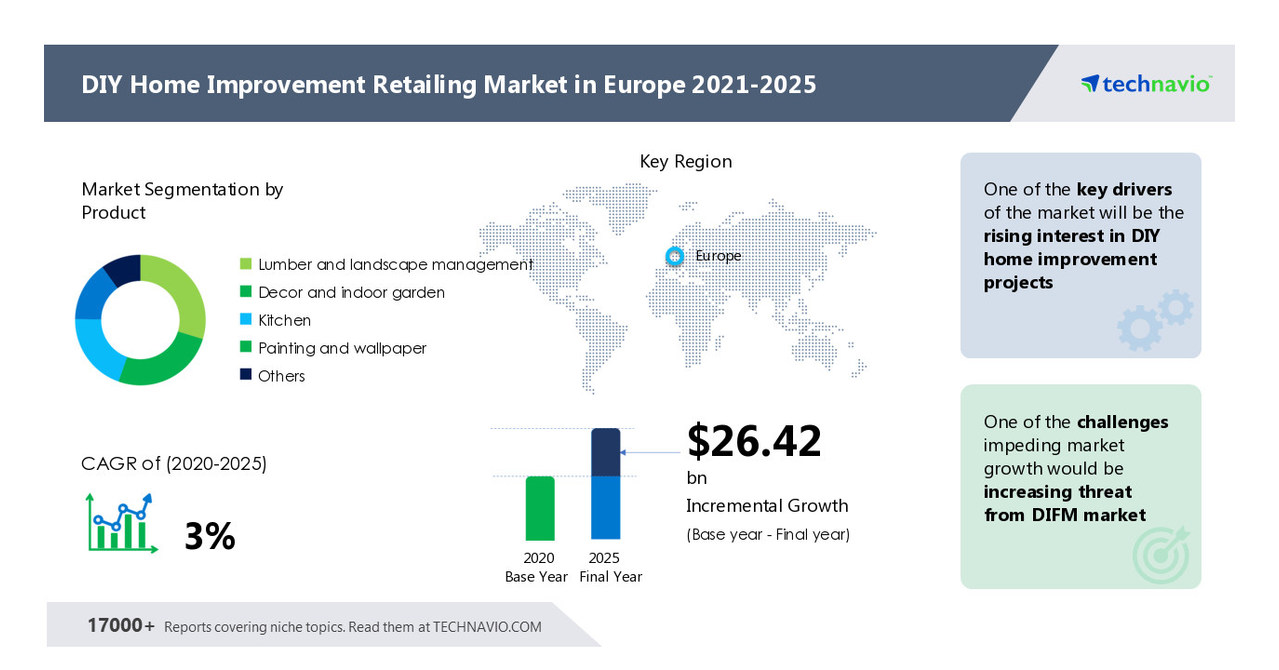
Segmentation by Product (lumber and landscape management, decor and indoor garden, kitchen, painting and wallpaper, and others), Distribution channel (offline and online), and Geography (Germany, France, the UK, Italy, and the Rest of Europe)–Forecast till 2025|Technavio

Segmentation by Product (lumber and landscape management, decor and indoor garden, kitchen, painting and wallpaper, and others), Distribution channel (offline and online), and Geography (Germany, France, the UK, Italy, and the Rest of Europe)–Forecast till 2025|Technavio

Parent Market Analysis

Technavio categorizes the global Do-it-Yourself Home Improvement Retailing Market in Europe as a part of the global household durables market within the global consumer discretionary market.

Technavio uses the total revenue generated by manufacturers to estimate the global Do-it-Yourself Home Improvement Retailing Market size in Europe. External factors influencing the parent market’s growth potential in the coming years have been thoroughly investigated in our research analysis. To know more about the levels of growth of the Do-it-Yourself Home Improvement Retailing Market in Europe throughout the forecast period, Download a free sample.

Vendor Insights 

The Do-it-Yourself Home Improvement Retailing Market in Europe is fragmented, and the vendors are deploying various organic and inorganic growth strategies to compete in the market. To make the best of the opportunity, the market vendors should focus more on the fast-growing segment’s growth prospect while maintaining their positions in the slow-growing segments.

We provide a detailed analysis of vendors operating in the Do-it-Yourself Home Improvement Retailing Market in Europe, including some of the vendors such as BAUHAUS AG, BAUVISTA GmbH & Co. KG, EUROBAUSTOFF Handelsgesellschaft mbH & Co. KG, Groupe Adeo, HORNBACH Baumarkt AG Group, Intergamma BV, ITM Entreprises (Les Mousquetaires SAS), Kesko Corp., Kingfisher Plc, OBI Group Holding SE & Co. KGaA.

Backed with competitive intelligence and benchmarking, our research reports on the Do-it-Yourself Home Improvement Retailing Market in Europe are designed to provide entry support, customer profile, and M&As as well as go-to-market strategy support.

Product Insights and News

  • HORNBACH Baumarkt AG Group – In September 2019, the company opened its fourth store in Slovakia
  • BAUHAUS AG – In March 2020, the company acquired Knauber’s home improvement stores in Germany
  • Kingfisher Plc – In January 2020, the company launched its new convenience store in the Nelson Industrial Estate in Merton, southwest London.

The Do-it-Yourself Home Improvement Retailing Market in Europe forecast report offers in-depth insights into key vendor profiles and offerings – Download Free Sample Report

Geographical Highlights

The Do-it-Yourself Home Improvement Retailing Market in Europe’s share growth in Germany will be significant during the forecast period. The country’s market will grow faster than the markets in the United Kingdom, Italy, and the rest of Europe. The most popular DIY home renovation projects in Germany include lumber and landscape management, painting and wallpapering, indoor garden decoration, lighting, and assembling RTA furniture.

Consumers are actively involved in DIY home improvement projects, which range from modest house repairs to sophisticated and huge projects, facilitating the DIY home improvement market in Europe’s growth in Germany over the predicted period. The most popular DIY home renovation projects in Germany include lumber and landscape management, painting and wallpapering, indoor garden decoration, lighting, and assembling RTA furniture.

Moreover, countries like Albania, Armenia, Australia, Aruba, and Bangladesh are the key market for the baby carrier market in APAC.

To unlock the top strategies practiced by the maximum growth generating region, View Sample Report

Key Market Dynamics-

  •  Do-it-Yourself Home Improvement Retailing Market in Europe Key Drivers:
    • Increase in the number of startups

Due to the increasing urbanization rate and changing lifestyles, people throughout the world are becoming more interested in DIY interior décor and home improvement projects. Furthermore, the growing number of working women and their involvement in the home-decorating decision-making process are driving up sales of tools needed for such projects, such as power drills, nail guns, bathroom and yard tools, and so on. Due to high average labor expenses, the DIY approach is gaining traction in both industrialized and developing European countries. To save money on outsourced services, consumers in these countries choose to do their maintenance and repairs on their machinery, automobiles, and residences.

  •  Do-it-Yourself Home Improvement Retailing Market in Europe Key Trends:
    • The increasing number of M&A activities

In Europe, the DIY home improvement sector is seeing significant technological advancements. To combat the fierce rivalry, leading market competitors such as ADEO, Kingfisher, and Travis Perkins have improved their product differentiating aspects, such as innovation and product assortment. Vendors are constantly striving to create new and unique items. Furthermore, home automation solutions that include new technology provide greater security and reliability than traditional home goods.

Download a free sample for highlights on market Drivers & Trends affecting Do-it-Yourself Home Improvement Retailing Market in Europe. 

Customize Your Report 

Don’t miss out on the opportunity to speak to our analyst and know more insights into this market report. Our analysts can also help you customize this report according to your needs. Our analysts and industry experts will work directly with you to understand your requirements and provide you with customized data in a short amount of time.

We offer USD 1,000 worth of FREE customization at the time of purchase. Speak to our Analyst now! 

Related Reports: 

Baby Fashion Accessories Market by Product and Geography – Forecast and Analysis 2021-2025

Houseware Market by Product, Distribution Channel, and Geography – Forecast and Analysis 2021-2025

DIY Home Improvement Market in Europe Scope

Report Coverage

Details

Page number

120

Base year

2020

Forecast period

2021-2025

Growth momentum & CAGR

Accelerate at a CAGR of 3{d4d1dfc03659490934346f23c59135b993ced5bc8cc26281e129c43fe68630c9}

Market growth 2021-2025

$ 26.42 billion

Market structure

Fragmented

YoY growth ({d4d1dfc03659490934346f23c59135b993ced5bc8cc26281e129c43fe68630c9})

2.60

Regional analysis

Germany, France, the UK, Italy, and the Rest of Europe

Performing market contribution

Germany at 29{d4d1dfc03659490934346f23c59135b993ced5bc8cc26281e129c43fe68630c9}

Key consumer countries

Albania, Armenia, Australia, Aruba, and Bangladesh

Competitive landscape

Leading companies, Competitive strategies, Consumer engagement scope

Companies profiled

BAUHAUS AG, BAUVISTA GmbH & Co. KG, EUROBAUSTOFF Handelsgesellschaft mbH & Co. KG, Groupe Adeo, HORNBACH Baumarkt AG Group, Intergamma BV, ITM Entreprises (Les Mousquetaires SAS), Kesko Corp., Kingfisher Plc, and OBI Group Holding SE & Co. KGaA

Market Dynamics

Parent market analysis, Market growth inducers and obstacles, Fast-growing and slow-growing segment analysis, COVID-19 impact and future consumer dynamics, Market condition analysis for the forecast period

Customization purview

If our report has not included the data that you are looking for, you can reach out to our analysts and get segments customized.

About Us: 

Technavio is a leading global technology research and advisory company. Their research and analysis focus on emerging market trends and provide actionable insights to help businesses identify market opportunities and develop effective strategies to optimize their market positions. With over 500 specialized analysts, Technavio’s report library consists of more than 17,000 reports and counting, covering 800 technologies, spanning across 50 countries. Their client base consists of enterprises of all sizes, including more than 100 Fortune 500 companies. This growing client base relies on Technavio’s comprehensive coverage, extensive research, and actionable market insights to identify opportunities in existing and potential markets and assess their competitive positions within changing market scenarios. 

Contact 
Technavio Research 
Jesse Maida 
Media & Marketing Executive 
US: +1 844 364 1100 
UK: +44 203 893 3200 
Email: [email protected] 
Website: www.technavio.com/

SOURCE Technavio

House Hunting in France: A Diamond in the Rough Near the Basque Coast

House Hunting in France: A Diamond in the Rough Near the Basque Coast

This nine-bedroom, Neo-Basque-style villa sits on a grassy 1.85-acre lot in Winter Park, a quiet residential district outside of downtown Biarritz, the resort town on France’s Basque coast, near the border with Spain.

Built in 1920, the 6,458-square-foot house was last renovated in the late 1990s, and has been unoccupied for five years. “You have to do some renovation work,” said Philippe Thomine-Desmazures, associate director of Barnes International Realty, Côte Basque, which has the listing.

A gravel driveway leads to the covered front portico. The entry hall has a checkerboard tile floor and a powder room. Double wood doors open to a parlor with high ceilings, a terra-cotta tile floor and a broad fireplace. French doors with transoms lead to the garden.

Beyond a trio of arches is a library with a fireplace, a double living room with a bay window, and a banquet-style dining room with extensive moldings, each with parquet floors and doors opening to a terrace or garden.

The kitchen has a white-and-blue patterned ceramic tile floor, with a La Cornue range against one wall and a glass breakfront with wood trim against another. Through a parlor archway, a stone staircase with a decorative metal balustrade leads to a Juliet balcony overlooking the ground floor.

The primary bedroom suite, at the center of the second floor, has pink wallpaper, floor-to-ceiling drapes and transomed double doors opening to a terrace. To one side is a bathroom with a barrel-shaped coffered ceiling over a claw foot tub. To the other side, a tub with a wood surround from a second bathroom off the bedroom juts into a study with armoires, bookshelves and windows overlooking the property.

Flanking the primary suite are two more bedrooms with wood-plank floors, decorative moldings and double balcony doors. Each has a full bath with a claw foot tub.

The third floor has five bedrooms. The largest has a seating area beneath exposed wood beams and a skylit bathroom. Two more bedrooms have exposed beams above dormer windows. A smaller nursery and maid’s rooms share a bathroom and separate commode.

The basement has a gas boiler room, a wine cellar and storage rooms.

The overgrown garden has plenty of room for a swimming pool, Mr. Thomine-Desmazures said, and an annex building has space for two to three cars and caretaker’s quarters.

The house is a few minutes’ walk to local bakeries, while restaurants and boutiques in the center of Biarritz are about a mile away. Once a small fishing village, Biarritz, with just over 25,000 residents on the Bay of Biscay, became a favored British winter residence and a darling of royals (“the queen of resorts and the resort of kings”) after Napoleon III and his Spanish empress, Eugénie, visited in 1854. It has long been considered the surfing capital of France.

Biarritz Pays Basque Airport, with flights to eight European countries, is a three-minute drive from the house. San Sebastián, the closest city in Spain, is a 30-minute drive.

Before the pandemic, most sales in Biarritz were for second homes used during high season, from April to October, when the population often quadrupled. “Biarritz and the area have been very sought after for secondary residences since Imperial times,” said Bénédicte Marchal, director of Biarritz Sotheby’s International Realty. “A lot of people from the aristocracy like to be in Biarritz.”

But since 2020, as in resort towns worldwide, the market has skewed younger. “We have seen many, many people between 35 and 45 move here to work remotely, or to go to work two to three days a week in Paris, Madrid or London and come back,” said Mr. Thomine-Desmazures, the listing agent. “We saw many, many people who moved their family here. It was a booming market with Covid.”

Those newcomers found a cramped seller’s market with surging prices. In the past few years, only small buildings with 10 to 15 apartments have been built in Biarritz, and approvals are hard to come by. “It is difficult to knock down and build something new,” Mr. Thomine-Desmazures said.

The pandemic added another layer of complexity, as inventory dwindled further. “We have some property that we work off market, confidentially, and some people prefer that,” Ms. Marchal said. “People are afraid to sell because they don’t know if they can buy something else. They don’t want to get stuck.”

The tight conditions in Biarritz have led to an average 15 percent rise in home prices over the past year, with luxury homes up 30 percent “if the property is well renovated and if it’s on the first line to the sea,” Ms. Marchal said.

Mr. Thomine-Desmazures said the average sale price in his office last year was 1.45 million euros ($1.64 million), with 50 houses going between 1 million and 1.5 million euros ($1.13 million and $1.7 million), and 10 selling for over 3 million euros ($3.4 million).

Stanislas de Roumefort, a partner in Côte Ouest Immobilier, an affiliate of Christie’s International Real Estate, said local prices have doubled since 2016, including a 40 percent spike in the past two years. “The market in the area was the most dynamic area in real estate in the country last year, and it is not because of the Covid,” Mr. de Roumefort said. “The only reason — and it is only this reason — is the bank. You can go to the bank, get money and buy.”

At his company, he said, an investor client bought four properties at 2 million euros apiece ($2.26 million), with just 15 percent down, and sold the lot for about 16 million euros ($18.1 million), he said. Ms. Marchal also noted an influx of investors aiming to create full-service luxury rentals, with butlers and cooks.

Villas with sea views sell for between 3 million and 10 million euros ($3.4 million and $11.3 million, Mr. de Roumefort said.

High-ceilinged apartments carved out of divided palaces and villas from the early 20th century sell for more than homes with balconies in buildings from the 1960s or 1970s. “The older buildings go for more,” Ms. Marchal said.

Even with the uptick near the Basque coast, prices remain less expensive than on France’s Côte d’Azur, where properties can fetch up to $40 million, Ms. Marchal said. “It’s more authentic, confidential and discreet than the Côte d’Azur,” she said. “The coastline is still more untouched, wild.”

About 80 percent of buyers in Biarritz and the Basque Coast are French, coming mostly from Paris, Bordeaux and Toulouse. Buyers also arrive from Spain, Belgium, Switzerland, Luxembourg and the United States, agents said.

Many French buyers are expatriates, while others come from Germany, Italy and Russia. “Mr. Putin has two houses in Biarritz,” Mr. de Roumefort said, referring to Russian president Vladimir Putin. “His former wife has a house and his daughter has a house.”

An hour east, in the rolling hills of southwest France’s Occitanie region, prices are comparatively attractive and British buyers predominate, said Jack Harris, a partner in the International Residential Department at Knight Frank, based in London. American buyers also look for large chateau-style properties or authentic manor houses.

There are no restrictions on foreign buyers in France. Closing costs, paid by the buyer, run about 7.5 percent of the price, Ms. Marchal said. Most sales are handled by notaries working on behalf of the government, for both the seller and the buyer.

As of Jan. 1, French mortgages cannot exceed 25 years and the debt ratio cannot exceed 35 percent.

Because of the reluctance of major French banks to lend to U.S. citizens, most American buyers should consider a cash purchase, Mr. Harris said.

French; euro (1 euro = $1.13)

The annual property tax on this house is 5,000 euros ($5,663).

Philippe Thomine-Desmazures, Barnes International Realty Côte Basque, 011-33-6-62-68-81-91; barnes-cotebasque.com

For weekly email updates on residential real estate news, sign up here. Follow us on Twitter: @nytrealestate.