6 leading real estate economists and pros on what to expect from the housing market this winter

6 leading real estate economists and pros on what to expect from the housing market this winter


Getty Photos

Some aspiring homebuyers are in for some substantially-essential reduction. “Right now may well appear additional desirable to some prospective buyers mainly because, not too long ago, the housing market place has been cooling. Charges are dropping in a lot of locations, housing offer is increasing, sellers are featuring more concessions and property finance loan charges are falling,” suggests Jacob Channel, senior economist at LendingTree. (See the greatest property finance loan charges you may perhaps get now listed here.)

But no doubt, following swift escalations in household price ranges and mortgage loan fees in the past couple yrs (though both of those have eased just lately), numerous purchasers are cautious of what is to appear. So we questioned economists and true estate execs for their housing marketplace predictions this winter. 

Prediction 1: Property finance loan costs will “continue their downward trek”

“With the Fed switching to a smaller sized charge hike in February, house loan prices will go on their downward trek and a decrease home finance loan rate enhances affordability, bringing far more prospective buyers back to the sector,” suggests Nadia Evangelou, senior economist and director of real estate exploration at the Nationwide Affiliation of Realtors (NAR).

For his section, Channel also says decrease fees also may provide at least some consumers again. “There may possibly be additional purchaser demand from customers assuming prices go on to fall, or at the really the very least really do not get started climbing once again, but it does not seem like there’s a high chance that demand will dramatically rise back again to wherever it was at the begin of final 12 months. All in all, February’s housing sector will probable remain far more pleasant to purchasers than it was just a handful of months in the past,” suggests Channel.

Kate Wooden, household qualified at NerdWallet, gives a comparable sentiment: “Buyers might be additional determined if fees show up to stabilize and people who ended up priced out when premiums rapidly elevated final fall might be keen to give dwelling acquiring an additional shot.”

Prediction 2: Household value gains will sluggish even further more

Realtor.com facts reveals that the expansion of median inquiring selling prices for residences nationwide eased again into solitary-digits in December for the to start with time in 12 months and just about held that speed shifting into January.

“The milestone of single-digit rate development is genuinely a continuation of the moderation that began in the summer season when rates had been increasing at a rate of 18{d4d1dfc03659490934346f23c59135b993ced5bc8cc26281e129c43fe68630c9} 12 months more than yr,” suggests Danielle Hale, chief economist at Realtor.com. The report reveals that the median rate of homes for sale has increased by 8.1{d4d1dfc03659490934346f23c59135b993ced5bc8cc26281e129c43fe68630c9} each year in January, which is somewhat fewer than December’s expansion rate with the national median record value remaining stable at $400,000 in January, down from a history high of $449,000 in June.

Hope even slower progress this month, suggests Evangelou. “Home cost gains will slow even more in February. Home loan prices are last but not least relocating down, easing affordability, but several purchasers continue on to be priced out of the current market, particularly initially time potential buyers,” says Evangelou.

That mentioned, rate alterations will change involving markets. “Markets with the greatest imbalance amongst supply and desire will see increased softness in prices, even though for the majority of other folks it is far more a leveling out in price ranges,” states Greg McBride, chief financial analyst at Bankrate. 

Prediction 3: Buyers have a lot more place to negotiate

Hale suggests: “It will not be all annoyance for purchasers. A surging selection of houses for sale might not signify falling  household costs, but it is enabling potential buyers to acquire back a evaluate of negotiating ability and together with a extended time on market place compared to a year ago, prospective buyers are additional likely to see homes with a record price tag that has been decreased down below original inquiring value,” says Hale.

Prediction 4: The market place is on a sluggish route to normalcy

“The housing sector is continuing its return back to a extra regular-on the lookout industry following the pandemic-fueled frenzy. We are far from out of the woods with the affordability disaster that has been weighing heavily on dwelling product sales, but we are beginning to see some green shoots pushing up as price ranges and mortgage loan costs have fallen. That dip in mortgage loan costs has started to entice renewed desire from customers and gross sales are climbing again when compared to very last year, but need stays considerably reduced than the past two years,” states Nicole Bachaud, senior economist at Zillow.

The guidance, suggestions or rankings expressed in this post are individuals of MarketWatch Picks, and have not been reviewed or endorsed by our business associates.

How Much Will Capital Gains Tax on Real Estate Investment Property

How Much Will Capital Gains Tax on Real Estate Investment Property

SmartAsset: Capital gains tax on real estate investment property

SmartAsset: Capital gains tax on real estate investment property

Real estate investments can be lucrative assets. However, they can also incur capital gains taxes that weaken your profits. Fortunately, you can implement tactics that reduce capital gains taxes so you can keep more of your money. Although the IRS taxes short-term and long-term gains differently, you can combat high tax rates on both. We’ll explain short-term and long-term capital gains and how to keep the associated taxes from costing you an arm and a leg.

A financial advisor can help you tax-optimize your investment portfolio. Find a financial advisor today.

What Are Capital Gains Taxes?

You pay capital gains taxes when you profit from selling assets. You can incur two types of capital gains taxes: short-term and long-term. Short-term capital gains are from selling assets you’ve held for less than a year. On the other hand, long-term capital gains come from selling assets after holding them for a year or more. So, if you sell an investment property, the time you owned it before selling it will determine what kind of capital gains taxes you pay.

How Are Capital Gains Taxed?

The IRS taxes short-term capital gains as standard income, meaning your income tax bracket will determine your tax rate. Income tax brackets are as follows: 10{d4d1dfc03659490934346f23c59135b993ced5bc8cc26281e129c43fe68630c9}, 12{d4d1dfc03659490934346f23c59135b993ced5bc8cc26281e129c43fe68630c9}, 22{d4d1dfc03659490934346f23c59135b993ced5bc8cc26281e129c43fe68630c9}, 24{d4d1dfc03659490934346f23c59135b993ced5bc8cc26281e129c43fe68630c9}, 32{d4d1dfc03659490934346f23c59135b993ced5bc8cc26281e129c43fe68630c9}, 35{d4d1dfc03659490934346f23c59135b993ced5bc8cc26281e129c43fe68630c9}, and 37{d4d1dfc03659490934346f23c59135b993ced5bc8cc26281e129c43fe68630c9}. Your income determines your capital gains tax rates.

For example, say you make $85,000 from your day job. You sell an investment property nine months after purchasing it and make a $30,000 profit. The sale results in a short-term capital gain, and your income is $115,000 when you file taxes. In addition, you’re a single filer, putting a portion of your income in the 24{d4d1dfc03659490934346f23c59135b993ced5bc8cc26281e129c43fe68630c9} tax bracket.

Conversely, long-term capital gains have different tax rates than short-term gains: 0{d4d1dfc03659490934346f23c59135b993ced5bc8cc26281e129c43fe68630c9}, 15{d4d1dfc03659490934346f23c59135b993ced5bc8cc26281e129c43fe68630c9}, and 20{d4d1dfc03659490934346f23c59135b993ced5bc8cc26281e129c43fe68630c9}, depending on your income level and filing status. For 2023, single filers making up to $44,625 receive the 0{d4d1dfc03659490934346f23c59135b993ced5bc8cc26281e129c43fe68630c9} rate. Single filers with income between $44,626 and $492,300 will pay 15{d4d1dfc03659490934346f23c59135b993ced5bc8cc26281e129c43fe68630c9}. Finally, single filers with income above $492,300 will pay 20{d4d1dfc03659490934346f23c59135b993ced5bc8cc26281e129c43fe68630c9} long-term capital gains taxes. In addition, single filers making $125,000 or more annually will pay a net investment income tax of 3.8{d4d1dfc03659490934346f23c59135b993ced5bc8cc26281e129c43fe68630c9} on capital gains from real estate.

A married couple filing 2023 taxes jointly will pay 0{d4d1dfc03659490934346f23c59135b993ced5bc8cc26281e129c43fe68630c9} if they earn up to $89,250. The 15{d4d1dfc03659490934346f23c59135b993ced5bc8cc26281e129c43fe68630c9} rate applies if the couple earns $89,251 to $553,850. The 20{d4d1dfc03659490934346f23c59135b993ced5bc8cc26281e129c43fe68630c9} rate applies if they earn more than $553,850.

How to Limit Capital Gains on Real Estate Investment Properties

SmartAsset: Capital gains tax on real estate investment property

SmartAsset: Capital gains tax on real estate investment property

You can use a variety of strategies to avoid capital gains on real estate properties:

Use Tax-Deferred Funds

You don’t have to invest in real estate with dollars from your bank account. Instead, you can use your individual retirement account (IRA) or 401(k). Depositing investment profits in your investment account allows your money to grow tax-free. Plus, your IRA contributions can garner you another tax deduction.

Make the Property Your Primary Residence

The internal revenue service (IRS) exempts primary residence sales from capital gains taxes up to $500,000 for married joint filers and $250,000 for single filers. You can also avoid paying taxes on depreciation deductions this way. Using this option means fulfilling the following requirements:

  • Owning the home for two or more of the last five years

  • Living in the home as the primary residence for two or more of the last five years

  • You haven’t taken a primary residence exemption in two years

Tax-Loss Harvesting

Tax-loss harvesting means deliberately selling an asset for a loss to mitigate profits from another asset. Therefore, you can sell a property for less than you bought it, reducing your taxes.

For instance, say you sell one property and make $30,000. You don’t want to pay taxes on this gain, so you sell another property for $25,000 less than what you paid. As a result, you pay taxes on $5,000 of capital gains.

1031 Exchange

The depreciation deduction for rental properties has one major drawback: when you sell a rental property, you owe taxes on the depreciation amount (if you received any). Fortunately, the 1031 exchange allows you to circumvent this rule.

The 1031 exchange means using the income from the sale of an investment property to purchase another investment property of equal or greater value. Then, you don’t have to pay taxes on prior depreciation deductions. This caveat allows you to avoid income taxes on depreciation into perpetuity if you buy another property of equal or greater value.

How to Minimize Your Capital Gains Tax

Even if you can’t altogether avoid capital gains taxes, the following tactics will minimize your capital gains taxes:

Depreciation Deduction

The IRS allows rental property owners to deduct an annual depreciation amount from their income. The deduction comes from the expected lifespan of rental property, which the IRS defines as 27.5 years. As a result, you can calculate your depreciation deduction by dividing your rental property value by 27.5 (commercial real estate uses the lifespan figure of 39 years).

For instance, say you have a $250,000 residential investment property. Dividing this figure by the depreciation deduction lifespan of 27.5 gives you an annual deduction of $9,090.

Itemized Deductions

Generally, you can deduct the costs of managing property, lowering your tax burden. Running your real estate investment business incurs costs such as travel, legal fees, and business equipment. These expenses can add up – but instead of hurting your wallet, they can create a tax benefit.

In addition, you can deduct mortgage interest and the costs of repairing or maintaining a property. Therefore, keeping detailed records and saving every receipt is vital to claiming as many deductions as possible.

Methods to Boost Property Basis

SmartAsset: Capital gains tax on real estate investment property

SmartAsset: Capital gains tax on real estate investment property

Improving your property gives two financial advantages: the costs of doing so can shrink your capital gains taxes, and the improvements can bolster your property value. Here’s how you can boost property basis:

  • New windows and doors

  • Updated appliances, roofing, and flooring

  • Renovate plumbing, electrical, and HVAC systems

  • Paying commissions to real estate agents

  • Expenses for the appraisal, inspection, and legal services

  • Closing costs, including title search, escrow, and taxes

Bottom Line

Capital gains taxes can curb your profits from real estate investments. Fortunately, multiple deductions and tax strategies can lower your tax burden. For example, you can deduct depreciation and make a home your primary residence before you sell it. In addition, upgrading your home can boost your property basis and lower your capital gains taxes. So, it’s essential to be thorough in your research and record keeping to ensure you minimize capital gains taxes on real estate investments.

Tips on Capital Gains Tax on Real Estate Investment Property

  • You can make the most of your real estate investments by familiarizing yourself with relevant tax laws. A financial advisor can help you understand your financial position and make the most of your tax return. Finding a qualified financial advisor doesn’t have to be hard. SmartAsset’s free tool matches you with up to three vetted financial advisors who serve your area, and you can interview your advisor matches at no cost to decide which one is right for you. If you’re ready to find an advisor who can help you achieve your financial goals, get started now.

  • Check out our free capital gains capital gains tax calculator for a quick estimate of what you’ll owe.

  • If you’re considering starting a real estate venture, it’s wise to do your homework first. Use this guide for how to buy investment property.

Photo credit: ©iStock.com/Perawit Boonchu, ©iStock.com/ArLawKa AungTun, ©iStock.com/ArLawKa AungTun

The post Capital Gains Tax on Real Estate Investment Property appeared first on SmartAsset Blog.

China’s real estate crisis isn’t over yet, IMF says

China’s real estate crisis isn’t over yet, IMF says

China’s serious estate current market has slumped in the past two years after Beijing cracked down on developers’ substantial reliance on financial debt for progress.

Long run Publishing | Foreseeable future Publishing | Getty Pictures

BEIJING — China demands to do extra in buy to correct its true estate issues, the Global Monetary Fund stated Friday.

The assets market place contributes to about a quarter of China’s GDP and has been a drag on expansion, particularly considering that Beijing cracked down on developers’ substantial reliance on personal debt in 2020.

Chinese authorities commenced to relieve constraints on funding for the sector in excess of the previous several months.

“Authorities’ the latest coverage actions are welcome, but in our look at extra action will be wanted in purchase to conclusion the real estate crisis,” Thomas Helbling, deputy director in the IMF’s Asia Pacific Office, stated in a briefing.

“If you glance at the actions, a good deal of them handle funding problems for the developers that are still in reasonably superior economical health, so that will aid,” he added in an job interview with CNBC. “But the difficulties of the property developers’ dealing with severe economic difficulties are not however dealt with. The issue of the large inventory of unfinished housing more broadly is not but addressed.”

China is slowly coming back, Dassault Systemes CEO says

Flats in China are generally bought to homebuyers just before completion. Covid and economic issues slowed construction so significantly that some homebuyers halted their home loan payments final summertime in protest.

Chinese authorities subsequently emphasized the will need to assistance builders complete developing these pre-bought apartments. Still, household ground area offered in China dropped by practically 27{d4d1dfc03659490934346f23c59135b993ced5bc8cc26281e129c43fe68630c9} past calendar year, though true estate investment fell by 10{d4d1dfc03659490934346f23c59135b993ced5bc8cc26281e129c43fe68630c9}, according to formal figures.

“I assume it would be practical to point to a way out and … how the restructuring could be accomplished and who will soak up losses if there are any losses,” Helbling stated. He also called for more steps to address the large stock of unfinished residences.

Read more about China from CNBC Professional

“If not the sector will go on to slump and remain a threat and also constrain homes that are overexposed to the property sector, and will have dollars tied up and their discounts tied up which will be a handicap for the broader financial restoration,” he stated.

Helbling declined to name a particular timeframe in just which authorities necessary to act prior to the circumstance bought a great deal worse.

“The faster you deal with draw back challenges the improved.”

China claims it truly is not a crisis

The IMF assessment was aspect of the organization’s most current report on China, subsequent yearly conversations with Chinese officers that finished in November.

The officials pushed back on the IMF’s serious estate evaluation, according to a assertion in the IMF report by Zhengxin Zhang, govt director for People’s Republic of China, and Xuefei Bai, senior advisor to the government director, dated Jan. 12.

China’s assets market place has typically operated effortlessly and “is not in a ‘crisis’ condition,” the assertion explained, casting the sector’s problem as “a natural evolution of ‘deleveraging and destocking’ in the past couple of many years.”

“The relevant pitfalls are nearby and only issue personal corporations, and their influence on the relaxation of the earth has been somewhat compact,” the central lender associates claimed. Hunting in advance, the Chinese aspect explained they would get the job done towards guaranteeing the delivery of accomplished residences, and merging developers.

Examine more about China from CNBC Professional

“The sector’s contraction is also primary to strains in nearby governments. Slipping land sale revenues have diminished their fiscal capacity at the same time as community federal government financing vehicles (LGFVs) have also substantially amplified land buys.”

The IMF on Monday lifted its worldwide progress anticipations for the year thanks to greater-than-envisioned growth in big international locations late final 12 months, softening inflationary pressures and the stop of China’s Covid controls.

The new 2.9{d4d1dfc03659490934346f23c59135b993ced5bc8cc26281e129c43fe68630c9} forecast for the globe is .2 proportion points better than anticipated in Oct. But it truly is nonetheless a slowdown from 3.4{d4d1dfc03659490934346f23c59135b993ced5bc8cc26281e129c43fe68630c9} progress in 2022.

For China, the IMF projects advancement of 5.2{d4d1dfc03659490934346f23c59135b993ced5bc8cc26281e129c43fe68630c9} this calendar year, more quickly than the 3{d4d1dfc03659490934346f23c59135b993ced5bc8cc26281e129c43fe68630c9} speed in 2022.

— CNBC’s Silvia Amaro contributed to this report.

Residential real estate investors and investment properties in 2020

Residential real estate investors and investment properties in 2020

Overview

For the first time, the Canadian Housing Statistics Program (CHSP) is publishing data on investors. This article presents a profile of these owners and the residential properties they owned in the provinces of Nova Scotia, New Brunswick, Ontario, Manitoba and British Columbia in 2020.

Key findings

  • The proportion of investors among owners varied from 20.2{d4d1dfc03659490934346f23c59135b993ced5bc8cc26281e129c43fe68630c9} in Ontario to 31.5{d4d1dfc03659490934346f23c59135b993ced5bc8cc26281e129c43fe68630c9} in Nova Scotia.
  • Among houses and condominium apartments, just under one in five properties was used as an investment in British Columbia, Manitoba, Ontario, New Brunswick and Nova Scotia combined.
  • Condominium apartments were used as an investment more often than houses (single-detached houses, semi-detached houses, row houses, and mobile homes). Ontario topped the list with the highest rate of condominium apartments used as an investment, at 41.9{d4d1dfc03659490934346f23c59135b993ced5bc8cc26281e129c43fe68630c9}.
  • Houses used as an investment were mainly owned by individuals living in the same province as the property.

Introduction

Residential properties can be owned for several reasons: for use as a primary place of residence, but also for occasional use as a secondary residence, to generate income or other investment purposes. When properties are owned by investors, they can contribute to the rental housing supply—and therefore meet the population’s need for rental housing—but that can also limit the number of properties available to buyers who intend to use it as a primary place of residence. Data from the 2021 Census showed that the proportion of Canadian households who owned their home fell from 69.0{d4d1dfc03659490934346f23c59135b993ced5bc8cc26281e129c43fe68630c9} in 2011 to 66.5{d4d1dfc03659490934346f23c59135b993ced5bc8cc26281e129c43fe68630c9} in 2021. This article distinguishes between investors and other types of owners to better understand the profile of investors, what they own, and the role they play in the market.

This topic is especially important since, in the United States, the study by Haughwout et al. (2011) showed an increase in the proportion of investors among buyers from 2000 to 2007, when a housing bubble emerged. These borrowers then contributed considerably to the rise in delinquency rates during the 2007/2008 housing crisis. Analyzing the subsequent period in the United States (2009 to 2013), the study by Allen et al. (2018) also found that an increase in the percentage of houses purchased by investors in a given area led to higher prices in that market.

North of the border, the Bank of Canada (2022) analyzed the importance of investors—defined as buyers who own multiple mortgaged properties—and found an increase in the proportion of purchases by investors in Canada in the first half of 2021. Teranet (2022) made a similar observation in an analysis of transactions carried out by owners of multiple properties in Ontario. The Canada Mortgage and Housing Corporation (2016) also investigated investors — defined as households who own a primary residence and at least one secondary condominium unit — using a survey of condominium owner households in Toronto and Vancouver. They found that 48.4{d4d1dfc03659490934346f23c59135b993ced5bc8cc26281e129c43fe68630c9} of investors in 2015 stated that their secondary unit was rented out while 42.0{d4d1dfc03659490934346f23c59135b993ced5bc8cc26281e129c43fe68630c9} stated that they or a family member were using the unit.

In this release, the CHSP follows a different approach by identifying properties owned by investors among the entire stock of residential properties in Nova Scotia, New Brunswick, Ontario, Manitoba and British Columbia for the reference year 2020.Note The findings provide a snapshot of the situation in these provinces before the COVID-19 pandemic and can therefore be used as a point of comparison to determine the effects of the public health crisis when examining subsequent years.

What is an investor?

In this analysis, owners are divided into three categories: investors, investor-occupants, and non-investors.

An investor is defined as an owner who owns at least one residential property that is not used as their primary place of residence. Individual owners who own a single property in the same province as where they reside are not considered investors, so long as it is not a property with multiple units.

Specifically, the following owners are considered to be investors:

  • A business or government that owns at least one residential property, excluding Canadian non-profit organizations.Note Given the predominance of businesses in this category, they will simply be referred to as “business” in what follows.
  • An individual owner who is not resident in Canada, referred to as a “non-resident investor” below.
  • An individual owner who lives outside the province where they own residential property, referred to as an “out-of-province investor” in the province of the non-principal residence.
  • An individual owner who lives in the province and owns two or more residential properties, or owns a property with multiple residential units who does not occupy that property. These individuals will be referred to as “in-province investors”.

The investor category thus can include, among others, secondary residence owners, landlords, short-term rental owners, developers, for-profit businesses and speculators.

An owner is classified as an investor-occupant if they own a single property with multiple residential units, one of which is their primary place of residence. For example, this category includes owners of a house with a laneway unit or basement suite and owners of a duplex who live in one of the units. In all cases, at least one of the units must be occupied by one of the owners.

An owner is classified as a non-investor when they are not an investor or an investor-occupant. This category primarily includes owners who live in the province where the property is located, who own a single property, and this property does not have multiple residential units. Canadian non-profit businesses are also included in this category.Note

More than one in five owners is an investor

For British Columbia, Manitoba, Ontario, New Brunswick and Nova Scotia combined, CHSP data show that a total of 21.9{d4d1dfc03659490934346f23c59135b993ced5bc8cc26281e129c43fe68630c9} of owners were investors in 2020. The proportion of investors was higher in Nova Scotia (31.5{d4d1dfc03659490934346f23c59135b993ced5bc8cc26281e129c43fe68630c9}) and New Brunswick (29.0{d4d1dfc03659490934346f23c59135b993ced5bc8cc26281e129c43fe68630c9}) than in British Columbia (23.3{d4d1dfc03659490934346f23c59135b993ced5bc8cc26281e129c43fe68630c9}), Manitoba (20.4{d4d1dfc03659490934346f23c59135b993ced5bc8cc26281e129c43fe68630c9}), and Ontario (20.2{d4d1dfc03659490934346f23c59135b993ced5bc8cc26281e129c43fe68630c9}).
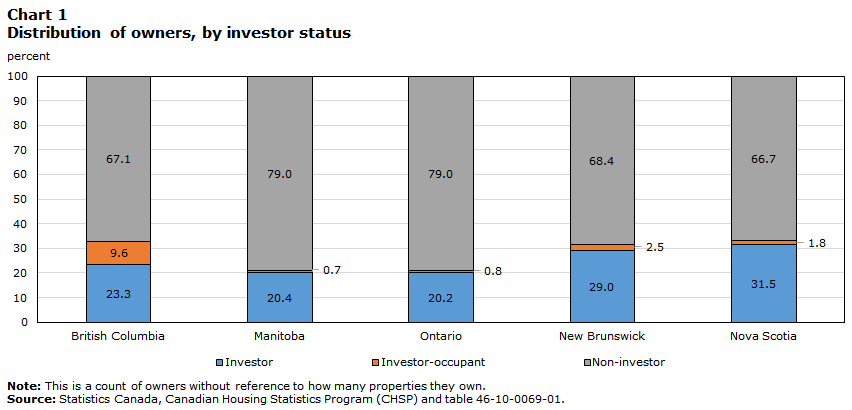
Residential real estate investors and investment properties in 2020

Data table for Chart 1


Data table for chart 1

Table summary

This table displays the results of Data table for chart 1 British Columbia, Manitoba, Ontario, New Brunswick and Nova Scotia, calculated using percent units of measure (appearing as column headers).

British Columbia Manitoba Ontario New Brunswick Nova Scotia
percent
Investor 23.3 20.4 20.2 29.0 31.5
Investor-occupant 9.6 0.7 0.8 2.5 1.8
Non-investor 67.1 79.0 79.0 68.4 66.7


This difference is largely due to a higher proportion of vacant land in the two Atlantic provinces, which is a type of property often owned in addition to the primary place of residence. The proportion of investors who live in the province and own one or two pieces of vacant land in addition to their primary place of residence was 6.7{d4d1dfc03659490934346f23c59135b993ced5bc8cc26281e129c43fe68630c9} in Nova Scotia and 7.7{d4d1dfc03659490934346f23c59135b993ced5bc8cc26281e129c43fe68630c9} in New Brunswick. If we remove this type of investor, the rate of investors falls to 24.8{d4d1dfc03659490934346f23c59135b993ced5bc8cc26281e129c43fe68630c9} in Nova Scotia and 21.3{d4d1dfc03659490934346f23c59135b993ced5bc8cc26281e129c43fe68630c9} in New Brunswick. The proportions of investors are then more comparable to those of the other provinces.

Given that the stock of vacant land is proportionally lower and more expensive in British Columbia and Ontario, less than 2{d4d1dfc03659490934346f23c59135b993ced5bc8cc26281e129c43fe68630c9} of owners in these provinces were in-province investors who owned one or two pieces of vacant land in addition to their primary place of residence. In Manitoba, the proportion of homeowners in this situation was also low, at 2.5{d4d1dfc03659490934346f23c59135b993ced5bc8cc26281e129c43fe68630c9}.

Investor-occupants are more common in British Columbia, where they made up 9.6{d4d1dfc03659490934346f23c59135b993ced5bc8cc26281e129c43fe68630c9} of owners. This higher proportion is mostly due to the composition of the housing stock. In this province, properties with multiple residential units represented 11.7{d4d1dfc03659490934346f23c59135b993ced5bc8cc26281e129c43fe68630c9} of the stock, a higher proportion than in the other provinces, where it varied from 2.9{d4d1dfc03659490934346f23c59135b993ced5bc8cc26281e129c43fe68630c9} in Ontario to 5.7{d4d1dfc03659490934346f23c59135b993ced5bc8cc26281e129c43fe68630c9} in Nova Scotia. This higher percentage in British Columbia was mostly attributable to many residences with a laneway unit or a basement suite among properties with multiple residential units. These kinds of properties were more likely to be occupied by the owner when compared to apartment buildings in British Columbia and elsewhere.

How is the investment status of the property defined?

An analysis of properties used as an investment helps clarify the role that investors play in the housing market. The investment status of the property is determined by analyzing the investor status of the owner and the use of the property. Properties are divided into one of the following three categories: an investment property, an owner-occupied investment property, and a non-investment property.Note

An investment property is defined as a property owned by at least one investor that is not the primary place of residence of any of the owners. This can include, for example, a rented property with one or more units, a cottage or a property owned for speculative purposes.

If the property is not included in the previous category, it can be considered an owner-occupied investment property if it is a property with multiple residential units where at least one of the owners occupies a unit.Note

Finally, the non-investment property category includes properties owned only by non-investors or those used as a primary place of residence by at least one of the owners.

The proportion of investment properties varies greatly by the type of property analyzed. Vacant land and properties with multiple residential units are used more for investment than single-detached houses, semi-detached houses, row houses, and mobile homes — which we refer to as “houses” in this article — and condominium apartments.

In all the provinces analyzed in this study combined, more than 9 in 10 vacant lots were investment properties or were owned by a non-profit organization. The remainder were owned by individuals residing in the province where they owned a single vacant lot. Similarly, for all these provinces, 96.7{d4d1dfc03659490934346f23c59135b993ced5bc8cc26281e129c43fe68630c9} of properties with multiple residential units were either investment properties (45.6{d4d1dfc03659490934346f23c59135b993ced5bc8cc26281e129c43fe68630c9}) or owner-occupied investment properties (51.1{d4d1dfc03659490934346f23c59135b993ced5bc8cc26281e129c43fe68630c9}), while the rest were owned by non-profit organizations. However, these proportions varied from one province to another. In British Columbia, 73.0{d4d1dfc03659490934346f23c59135b993ced5bc8cc26281e129c43fe68630c9} of properties with multiple dwellings were owner-occupied investment properties. By contrast, in the other provinces, the majority of properties with multiple dwellings were investment properties, with the proportion reaching 72.0{d4d1dfc03659490934346f23c59135b993ced5bc8cc26281e129c43fe68630c9} in Manitoba.

As a result, provinces with a large stock of vacant land, such as New Brunswick and Nova Scotia, and those with a high proportion of properties with multiple residential units, such as British Columbia, had high rates of investors or investor-occupants. The portrait shifts when the focus is on houses and condominium apartments, which are more likely to be owner-occupied, and therefore not used for investment purposes. In the following sections, the analysis of properties focuses exclusively on houses and condominium apartments, and excludes properties with multiple dwellings and vacant land.

In Nova Scotia, more than 1 in 20 houses is used as an investment by a person living outside the province or the country

The analysis by property type found that investors were drawn more to condominium apartments than houses. The share of houses used as an investment varied from 14.3{d4d1dfc03659490934346f23c59135b993ced5bc8cc26281e129c43fe68630c9} in New Brunswick to 20.1{d4d1dfc03659490934346f23c59135b993ced5bc8cc26281e129c43fe68630c9} in Nova Scotia, with an overall average of 15.6{d4d1dfc03659490934346f23c59135b993ced5bc8cc26281e129c43fe68630c9} for all five provinces. By comparison, this same statistic for condominium apartments was 39.4{d4d1dfc03659490934346f23c59135b993ced5bc8cc26281e129c43fe68630c9}. For the five provinces, a total of 918,695 houses were used as an investment, 584,615 of which were in Ontario. A regional analysis found that the proportion of houses used as an investment was generally higher in more touristic regions, where there may be more cottages.

In-province investors owned, as investment properties, between 8.7{d4d1dfc03659490934346f23c59135b993ced5bc8cc26281e129c43fe68630c9} of the houses in New Brunswick and 12.4{d4d1dfc03659490934346f23c59135b993ced5bc8cc26281e129c43fe68630c9} in Nova Scotia, and, as such, they owned more houses used as an investment than all the other types of investors combined.
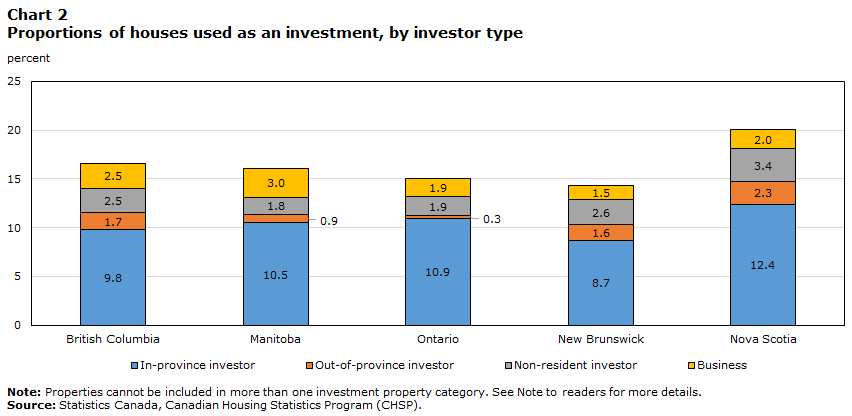
Chart 2: Proportions of houses used as an investment, by investor type

Data table for Chart 2


Data table for chart 2

Table summary

This table displays the results of Data table for chart 2 British Columbia, Manitoba, Ontario, New Brunswick and Nova Scotia, calculated using percent units of measure (appearing as column headers).

British Columbia Manitoba Ontario New Brunswick Nova Scotia
percent
In-province investor 9.8 10.5 10.9 8.7 12.4
Out-of-province investor 1.7 0.9 0.3 1.6 2.3
Non-resident investor 2.5 1.8 1.9 2.6 3.4
Business 2.5 3.0 1.9 1.5 2.0


Out-of-province investors owned proportionally fewer houses used as an investment in Ontario (0.3{d4d1dfc03659490934346f23c59135b993ced5bc8cc26281e129c43fe68630c9}) than out-of-province investors in the other provinces, which is likely partly due to higher real estate prices in Ontario than most of the provinces. Nova Scotia, New Brunswick and British Columbia seemed more popular with out-of-province investors, who owned, as investments, 2.3{d4d1dfc03659490934346f23c59135b993ced5bc8cc26281e129c43fe68630c9}, 1.6{d4d1dfc03659490934346f23c59135b993ced5bc8cc26281e129c43fe68630c9} and 1.7{d4d1dfc03659490934346f23c59135b993ced5bc8cc26281e129c43fe68630c9} of houses, respectively. New Brunswick and Nova Scotia may have attracted residents from other provinces with lower average housing prices than in other provinces. As for British Columbia, the number of out-of-province investors was particularly high in the areas near the Alberta border. In British Columbia, non-residents and out-of-province investors owned 43,890 houses used as an investment.

Condominium apartments are more popular with investors than houses

The share of condominium apartments used as an investment was higher than for houses, varying from 22.6{d4d1dfc03659490934346f23c59135b993ced5bc8cc26281e129c43fe68630c9} in New Brunswick to 41.9{d4d1dfc03659490934346f23c59135b993ced5bc8cc26281e129c43fe68630c9} in Ontario and totalling 39.4{d4d1dfc03659490934346f23c59135b993ced5bc8cc26281e129c43fe68630c9} for all five provinces. Although this share was higher in Ontario and British Columbia (36.2{d4d1dfc03659490934346f23c59135b993ced5bc8cc26281e129c43fe68630c9}) than in Manitoba (29.2{d4d1dfc03659490934346f23c59135b993ced5bc8cc26281e129c43fe68630c9}) and New Brunswick, this does not appear to be attributable to the large census metropolitan areas (CMAs) in those provinces. In fact, the rate of condominium apartments used as investment was lower in the CMAs of Toronto (36.2{d4d1dfc03659490934346f23c59135b993ced5bc8cc26281e129c43fe68630c9}) and Vancouver (34.0{d4d1dfc03659490934346f23c59135b993ced5bc8cc26281e129c43fe68630c9}) than the rate in the rest of their respective provinces.
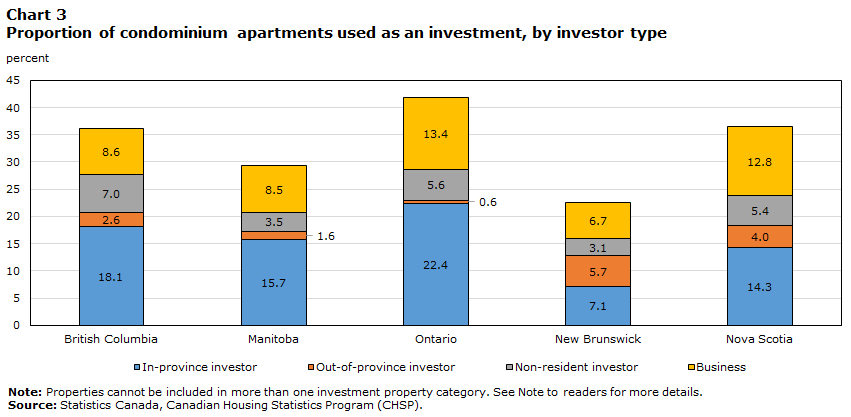
Chart 1: Proportion of condominium apartments used as an investment, by investor type

Data table for Chart 3


Data table for chart 3

Table summary

This table displays the results of Data table for chart 3 British Columbia, Manitoba, Ontario, New Brunswick and Nova Scotia, calculated using percent units of measure (appearing as column headers).

British Columbia Manitoba Ontario New Brunswick Nova Scotia
percent
In-province investor 18.1 15.7 22.4 7.1 14.3
Out-of-province investor 2.6 1.6 0.6 5.7 4.0
Non-resident investor 7.0 3.5 5.6 3.1 5.4
Business 8.6 8.5 13.4 6.7 12.8


There was a higher rate of business-owned investment properties among the condominium apartment stock than in the stock of houses. In Ontario, businesses owned 74,485 condominium apartments for investment purposes, or 13.4{d4d1dfc03659490934346f23c59135b993ced5bc8cc26281e129c43fe68630c9} of all properties of this type, which is the highest share among the provinces analyzed. Nevertheless, most condominium apartments used as an investment in both Ontario and Manitoba were owned by in-province investors. In the other jurisdictions, this was not the case.

The proportion of condominium apartments owned for investment purposes by non-resident investors was the highest in British Columbia (7.0{d4d1dfc03659490934346f23c59135b993ced5bc8cc26281e129c43fe68630c9}), followed by Ontario (5.6{d4d1dfc03659490934346f23c59135b993ced5bc8cc26281e129c43fe68630c9}).

More investment properties outside CMAs and census agglomerations (CAs) seem to be used as a secondary residence

While some investors rent out their investment property, others may use it as a secondary residence. Properties located outside CMAs and CAs are more likely to be used as secondary or recreational properties, such as cottages, when the owners are residents of the province and only own one additional property outside the region of their primary residence.Note These properties may or may not be rented.

Outside the major centres, this type of investment made up between 3.2{d4d1dfc03659490934346f23c59135b993ced5bc8cc26281e129c43fe68630c9} of houses and condominium apartments in New Brunswick and 11.1{d4d1dfc03659490934346f23c59135b993ced5bc8cc26281e129c43fe68630c9} in Ontario. In the latter, this amounted to 70,610 properties, or 1.6{d4d1dfc03659490934346f23c59135b993ced5bc8cc26281e129c43fe68630c9} of all houses and condominium apartments in the province. Of these, more than 99{d4d1dfc03659490934346f23c59135b993ced5bc8cc26281e129c43fe68630c9} were houses, while condominium apartments, which are less common outside major centres, represented less than 1{d4d1dfc03659490934346f23c59135b993ced5bc8cc26281e129c43fe68630c9} of the investment properties of this type.

In British Columbia and, to a lesser extent, Nova Scotia, the share of potential secondary residences owned by out-of-province investors was higher than in the other jurisdictions. In British Columbia, investment properties owned by out-of-province residents represented 6.3{d4d1dfc03659490934346f23c59135b993ced5bc8cc26281e129c43fe68630c9} of the houses and condominium apartments outside CMAs and CAs, while the figure for Nova Scotia was 3.5{d4d1dfc03659490934346f23c59135b993ced5bc8cc26281e129c43fe68630c9}.
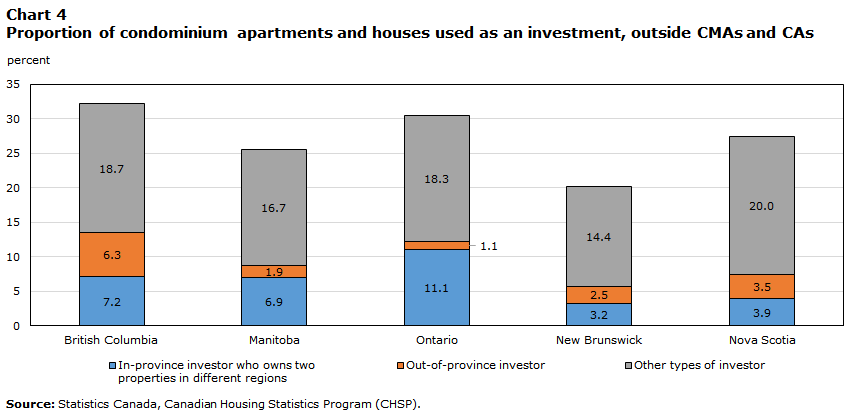
Chart 4: Proportion of investment properties outside CMAs and CAs among condominium apartments and houses

Data table for Chart 4


Data table for chart 4

Table summary

This table displays the results of Data table for chart 4 British Columbia, Manitoba, Ontario, New Brunswick and Nova Scotia, calculated using percent units of measure (appearing as column headers).

British Columbia Manitoba Ontario New Brunswick Nova Scotia
percent
In-province investor who owns two properties in different regions 7.2 6.9 11.1 3.2 3.9
Out-of-province investor 6.3 1.9 1.1 2.5 3.5
Other types of investor 18.7 16.7 18.3 14.4 20.0


Although a secondary residence could also be a pied-à-terre in the city, this seemed less common. In large urban centres, the proportion of houses and condominium apartments used as an investment owned by residents from outside the region or the province was lower than in areas outside CMAs or CAs. This proportion was highest in the CAs and CMAs in Nova Scotia (2.2{d4d1dfc03659490934346f23c59135b993ced5bc8cc26281e129c43fe68630c9}) and British Columbia (2.2{d4d1dfc03659490934346f23c59135b993ced5bc8cc26281e129c43fe68630c9}). In CMAs and CAs of the five provinces, the second property of in-province investors living in a different region was more often a condominium (23.0{d4d1dfc03659490934346f23c59135b993ced5bc8cc26281e129c43fe68630c9} of cases) than was the case outside major centres.
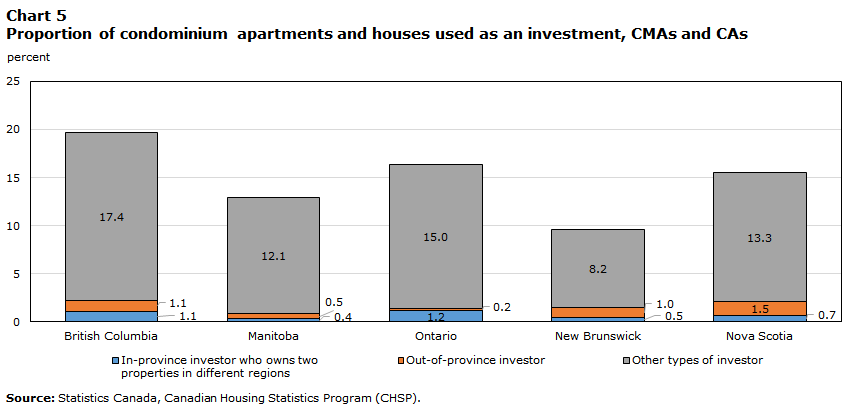
Chart 5: Proportion of investment properties among condominium apartments and houses, CMAs and CAs

Data table for Chart 5


Data table for chart 5

Table summary

This table displays the results of Data table for chart 5 British Columbia, Manitoba, Ontario, New Brunswick and Nova Scotia, calculated using percent units of measure (appearing as column headers).

British Columbia Manitoba Ontario New Brunswick Nova Scotia
percent
In-province investor who owns two properties in different regions 1.1 0.4 1.2 0.5 0.7
Out-of-province investor 1.1 0.5 0.2 1.0 1.5
Other types of investor 17.4 12.1 15.0 8.2 13.3


In the Toronto and Vancouver CMAs, investment properties were concentrated in the downtown core

In both Toronto and Vancouver CMAs, there was a higher proportion of investment properties in the core census subdivisions (CSDs). In the Vancouver CMA, the Greater Vancouver ANote CSD was the one exception, with a higher proportion of houses and condominium apartments used as an investment (42.1{d4d1dfc03659490934346f23c59135b993ced5bc8cc26281e129c43fe68630c9}) than in the other CSDs in the region. This is consistent with other trends observed for Greater Vancouver A. According to the 2021 Census, this CSD had a higher proportion of renters (57.3{d4d1dfc03659490934346f23c59135b993ced5bc8cc26281e129c43fe68630c9} of households) than in the rest of the CMA. This difference is partially due to the students who attend the University of British Columbia, which is located in this area. Students are more likely to be renters, but they could also be owners, or they could live in a second property owned by a family member. In addition, this CSD had the highest non-resident ownership rate (14.9{d4d1dfc03659490934346f23c59135b993ced5bc8cc26281e129c43fe68630c9}) in the CMA in 2020.

In the City of Vancouver, which is the core CSD, the proportion of houses and condominium apartments used as an investment was 32.5{d4d1dfc03659490934346f23c59135b993ced5bc8cc26281e129c43fe68630c9}, the second highest proportion in the Vancouver CMA, which had an overall rate of 21.3{d4d1dfc03659490934346f23c59135b993ced5bc8cc26281e129c43fe68630c9}. The higher share of investment properties in the core CSD is partly due to a greater concentration of condominium apartments, which are more often used as an investment. However, even considering condominium apartments and single detached houses separately, both had a higher rate of properties used as an investment in the Vancouver CSD than in the rest of the CMA.
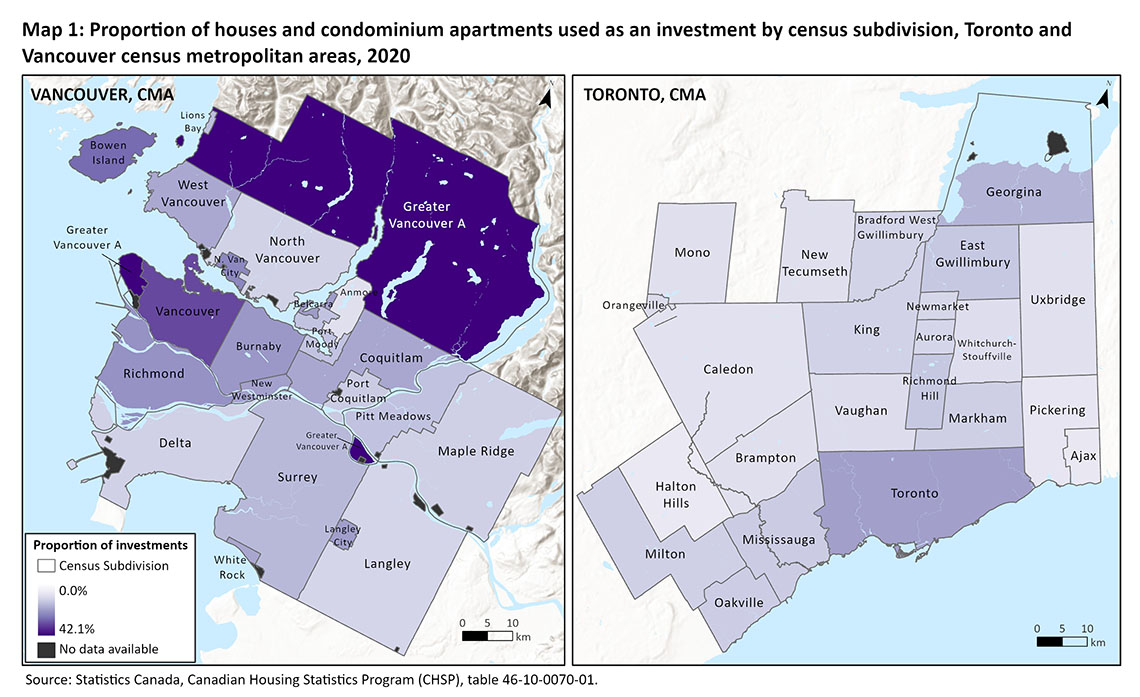
Map 1: Proportion of houses and condominium apartments used as an investment by census subdivision. Toronto and Vancouver census metropolitan areas, 2020

Description for Map 1


The title of the map is: “Proportion of houses and condominium apartments used as an investment by census subdivision, Toronto and Vancouver census metropolitan areas, 2020.” This figure displays two maps of the CSDs in the Vancouver CMA (left side) and the Toronto CMA (right side). 


Each CSD is shaded from light to dark purple based on the proportion of houses and condominium apartments used as an investment. The darker the shade, the higher the proportion of houses and condominium apartments used as an investment in that CSD. The map shows that the proportion of houses and condominium apartments used as an investment is generally higher in CSDs near the core of the Vancouver and Toronto CMAs. A continuous scale is used and ranges from 0.0{d4d1dfc03659490934346f23c59135b993ced5bc8cc26281e129c43fe68630c9} to 42.1{d4d1dfc03659490934346f23c59135b993ced5bc8cc26281e129c43fe68630c9}.


Proportion of houses and condominium apartments used as an investment by census subdivision, Toronto and Vancouver census metropolitan areas, 2020

Table summary

This table displays the results of Proportion of houses and condominium apartments used as an investment by census subdivision. The information is grouped by Census subdivision name (appearing as row headers), Proportion of houses and condominium apartments used as an investment (percent) (appearing as column headers).
Census subdivision name Proportion of houses and condominium apartments used as an investment (percent)
Toronto CMA
Ajax, Town 7.4
Aurora, Town 12.1
Bradford West Gwillimbury, Town 12.6
Brampton, City 9.8
Caledon, Town 9.2
East Gwillimbury, Town 15.1
Georgina, Town 18.4
Halton Hills, Town 7.1
King, Township 12.9
Markham, City 13.7
Milton, Town 13.2
Mississauga, City 14.2
Mono, Town 9.6
New Tecumseth, Town 9.8
Newmarket, Town 12.1
Oakville, Town 13.9
Orangeville, Town 11.5
Pickering, City 8.0
Richmond Hill, Town 15.0
Toronto, City 21.7
Uxbridge, Township 9.5
Vaughan, City 10.6
Whitchurch-Stouffville, Town 10.2
Vancouver
Anmore, Village 9.2
Belcarra, Village 20.9
Bowen Island, Island municipality 28.3
Burnaby, City 21.6
Coquitlam, City 19.1
Delta, District municipality 12.1
Greater Vancouver A, Regional district electoral area 42.1
Langley, City 20.6
Langley, District municipality 11.4
Lions Bay, Village 16.0
Maple Ridge, City 12.3
New Westminster, City 20.2
North Vancouver, City 24.3
North Vancouver, District municipality 11.8
Pitt Meadows, City 14.8
Port Coquitlam, City 13.3
Port Moody, City 14.8
Richmond, City 22.4
Surrey, City 16.5
Vancouver, City 32.5
West Vancouver, District municipality 19.0
White Rock, City 19.2


The finding was similar in Toronto, where the proportion of investment properties was higher in the core CSD of the City of Toronto (21.7{d4d1dfc03659490934346f23c59135b993ced5bc8cc26281e129c43fe68630c9}) than in the CMA as a whole (16.3{d4d1dfc03659490934346f23c59135b993ced5bc8cc26281e129c43fe68630c9}). For the CSD, this amounts to 112,220 condominium apartments and 52,935 houses used as an investment.

Note to readers

The Canadian Housing Statistics Program (CHSP) is an innovative data project that leverages existing data sources and transforms them into new and timely indicators on Canadian housing.

The data in this study are compiled from the CHSP for the reference year 2020. Complete information about the reference years of the property stock, by province and territory, are available here.

Methodology

Investor status and investment status of the residential property take into consideration the type of property as obtained by our data providers. Certain properties may have secondary units that are not known to the authorities. As a result, we cannot account for them. The counts and distribution of properties are calculated based on the property classifications established by the CHSP. These may differ from the ones used by local authorities.

Once the property is categorized as an investment property, a subcategory is created to determine the type of investment property. This is based on the type of investor who owns it. The order of priority is as follows:

  1. Investment property owned by at least one business or one government;
  2. Investment property owned by at least one non-resident individual;
  3. Investment property owned by at least one out-of-province individual;
  4. Investment property owned by an individual living in the province.

Properties cannot be included in more than one investment property category. If the property has multiple owners with various profiles, once an owner fits in one of the categories, by order of priority, then the property is included in that category.

Geographical boundaries

In CHSP releases, data are based on the geographical boundaries from the Standard Geographical Classification 2016.

The CHSP database does not contain information about residential properties on Indian reserves.

Definitions

A property owner refers to an individual or an entity included in the classification of ‘business and government’ (such as corporations, governments, sole proprietorships and partnerships, and other legal types) that has property title transferred to, recorded in, registered in, or otherwise carried in their name.

A property may have more than one owner or an owner may have more than one property, therefore the count of owners and properties can differ.

An individual is considered a non-resident if their primary dwelling is outside the economic territory of Canada.

The core of a geographic area, for the purposes of this release, refers to the census subdivision (CSD) within a census metropolitan area (CMA) with the highest number of residential properties.

An investor is defined as an owner who owns at least one residential property that is not used as their primary place of residence, excluding Canadian non-profit organizations. An individual owner who owns a single property in the same province as where they reside is not considered an investor, so long as it is not a property with multiple residential units. This category excludes investor-occupants.

An investor-occupant is defined as an owner who possesses a single property with multiple residential units and who occupies that property.

A non-investor is defined as an owner who is not an investor or an investor-occupant. An owner who lives in the same province as where the property is owned and owns a single property is included in this category, so long as it is not a property with multiple residential units.

An investment property refers to a residential property owned by at least one investor and is not used as a primary place of residence by any of the owners. This category excludes owner-occupied investment properties.

An owner-occupied investment property refers to a property with multiple residential units where at least one of the owners occupies a unit.

A non-investment property refers to a property held solely by non-investors or a property being used as a primary place of residence by at least one of the owners and that is not an owner-occupied investment property.

The term unspecified investment property status refers to properties whose owner is unknown, and therefore the investment status of the property cannot be determined.

A property with multiple residential units refers to a property containing more than one set of living quarters owned by the same owner(s), as is the case for an apartment building or a duplex or a property with two houses on the same lot.

A condominium apartment refers to a set of living quarters that is owned individually, while land and common elements are held in joint ownership with others.

Bibliography

Allen, Marcus T., Rutherford, J., Rutherford, R., Yavas, A. (2018). Impact of Investors in Distressed Housing Markets. The Journal of Real Estate Finance and Economics. 56. 622-652.

Canada Mortgage and Housing Corporation (2016). “Condominium owners report – Toronto and Vancouver”. April 2016. https://publications.gc.ca/collections/collection_2016/schl-cmhc/NH21-3-2016-eng.pdf

Haughwout, A., D. Lee, J. Tracy, and van der Klaauw, W. (2011). Real estate investors, the leverage cycle, and the housing market crisis. Staff Reports 514, Federal Reserve Bank of New York.

Khan, M., Xu, Y. (2022). Housing demand in Canada: A novel approach to classifying mortgaged homebuyers. Staff Analytical Note 2022-1, Bank of Canada.

Statistics Canada. (2021). “Canadian Housing Statistics Program, 2020.” The Daily. September 17, Statistics Canada Catalogue no. 11-001-X. https://www150.statcan.gc.ca/n1/daily-quotidien/210917/dq210917b-eng.htm

Statistics Canada. (2022). “To buy or to rent: The housing market continues to be reshaped by several factors as Canadians search for an affordable place to call home.” The Daily. September 21. Statistics Canada Catalogue no. 11-001-X. https://www150.statcan.gc.ca/n1/daily-quotidien/220921/dq220921b-eng.htm

Statistic Canada. (2022). “Canadian Housing Statistics Program, 2019 and 2020.” The daily. November 11. Statistics Canada no.11-001-X. https://www150.statcan.gc.ca/n1/daily-quotidien/221110/dq221110c-eng.htm

Statistics Canada. (2022). Census Profile, 2021 Census. Statistics Canada Catalogue no. 98-316-X2021001. Last updated on September 21, 2022. https://www12.statcan.gc.ca/census-recensement/2021/dp-pd/prof/index.cfm?Lang=E

Teranet. (2022). Market Insight – The Canadian Source for Housing Information – Q2 2022, https://www.teranet.ca/wp-content/uploads/2022/06/Teranet-Market-Insight-Quarterly-Report-Q2-2022.pdf (accessed September 12, 2022).

Zillow ranks Cleveland second hottest real estate market in the U.S. for 2023

Zillow ranks Cleveland second hottest real estate market in the U.S. for 2023

CLEVELAND — It is no mystery that Cleveland rocks.

Just talk to anybody who life right here.

But our hometown is in the nationwide spotlight earning major marks when it will come to the actual estate market and people today wanting to purchase a residence.

Serious estate site “Zillow” just named the CLE a single of the hottest housing marketplaces in the United States.

Cleveland ranked range 2 in the top 10.

Charlotte nabbed the range 1 location.

Pittsburgh took 3rd location (Check out out the comprehensive listing listed here: https://www.zillow.com/exploration/2023-most popular-marketplace-31982/).

In accordance to Zillow, the things behind the rankings consist of anticipated property price progress, projected change in operator-occupied households and task growth compared to new construction.

Nearby serious estate professionals say just obtaining the word out on a countrywide scale entices possible dwelling prospective buyers to invest and plant roots in Northeast Ohio.

Cleveland is also having main notice due to the fact the city presents all the facilities at a fraction of the cost of other big Metropolitan towns, according to gurus.

Generate around any Cleveland community, and you’ll most likely place just one “For Sale” signal after the following.

Even with financial uncertainty, the housing industry in Northeast Ohio carries on to entice prospective buyers.

Zillow appeared at purchaser demand from customers, envisioned home worth advancement and affordability when it compiled the 2023 rankings.

“I guess that is great for Cleveland, suitable?” Matt Stevens mentioned.

Berkshire Hathaway Stouffer Realty agent Sarah Halsey states the marketplace has definitely absent through a changeover time period, but the last 8 many years have been continually chaotic, whether you’re a initially-time purchaser, transient or looking to downsize your space as a retiree.

“I feel that people are continue to intrigued in the Cleveland marketplace for a couple distinctive factors. A single becoming the charge of living. Two, the position prospects. And three, the new housing developments.”

Halsey claims the market place has progressed and designed additional of an even, good enjoying discipline for everyone more than the very last year.

It’s not like it was in the course of peak pandemic, exactly where realtors ended up getting a number of features $50 thousand pounds around asking cost and waiving house inspections, Halsey said.

Halsey states curiosity costs have also adjusted the match.

“Fees a calendar year or so in the past, even fewer than a year back ended up about 2-3{d4d1dfc03659490934346f23c59135b993ced5bc8cc26281e129c43fe68630c9}. We have not witnessed low fees like that at any time, really. And now fees are about 5-6{d4d1dfc03659490934346f23c59135b993ced5bc8cc26281e129c43fe68630c9},” Halsey explained.

And as for why so quite a few men and women are hunting to settle down listed here as opposed to a additional year-spherical hotter climate–

“I comprehend men and women require affordability, and I would live some place with my spouse and children that was like this,” Barbara Cossey explained.

Halsey says despite the fact that rent selling prices are high just about everywhere–they’re manageable right here.

And if you obtain a house, your mortgage—will likely be much less expensive.

“The expense of living in Cleveland is drastically fewer than other spots. It is really 11{d4d1dfc03659490934346f23c59135b993ced5bc8cc26281e129c43fe68630c9} under the national common, and rentals are 11{d4d1dfc03659490934346f23c59135b993ced5bc8cc26281e129c43fe68630c9} down below the Ohio common, getting a massive city by a large physique of water,” Halsey reported.

The median listing selling price for a property in Cleveland is all-around $110-$115 thousand dollars.

Serious estate officers say it is engaging to initially-time residence prospective buyers.

As for the coolest or worst marketplaces to get a home– Zillow ranked San Jose, Minneapolis and Sacramento.

Capital Gains Tax on Real Estate Investment Property

Capital Gains Tax on Real Estate Investment Property

SmartAsset: Capital gains tax on real estate investment property

Real estate investments can be lucrative assets. However, they can also incur capital gains taxes that weaken your profits. Fortunately, you can implement tactics that reduce capital gains taxes so you can keep more of your money. Although the IRS taxes short-term and long-term gains differently, you can combat high tax rates on both. We’ll explain short-term and long-term capital gains and how to keep the associated taxes from costing you an arm and a leg.

A financial advisor can help you tax-optimize your investment portfolio. Find a financial advisor today.

What Are Capital Gains Taxes?

You pay capital gains taxes when you profit from selling assets. You can incur two types of capital gains taxes: short-term and long-term. Short-term capital gains are from selling assets you’ve held for less than a year. On the other hand, long-term capital gains come from selling assets after holding them for a year or more. So, if you sell an investment property, the time you owned it before selling it will determine what kind of capital gains taxes you pay.

How Are Capital Gains Taxed?

The IRS taxes short-term capital gains as standard income, meaning your income tax bracket will determine your tax rate. Income tax brackets are as follows: 10{d4d1dfc03659490934346f23c59135b993ced5bc8cc26281e129c43fe68630c9}, 12{d4d1dfc03659490934346f23c59135b993ced5bc8cc26281e129c43fe68630c9}, 22{d4d1dfc03659490934346f23c59135b993ced5bc8cc26281e129c43fe68630c9}, 24{d4d1dfc03659490934346f23c59135b993ced5bc8cc26281e129c43fe68630c9}, 32{d4d1dfc03659490934346f23c59135b993ced5bc8cc26281e129c43fe68630c9}, 35{d4d1dfc03659490934346f23c59135b993ced5bc8cc26281e129c43fe68630c9}, and 37{d4d1dfc03659490934346f23c59135b993ced5bc8cc26281e129c43fe68630c9}. Your income determines your capital gains tax rates.

For example, say you make $85,000 from your day job. You sell an investment property nine months after purchasing it and make a $30,000 profit. The sale results in a short-term capital gain, and your income is $115,000 when you file taxes. In addition, you’re a single filer, putting a portion of your income in the 24{d4d1dfc03659490934346f23c59135b993ced5bc8cc26281e129c43fe68630c9} tax bracket.

Conversely, long-term capital gains have different tax rates than short-term gains: 0{d4d1dfc03659490934346f23c59135b993ced5bc8cc26281e129c43fe68630c9}, 15{d4d1dfc03659490934346f23c59135b993ced5bc8cc26281e129c43fe68630c9}, and 20{d4d1dfc03659490934346f23c59135b993ced5bc8cc26281e129c43fe68630c9}, depending on your income level and filing status. For 2023, single filers making up to $44,625 receive the 0{d4d1dfc03659490934346f23c59135b993ced5bc8cc26281e129c43fe68630c9} rate. Single filers with income between $44,626 and $492,300 will pay 15{d4d1dfc03659490934346f23c59135b993ced5bc8cc26281e129c43fe68630c9}. Finally, single filers with income above $492,300 will pay 20{d4d1dfc03659490934346f23c59135b993ced5bc8cc26281e129c43fe68630c9} long-term capital gains taxes. In addition, single filers making $125,000 or more annually will pay a net investment income tax of 3.8{d4d1dfc03659490934346f23c59135b993ced5bc8cc26281e129c43fe68630c9} on capital gains from real estate.

A married couple filing 2023 taxes jointly will pay 0{d4d1dfc03659490934346f23c59135b993ced5bc8cc26281e129c43fe68630c9} if they earn up to $89,250. The 15{d4d1dfc03659490934346f23c59135b993ced5bc8cc26281e129c43fe68630c9} rate applies if the couple earns $89,251 to $553,850. The 20{d4d1dfc03659490934346f23c59135b993ced5bc8cc26281e129c43fe68630c9} rate applies if they earn more than $553,850.

How to Limit Capital Gains on Real Estate Investment Properties

SmartAsset: Capital gains tax on real estate investment property

You can use a variety of strategies to avoid capital gains on real estate properties:

Use Tax-Deferred Funds

You don’t have to invest in real estate with dollars from your bank account. Instead, you can use your individual retirement account (IRA) or 401(k). Depositing investment profits in your investment account allows your money to grow tax-free. Plus, your IRA contributions can garner you another tax deduction.

Make the Property Your Primary Residence

The internal revenue service (IRS) exempts primary residence sales from capital gains taxes up to $500,000 for married joint filers and $250,000 for single filers. You can also avoid paying taxes on depreciation deductions this way. Using this option means fulfilling the following requirements:

  • Owning the home for two or more of the last five years
  • Living in the home as the primary residence for two or more of the last five years
  • You haven’t taken a primary residence exemption in two years

Tax-Loss Harvesting

Tax-loss harvesting means deliberately selling an asset for a loss to mitigate profits from another asset. Therefore, you can sell a property for less than you bought it, reducing your taxes.

For instance, say you sell one property and make $30,000. You don’t want to pay taxes on this gain, so you sell another property for $25,000 less than what you paid. As a result, you pay taxes on $5,000 of capital gains.

1031 Exchange

The depreciation deduction for rental properties has one major drawback: when you sell a rental property, you owe taxes on the depreciation amount (if you received any). Fortunately, the 1031 exchange allows you to circumvent this rule.

The 1031 exchange means using the income from the sale of an investment property to purchase another investment property of equal or greater value. Then, you don’t have to pay taxes on prior depreciation deductions. This caveat allows you to avoid income taxes on depreciation into perpetuity if you buy another property of equal or greater value.

How to Minimize Your Capital Gains Tax

Even if you can’t altogether avoid capital gains taxes, the following tactics will minimize your capital gains taxes:

Depreciation Deduction

The IRS allows rental property owners to deduct an annual depreciation amount from their income. The deduction comes from the expected lifespan of rental property, which the IRS defines as 27.5 years. As a result, you can calculate your depreciation deduction by dividing your rental property value by 27.5 (commercial real estate uses the lifespan figure of 39 years).

For instance, say you have a $250,000 residential investment property. Dividing this figure by the depreciation deduction lifespan of 27.5 gives you an annual deduction of $9,090.

Itemized Deductions

Generally, you can deduct the costs of managing property, lowering your tax burden. Running your real estate investment business incurs costs such as travel, legal fees, and business equipment. These expenses can add up – but instead of hurting your wallet, they can create a tax benefit.

In addition, you can deduct mortgage interest and the costs of repairing or maintaining a property. Therefore, keeping detailed records and saving every receipt is vital to claiming as many deductions as possible.

Methods to Boost Property Basis

SmartAsset: Capital gains tax on real estate investment property

Improving your property gives two financial advantages: the costs of doing so can shrink your capital gains taxes, and the improvements can bolster your property value. Here’s how you can boost property basis:

  • New windows and doors
  • Updated appliances, roofing, and flooring
  • Renovate plumbing, electrical, and HVAC systems
  • Paying commissions to real estate agents
  • Expenses for the appraisal, inspection, and legal services
  • Closing costs, including title search, escrow, and taxes

Bottom Line

Capital gains taxes can curb your profits from real estate investments. Fortunately, multiple deductions and tax strategies can lower your tax burden. For example, you can deduct depreciation and make a home your primary residence before you sell it. In addition, upgrading your home can boost your property basis and lower your capital gains taxes. So, it’s essential to be thorough in your research and record keeping to ensure you minimize capital gains taxes on real estate investments.

Tips on Capital Gains Tax on Real Estate Investment Property

  • You can make the most of your real estate investments by familiarizing yourself with relevant tax laws. A financial advisor can help you understand your financial position and make the most of your tax return. Finding a qualified financial advisor doesn’t have to be hard. SmartAsset’s free tool matches you with up to three vetted financial advisors who serve your area, and you can interview your advisor matches at no cost to decide which one is right for you. If you’re ready to find an advisor who can help you achieve your financial goals, get started now.
  • Check out our free capital gains capital gains tax calculator for a quick estimate of what you’ll owe.
  • If you’re considering starting a real estate venture, it’s wise to do your homework first. Use this guide for how to buy investment property.

Photo credit: ©iStock.com/Perawit Boonchu, ©iStock.com/ArLawKa AungTun, ©iStock.com/ArLawKa AungTun

The post Capital Gains Tax on Real Estate Investment Property appeared first on SmartAsset Blog.

The views and opinions expressed herein are the views and opinions of the author and do not necessarily reflect those of Nasdaq, Inc.