You can find a rising consensus that US house costs will slide or crash in 2023.
But the director of real estate exploration at the Nationwide Association of Realtors would not imagine it.
Here are 3 explanations why there will not likely be a housing marketplace crisis this 12 months.
Renters hoping to get a home after the US housing sector collapses may well be ready a though.
Lots of pundits have warned lately that home prices are on skinny ice, but a report unveiled final 7 days by the National Affiliation of Realtors (NAR) showed the reverse: prices for current one-spouse and children properties in the US rose 4{d4d1dfc03659490934346f23c59135b993ced5bc8cc26281e129c43fe68630c9} yr-above-year in the fourth quarter of 2022.
Present home prices improved from the previous 12 months in an astounding 89{d4d1dfc03659490934346f23c59135b993ced5bc8cc26281e129c43fe68630c9} of the 186 metro places surveyed by the NAR. And 18{d4d1dfc03659490934346f23c59135b993ced5bc8cc26281e129c43fe68630c9} of metropolitan areas observed costs bounce by double digits in the fourth quarter, according to the report, even though that was down from 46{d4d1dfc03659490934346f23c59135b993ced5bc8cc26281e129c43fe68630c9} of markets in the prior quarter.
The toughness arrived as a shock considering how superior homebuyers’ borrowing expenditures are, reported Nadia Evangelou, the NAR’s director of actual estate research, in a new job interview with Insider. Her company found that the regular monthly mortgage loan payment on an current single-household home with a 20{d4d1dfc03659490934346f23c59135b993ced5bc8cc26281e129c43fe68630c9} down payment was $1,969, which is 58{d4d1dfc03659490934346f23c59135b993ced5bc8cc26281e129c43fe68630c9} increased than in the fourth quarter of 2021.
3 factors why house costs will never plummet
Most likely even a lot more astonishing than previous quarter’s house price advancement is Evangelou’s perception that US property price ranges will defy the consensus expectations by remaining elevated through the year.
There are three explanations why the US housing market place is unlikely to see popular selling price declines in 2023, Evangelou stated: property inventory remains reduced, property finance loan rates are slipping, and pending household sales are increasing.
Learners in Econ 101 could reveal the first level: a restricted offer of houses nationwide produces shortage that must continue to keep supporting selling prices, despite the reality that there are less homebuyers.
“The provide is not plenty of,” Evangelou advised Insider. “There are not more than enough homes that can make rates fall — even however there is certainly significantly less demand from customers.”
Need for houses has began to dry up mainly because borrowing expenditures continue to be uncomfortably superior, putting home ownership out of arrive at for millions of family members. 30-12 months fastened home finance loan prices rose to the greatest degree in two many years in late 2022 although the Federal Reserve rapidly elevated interest fees to test and get historically high inflation underneath command.
But mortgage prices have considering that fallen from their mid-November peak of 7.1{d4d1dfc03659490934346f23c59135b993ced5bc8cc26281e129c43fe68630c9}, and Evangelou expects borrowing expenses to continue to keep coming down even though the Fed shifts to scaled-down fee hikes.
Even a slight improvement in property affordability must promote need, Evangelou reported.
“As Us citizens can find the money for to obtain — the common relatives can pay for to obtain a medium-priced home — we are likely to have additional prospective buyers back to the sector,” Evangelou explained.
There is currently evidence that lower property finance loan fees are starting up to convey homebuyers back, Evangelou said: pending dwelling profits rose in December for the first time in seven months. She pointed out that the metric, which exhibits residence deal signings, foreshadows foreseeable future home revenue.
“Normally, the pending dwelling product sales is the indicator for the existing dwelling revenue,” Evangelou said. “There is a lag of about one to two months, which is the period that it will take for a deal to be shut. So we be expecting dwelling gross sales exercise to decide up in the pursuing months. Someday in the next few of months, we expect additional customers to be back again to the market place as prices are around 6{d4d1dfc03659490934346f23c59135b993ced5bc8cc26281e129c43fe68630c9}.”
Another close to-expression driver for the housing market is the seasonal development of desire buying up in hotter months, Evangelou mentioned. She thinks property finance loan apps will rise by the spring.
Benjamin C. Tankersley/For The Washington Post via Getty Images
After a record-breaking run that saw mortgage rates plunge to all-time lows and home prices soar to new highs, the U.S. housing market is finally slowing. Home sales had declined for 11 consecutive months as of December 2022, and home values seem to have peaked.
While demand and price gains are cooling, any correction is likely to be a modest one, housing economists and analysts say. No one expects price drops on the scale of the declines experienced during the Great Recession.
Rob Dietz, chief economist at the National Association of Home Builders, sums up the consensus among housing experts: “We’re thinking this is going to be a moderate downturn,” he says.
The real estate party raged on longer than anyone expected. The National Association of Realtors reported that median prices in the spring of 2022 topped $400,000 for the first time ever. Even after a recent retreat, prices are up a robust 32 percent since the coronavirus pandemic began in March 2020, according to NAR data.
Now, bidding wars have largely faded, inventories are loosening and the feeling of frothiness is gone. “The market is clearly turning,” says NAR chief economist Lawrence Yun.
Is the housing market going to crash?
The last time the U.S. housing market looked so frothy was back in 2005 to 2007. Then home values crashed, with disastrous consequences. When the real estate bubble burst, the global economy plunged into the deepest downturn since the Great Depression.
Now that the housing boom is threatened by soaring mortgage rates and a potential recession, buyers and homeowners are asking a familiar question: Is the housing market so hot that it’s about to crash?
Housing economists agree that prices could fall, but the decline won’t be as severe as the one homeowners experienced during the Great Recession. One obvious difference between now and then is that homeowners’ personal balance sheets are much stronger today than they were 15 years ago. The typical homeowner with a mortgage has stellar credit, a ton of equity and a fixed-rate mortgage locked in at a rate well below 5 percent. So no foreclosure crisis looms.
“The wild ride known as the U.S. housing market slowed dramatically in the fall of 2022, as mortgage rates surged and home prices remained high,” says Molly Boesel, principal economist at CoreLogic. “Home sales started strong in early 2022 but took a nosedive later in the year. On the plus side, generous amounts of home equity will protect many borrowers from experiencing the type of foreclosure activity seen during the Great Recession.”
What’s more, builders remember the Great Recession all too well, and they’ve been cautious about their pace of construction. The result is an ongoing shortage of homes for sale.
“We simply don’t have enough inventory,” Yun says. “Will some markets see a price decline? Yes,” he says. “[But] with the supply not being there, the repeat of a 30 percent price decline is highly, highly unlikely.”
Lightbulb
Key housing market statistics
A total of 30,822 U.S. homes had foreclosure filings — default notices, scheduled auctions or bank repossessions — as of December 2022, according to ATTOM Data Solutions.
South Carolina had the highest foreclosure rate of any state in December, at one foreclosure filing for every 2,301 housing units, according to ATTOM. It was followed by New Jersey, where one in every 2,378 homes were in some stage of foreclosure.
Lenders repossessed 3,663 U.S. properties through completed foreclosures — known as “real estate owned,” or REO — in December 2022. Altogether, 42,854 properties were repossessed in 2022, according to ATTOM.
Home sales fell 34 percent from December 2021 to December 2022, the National Association of Realtors says. The median sale price in December 2022 was $366,900.
Existing home sales for 2022 totaled just over 5 million, per NAR — down 17.8 percent from 2021.
Existing home prices
For many months, economists have been predicting that the housing market would eventually cool as home values become a victim of their own success. Home prices have risen far more quickly than incomes, creating an affordability squeeze, and mortgage rates doubled since August 2021, before starting to retreat a bit.
Experts say home prices could fall
“Most markets are going to experience price declines in the high single digits,” Dietz predicts. Home price declines of 8 to 9 percent would create some economic pain, to be sure. But this correction will be nothing like the utter collapse of property prices during the Great Recession, when some housing markets experienced a 50 percent cratering of values.
Rick Sharga, executive VP of market intelligence at ATTOM Data Solutions, expects declines of 5 percent. “It’s almost inevitable we’re going to see home prices drop,” he says.
Yun says high-priced regions such as California are most vulnerable to a downturn in prices. The Midwest, on the other hand, is unlikely to see a decline in home prices. Overall, he expects national prices to remain flat next year.
5 reasons the housing market is not about to crash
Housing economists point to five compelling reasons that no crash is imminent.
Inventories are still very low: The National Association of Realtors says there was a 2.9-month supply of homes for sale in December. In February, that figure was as low as a tiny 2.0-month supply. This ongoing lack of inventory explains why many buyers still have little choice but to bid up prices. And it also indicates that the supply-and-demand equation simply won’t allow a price crash in the near future.
Builders didn’t build quickly enough to meet demand: Homebuilders pulled way back after the last crash, and they never fully ramped up to pre-2007 levels. Now, there’s no way for them to buy land and win regulatory approvals quickly enough to quench demand. While they are building as much as they can, a repeat of the overbuilding of 15 years ago looks unlikely. “The fundamental reason for the run-up in price is heightened demand and a lack of supply,” says Greg McBride, CFA, Bankrate’s chief financial analyst. “As builders bring more available homes to market, more homeowners decide to sell and prospective buyers get priced out of the market, supply and demand can come back into balance. It won’t happen overnight.”
Demographic trends are creating new buyers: There’s strong demand for homes on many fronts. Many Americans who already owned homes decided during the pandemic that they needed bigger places, especially with the rise of working from home. Millennials are a huge group and in their prime buying years. And Hispanics are a young, growing demographic keen on homeownership.
Lending standards remain strict: In 2007, “liar loans,” in which borrowers didn’t need to document their income, were common. Lenders offered mortgages to just about anyone, regardless of credit history or down payment size. Today, lenders impose tough standards on borrowers — and those who are getting a mortgage overwhelmingly have excellent credit. The typical credit score for mortgage borrowers in the the third quarter of 2022 was a high 768, the Federal Reserve Bank of New York says. “If lending standards loosen and we go back to the wild, wild west days of 2004-2006, then that is a whole different animal,” says McBride. “If we start to see prices being bid up by the artificial buying power of loose lending standards, that’s when we worry about a crash.”
Foreclosure activity is muted: In the years after the housing crash, millions of foreclosures flooded the housing market, depressing prices. That’s not the case now. Most homeowners have a comfortable equity cushion in their homes. Lenders weren’t filing default notices during the height of the pandemic, pushing foreclosures to record lows in 2020.
All of that adds up to a consensus: Yes, home prices are still pushing the bounds of affordability. But no, this boom shouldn’t end in bust.
FAQs
When will the housing market crash?
Caret Down
Actually, economists do not think it will. Housing economists point to five main reasons that the market will not crash anytime soon: low inventory, lack of new-construction housing, large amounts of new buyers, strict lending standards and a drop in foreclosures.
When will housing prices drop?
Caret Down
Home prices rose sharply for years. And while the heated market has cooled down, it’s not likely to experience an equally sharp drop soon. Greg McBride, CFA, Bankrate’s chief financial analyst, says a plateauing of prices is more likely than a steep fall. Matthew Pointon, senior property economist at Capital Economics, also expects a slowdown rather than a freefall, predicting a 5 percent drop by mid-2023.
How much house can I afford?
Caret Down
It depends on how much money you earn versus how much you pay out in debts and expenses each month. Many financial advisors recommend the 28/36 percent rule of home affordability, which states that you should spend no more than 28 percent of your gross monthly income on housing expenses, and no more than 36 percent on total debt. Bankrate’s home affordability calculator can help you crunch the numbers.
What is a good credit score to buy a house?
Caret Down
Different minimum credit scores are required by lenders for different types of mortgages. However, a score of at least 620 is typically required for a conventional loan — and if it’s as high as 740, all the better. Successful borrowers today tend to have outstanding credit, with a median score of 768.
In a matter of months, the pandemic housing boom has turned into a rapidly spreading bust. Incredibly, recent reporting shows that home prices are now falling faster than they did during the run-up to the 2008 financial crisis.
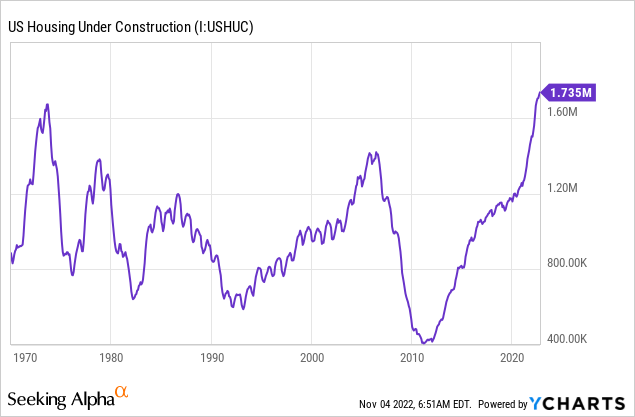
Decreased demand comes just as a tsunami of new supply is about to hit the market, with over 1.7 million privately owned homes currently under construction. This smashes the all-time record set in 2006.
The housing market was very overheated for a couple of years after the pandemic, as demand increased and rates were low. The market needs to get back into a balance between supply and demand (emphasis mine).
–Jerome Powell, Nov. 2 FOMC Meeting.
The developing crash in housing prices has profound implications for anyone looking to buy a house, as well as for investors in housing stocks. The iShares Home Construction ETF (BATS:ITB) is down a bit more than 30{d4d1dfc03659490934346f23c59135b993ced5bc8cc26281e129c43fe68630c9} for the year, but if the situation on the ground is as bad as it appears, then it might be headed a lot lower. ITB is the worst of the worst when it comes to this kind of interest rate shock, because homebuilders borrow a lot of money to build, and in turn, they sell to their customers who borrow a lot of money to buy. This crash has been a long time coming as prices got further and further from fair value. Now that huge declines are rolling down the tracks, there’s not much that can stop it. If you already own a house with a low mortgage rate and didn’t buy it during the bubble, then no worries. But if you’re looking to buy a house now, think twice!
A Tidal Wave Of Housing Supply Is Coming
1.7 million homes are presently under construction in the US, the highest level ever. The peak in 2006 was around 1.4 million homes in various stages of construction. This obscures the fact that the US population was growing by nearly 3 million people per year in 2006, whereas the population now is only growing by somewhere between 500,000 and 1 million people per year.
At the average of roughly 2.5 people per household, that implies a need for nearly 1.2 million housing units built in 2006, but only 400,000 units in 2022 if we assume we gained a million people in population. There are reasons to believe that population growth could be even lower going forward, as declining inflation-adjusted wages and declining life expectancy (coronavirus, opiates, general malaise, etc.) take their toll. With mortgages over 7{d4d1dfc03659490934346f23c59135b993ced5bc8cc26281e129c43fe68630c9} now and population growth flatlining, who is going to buy all of these homes?
Of course, there’s a continual toll of obsolescence for homes (mostly homes in rural areas and the Rust Belt where people abandon them and move to greener pastures). This is thought to be about 300,000 homes per year. All-in, demographics imply the need for around 700,000 housing starts per year. We’re adding about twice as many houses as demographics imply we need to the construction pipeline on an annualized basis.
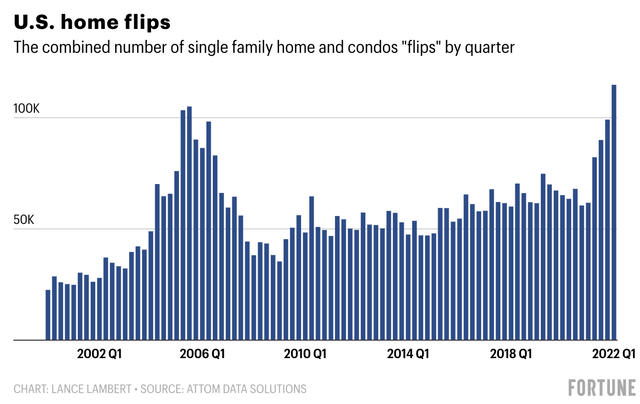
By contrast to the changing demographic picture, house flipping has been at an all-time high, with investors often selling to other investors.
Flip or Flop? (Fortune)
The Rental Market Is Reversing
Interestingly, a much higher percentage of units under construction than in the last cycle are multifamily units, either as condos for sale or apartments for rent (about 50{d4d1dfc03659490934346f23c59135b993ced5bc8cc26281e129c43fe68630c9}). Rents went crazy during COVID, but there’s actually a simple explanation for why they did, and why things may be about to reverse.
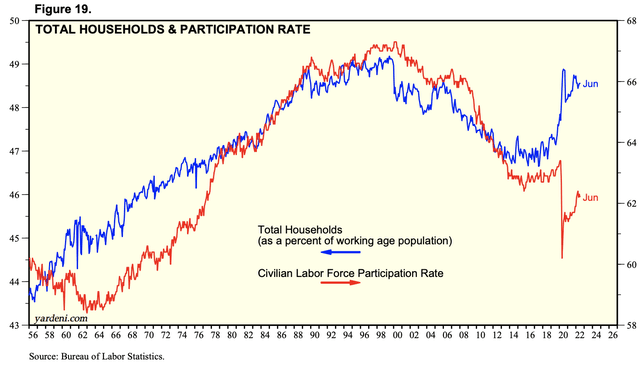
The eviction and foreclosure moratoriums allowed millions of people to live rent-free, massively choking the supply of housing while they were in effect. As I’ve written previously, the pandemic was the first time in the post-WW II era when fewer people worked but more people were occupying housing. Not normal! This is bound to revert to the mean, either millions more people are going to have to start working, or they’re not going to be able to pay rent/mortgage payments. In the vast majority of cases, people with insufficient income to support their current housing situation will just ride out their current leases and then not renew. They’ll move in with family, get roommates, or move to cheaper accommodation until supply and demand are balanced. When this data is updated next, I expect to see a lot of demand destruction.
Labor Force Participation Vs. Occupied Housing (Yardeni Research)
2. Price-fixing in the rental market. What’s not widely known is the effect that software used by large landlords may have had on the pandemic rental market. A recent class-action lawsuit alleges that a ubiquitous leasing software called YieldStar allowed large landlords to effectively form a cartel by letting a common algorithm set rental and lease renewal prices for all users. The software essentially used an algorithm to automatically coordinate pricing with thousands of other landlords, largely to avoid competing on price. Of course, the founder of YieldStar previously was forced to settle a case with the Justice Department for creating illegal price-fixing software for airlines. You can’t make this stuff up!
The evidence presented in the lawsuit is quite damning, and the fact that the main class action is being filed in Southern California means that this has the potential to be one of the largest class action payouts in US history. It’s very fashionable for people and politicians to blame rising prices on “greedy corporations,” and in many cases, it’s off-base. Here though, there’s evidence that using this software truly gave large landlords sufficient control over certain rental markets to extract monopolistic profits from tenants.
However, the theory will tell you that the free market will eventually respond to this sort of oligopoly, which is why we’re now seeing a huge boom in multifamily construction to cover for this artificial shortage. With some antitrust enforcement and letting the free market work, rents shouldactuallyfall over the next few years, which will help cool runaway inflation, albeit not nearly enough to bring inflation back to 2{d4d1dfc03659490934346f23c59135b993ced5bc8cc26281e129c43fe68630c9} by itself. In fact, asking rents have already begun falling.
The Demographic-Driven Housing Shortage Was Mostly A Myth
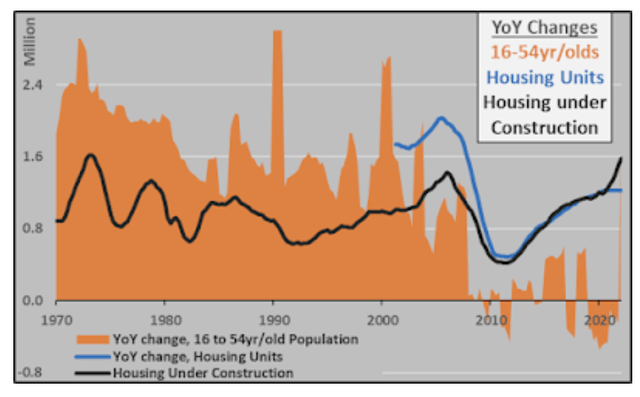
Though prices have skyrocketed, housing units per capita exceed the levels seen in 2008 in many markets. This doesn’t mean that housing isn’t scarce due to booming demand or too expensive, but what it does mean is that supply has easily kept up with demographics, albeit not speculative demand from investors, flippers, and second/third homeowners. The big spikes here below every 10 years are from one-off census adjustments, but the data shows that the US population aged 16-54 is actually falling.
Demographic Problems With Housing (Economica)
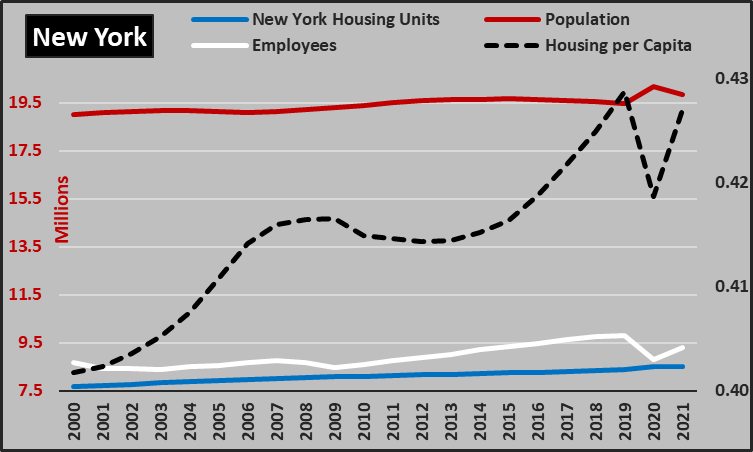
We see this when comparing the housing stock to the population. For example, construction in New York has continually increased the amount of housing stock available per capita (again note that the jagged lines in 2021 are from a census adjustment). This is the free market at work.
New York Housing Market (Economica)
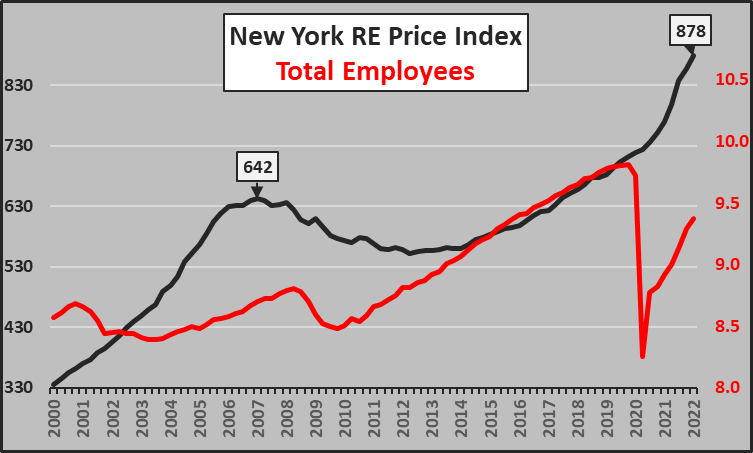
However, prices have surged, even while employment remains well below pre-pandemic levels. This is not the free market since 2019, instead, it was from interest rate suppression. Now that rates are skyrocketing, this is a huge shoe to drop.
New York Housing Market (Economica)
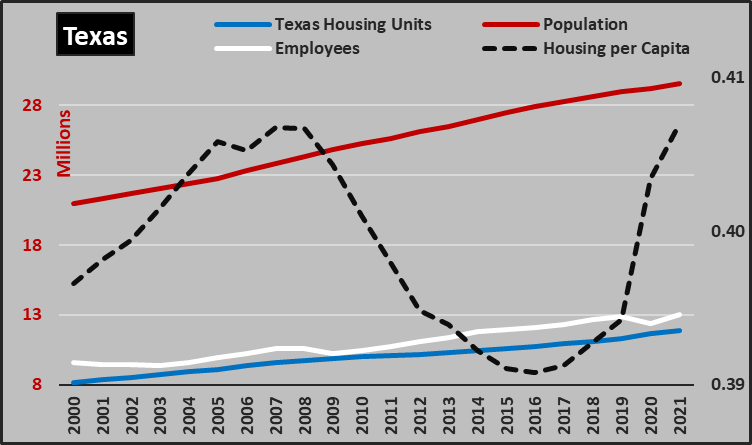
Texas also is an extremely interesting housing market to look at, because a lot of people are moving there, fueling the narrative that prices should automatically surge. But contrary to popular belief, construction in Texas has kept pace with migration trends, yet prices have skyrocketed. The most recent real-time data from Realtor.com shows that the Texas market is now among the leaders of the deepening housing market correction that started on the West Coast.
Texas Housing Market (Economica)
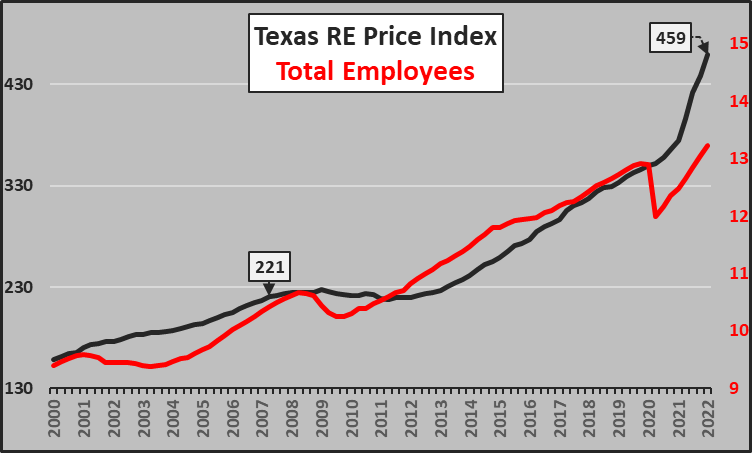
Surely prices should rise in line with supply and demand, but the degree of price rises while construction keeps pace with demographics should not happen. Note that while employment superficially looks better in Texas than in New York, median salaries are much lower while housing prices have surged far more.
Texas Housing Market (Economica)
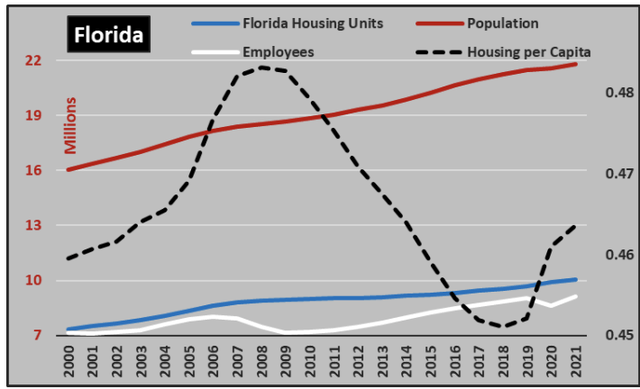
Construction hasn’t yet kept pace with migration in all markets. The author of the Economica blog noted that states like Florida, Nevada, and Washington had underlying demographic demand that could soak up homes if prices were to fall from their presently overvalued state. Still though, as hot as the real estate market is, Florida’s median income has increased something like 5{d4d1dfc03659490934346f23c59135b993ced5bc8cc26281e129c43fe68630c9} post-pandemic, while housing prices increased about 60{d4d1dfc03659490934346f23c59135b993ced5bc8cc26281e129c43fe68630c9}. Debt, debt, and more debt! Florida’s housing per capita has actually increased since bottoming in 2018 though when prices were almost half of where they are now. Also, a disproportionate amount of new housing supply will be coming online in sunbelt markets like Florida.
Florida Housing Market (Economica)
Demographic reality (i.e. wages) doesn’t square with the enormous boom in home prices, which is why many economists believe home prices are substantially overvalued. What’s really at play here is that housing prices have done nothing but go up because interest rates have done nothing but go down, fueling round after round of speculative buying.
But with an ongoing construction boom well in excess of population growth, the question is who will live in all these homes – five years from now, 10 years from now, and 30 years from now? 2008 showed that even markets with good long-term fundamentals tend to see crashes just the same because they receive a disproportionate amount of speculative investment flows. Tarrant County, in the Dallas-Fort Worth metro area, saw 52{d4d1dfc03659490934346f23c59135b993ced5bc8cc26281e129c43fe68630c9} of all home sales go to investors in 2021! That’s the height of insanity.
These figures imply that in a county with over 2 million people, less than half of homebuyers actually intended to live in the houses they were buying. This is after in the last 10 years, median income in Texas rose 29{d4d1dfc03659490934346f23c59135b993ced5bc8cc26281e129c43fe68630c9}, while the median mortgage payment on a new home purchase rose 280{d4d1dfc03659490934346f23c59135b993ced5bc8cc26281e129c43fe68630c9}. Home price gains of this magnitude are created by borrowing, not actual wealth. And while this article focuses on the US, I’d be remiss not to mention the other enormous housing bubbles globally, chiefly in Canada, Australia, and New Zealand.
The 20th Century housing market was boosted by steady population growth and a steady pace of urbanization, so prices went up. But with the process of urbanization complete in Western countries and population growth effectively at zero, continually adding supply should continually lower prices. This already has happened in parts of Europe where prices are well below 2007 inflation-adjusted peaks. In the long run, this can actually be a good thing because it means consumers get more for less, but it’s bad if you went all-in on housing with debt too early.
And Mortgage Demand Is Tanking
In the 2000s housing market bubble, America and much of the world had a cultural moment where real estate was praised as the only real way to build wealth. And after the 2008 crash, many of these same people got disillusioned and decided the juice of being a homeowner wasn’t worth the squeeze. From late 2019 to early 2022, a similar frenzy took hold. Now, demand is truly tanking again.
With mortgage rates over 7{d4d1dfc03659490934346f23c59135b993ced5bc8cc26281e129c43fe68630c9} and prices up substantially since the pandemic, this is perhaps the worst time to buy a house in our lifetimes. This comes 10 years after the best time to buy a house in our lifetimes, and likely 2-3 years before a similar time may come again. Mortgage applications are down 42{d4d1dfc03659490934346f23c59135b993ced5bc8cc26281e129c43fe68630c9} year over year. That’s simply stunning, considering how people were getting into bidding wars mere months ago.
There’s a famous economics paper from 2007 called Housing IS The Business Cycle. In it, the author argues that by setting interest rates to manage inflation and unemployment, the Federal Reserve had inadvertently inflated a housing bubble and would be forced to cause a housing bust to keep inflation from spiraling out of control. Instead, the argument is that the Fed should start hiking rates earlier in the business cycle to keep the housing market from becoming speculative chaos. Does this sound familiar at all? The key idea here: The later the Fed is in hiking interest rates (or doing quantitative tightening) during the boom, the less ability they have to help during the inevitable downturn.
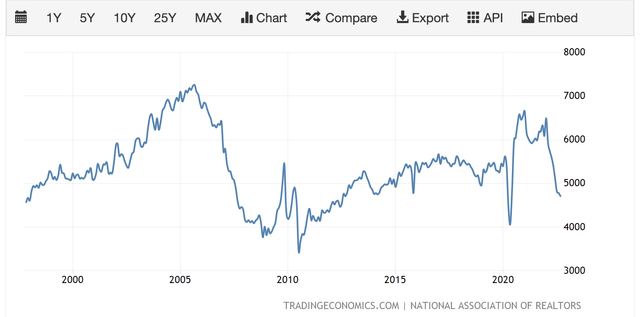
Notably, the paper was written in the middle of the 2000s crash at a point where buyers and sellers were in a similar standoff to today where sellers refused to sell and buyers could not or would not buy, so there also was a very interesting (wrong) prediction in the paper that prices would not crash but transactions would grind to a halt. Of course, prices went on shortly after to crash the most since the Great Depression. Here we are again, with leading indicators for future sales falling off a cliff.
US Existing Home Sales (Trading Economics)
One reason for this is – if I sell a house to buy another one, that’s not net housing supply. But if someone passes away and their kids put the house up for sale, or if a couple gets divorced and rents, or if investors sell because they realize that they’re not going to make money- that’s net supply. Unemployment is a huge driver of net supply over time, so if the unemployment rate begins to rise in the US, foreclosures and short sales hitting the market could have an unprecedented impact on the state of speculative demand.
The Fed May Need The Housing Market To Fall
The key difference between 2007 and now is that the Fed was far more behind the curve this time. In contrast to 2007-2008 when the government actively tried to help stabilize the housing market, the Fed is likely unable or unwilling to put a floor under housing prices, because they’re overpriced and they can’t waste money fighting the market. To this point, in light of the amount of arbitrary redistribution of wealth that the current housing boom has created, the housing market crashing from dizzying heights may be an intended feature of Fed policy, not a bug.
This isn’t my lifelong crusade. If housing prices fall 30{d4d1dfc03659490934346f23c59135b993ced5bc8cc26281e129c43fe68630c9} and you can get a mortgage under 5{d4d1dfc03659490934346f23c59135b993ced5bc8cc26281e129c43fe68630c9} (i.e. to historical norms vs. wages), I’d tell you that buying a house is a solid long-term investment. Similarly, if the stock market retreats to a more attractive valuation, you should buy it. If someone bought a house in 2017 and ends up being breakeven in price appreciation seven years later after the market crashes, that’s fine because they bought at fair prices and saved rent along the way in a similar fashion to investors getting dividends. But if someone bought a house in 2021 or 2022 for far above the house’s fundamental value, they’re in a ton of trouble, especially new construction buyers who locked in purchase prices at signing but had to wait to lock bank financing at completion (when mortgages soared from 3{d4d1dfc03659490934346f23c59135b993ced5bc8cc26281e129c43fe68630c9} to 7{d4d1dfc03659490934346f23c59135b993ced5bc8cc26281e129c43fe68630c9} or more). New buyers likely had no idea what they were getting into.
Buyers who are taking sellers’ asking prices right now are dramatically overpaying based on market fundamentals. This is why so few people are buying homes right now compared with the recent past, and why so many homebuyers are canceling their contracts with builders. Like it or not, the 21st Century real estate market has been a wild carnival ride – redistributing years and years of salary income to winners from losers. If you make a bad decision regarding housing, it can negate the earnings from a six-figure salary for a decade or longer. The market is speaking right now if you’re willing to listen, and what it’s telling you is that the unhealthy US housing market is in a twice-in-a-lifetime amount of trouble. Investors in housing-sensitive stocks like homebuilders should pay attention to the macro picture with the real estate market and consider selling their positions as well.
Bottom Line
Will this housing market crash outdo 2008? It’s yet to be seen. A key reason behind the 2008 housing crash was a rise in the rate of unemployment. If unemployment stays relatively low, then home prices may just grind downward. But if unemployment rises to 6{d4d1dfc03659490934346f23c59135b993ced5bc8cc26281e129c43fe68630c9}, 7{d4d1dfc03659490934346f23c59135b993ced5bc8cc26281e129c43fe68630c9}, or more, millions of motivated sellers will hit the market with relatively few takers due to the changing demographic reality of America and the amount of demand that was already pulled forward during the pandemic. And in 2008, houses were objectively cheap, drawing capital in from institutional investors. If home prices were to fall something 10{d4d1dfc03659490934346f23c59135b993ced5bc8cc26281e129c43fe68630c9}-20{d4d1dfc03659490934346f23c59135b993ced5bc8cc26281e129c43fe68630c9} from here, valuations would still be higher than fundamentals suggest they should be. Those declines would only take us back to 2021 prices, with rates dramatically higher. For these reasons, it’s very possible for this crash in housing prices to exceed 2008’s in magnitude.
Need to I wait for actual estate costs to crash prior to I buy a home? Here are 3 easy causes why this housing downturn is nothing at all like 2008
Two decades in, this 10 years has by now introduced a world pandemic, file-setting inflation, growing fascination charges and a region additional divided than at any time just before.
So why not a housing crash way too?
Americans who lived by means of the 2008 crisis may be looking at the crimson-incredibly hot sector beginning to awesome and receiving flashbacks. And for potential house owners, it may well be appealing to set your ideas on pause till the market bottoms out so you can snag a home at a good selling price.
But gurus say there are great causes to believe that that nonetheless this shakes out, it will not be a return to 2008 — which will no doubt be a reduction to any one whose apple bottom denims and boots with the fur have been lengthy place away in storage.
Really do not miss out on
1. Creditors stopped remaining so lax
Blame it on the banking companies. A enormous contributor to the housing crisis in 2008 was dicey lending methods inside the monetary business. Years of deregulation created it much easier — and more profitable — to hand out dangerous loans.
The Dodd-Frank Act, which was signed into legislation in 2010 aimed to stop that by rising oversight in the business.
Though the act’s effectiveness has been termed into concern over the many years, it has without doubt compelled lenders to be stricter about their lending methods, which indicates far much less borrowers are most likely to land in hot water.
The median credit history score of freshly originated home loans was 773 in the 2nd quarter of the year, according to the Federal Reserve Bank of New York. But 65{d4d1dfc03659490934346f23c59135b993ced5bc8cc26281e129c43fe68630c9} of new house loan holders had a credit rating of 760 or a lot more.
The New York Fed extra in its quarterly examination that, “credit scores on newly originated mortgages stay incredibly significant and mirror continuing significant lending specifications.”
2. Homeowners are performing good
The onset of the pandemic could have been catastrophic for the housing market place if thousands and thousands of house owners had no choice but to default on their loans.
The good news is, mortgage forbearance programs allowed struggling debtors to pause their payments till they could get back on their feet. And it labored: by the conclusion of June, the share of home loan balances 90-furthermore days earlier due remained at .5{d4d1dfc03659490934346f23c59135b993ced5bc8cc26281e129c43fe68630c9} — a historic reduced.
And when compared to 2010, when delinquencies on solitary-spouse and children residences strike a 30-calendar year substantial of 11.36{d4d1dfc03659490934346f23c59135b993ced5bc8cc26281e129c43fe68630c9}, the level was just 2.13{d4d1dfc03659490934346f23c59135b993ced5bc8cc26281e129c43fe68630c9} in the first quarter of 2022.
On leading of that, climbing residence prices has translated into enhanced fairness for homeowners. In whole, home finance loan holders now have $2.8 trillion additional in tappable fairness in contrast to a year in advance of, in accordance to Black Knight, a property finance loan engineering and info company. That is a 34{d4d1dfc03659490934346f23c59135b993ced5bc8cc26281e129c43fe68630c9} maximize and much more than $207,000 in extra available equity for every borrower.
3. There’s even now plenty of supply
“It’s not normally as easy as supply and desire — but it pretty much always is,” host Dave Ramsey said on The Ramsey Present previous thirty day period.
Ramsey states the important issue in 2008 was there was a “tremendous oversupply for the reason that foreclosures went in all places and the sector just froze.” The crisis wasn’t down to the economic climate or curiosity rates, it was “a actual estate worry.”
In comparison, now, there’s a substantial need and a shortage of offer. But the Federal Reserve’s attempts to dampen demand by elevating fascination fees is beginning to function. And new housing is setting up to slowly but surely arrive on the marketplace as well.
What Ramsey says we’re seeing now is a softening in the rate of maximize of prices, but he doesn’t foresee they’ll go down like they did in 2008.
What to go through up coming
Signal up for our MoneyWise investing e-newsletter to acquire a continuous move of actionable concepts from Wall Street’s top companies.
If your retirement strategies have been thrown off by inflation, here’s a strain-free way to get again on observe
‘There’s generally a bull industry somewhere’: Jim Cramer’s well-known text counsel you can make money no make a difference what. In this article are 2 highly effective tailwinds to consider benefit of today
This posting provides facts only and must not be construed as suggestions. It is delivered without having warranty of any sort.
The United States has professional an unparalleled housing boom triggered mostly by the Covid pandemic. Need for properties in particular marketplaces improved exponentially particularly as organizations loosened or eliminated procedures about the place employees had to work from.
Clearly, lots of New Yorkers decided that having to pay Manhattan (or even Queens or Very long Island) prices produced no feeling when they could go to Florida. In truth, a amount of Wall Avenue corporations took workplace house in southern Florida cities together with Miami, Fort Lauderdale, and West Palm Beach front.
That led to exploding prices in those marketplaces because someone advertising a Manhattan one-bedroom for $500,000 thinks they’re finding a deal when that similar dollar figure buys you a two, or even three bed room in a single of individuals Florida metropolitan areas.
The influx of New Yorkers had a ripple impact pushing locals farther north or even into Central Florida. Both of those of those people markets noticed will increase, but not nearly at the tempo of the value development in Southern Florida. Even though New York briefly observed charges stagnate, that turned close to when pandemic-related constraints eased because even though there ended up doom and gloom predictions about New York (and other huge metropolitan areas) they continue being massive attracts.
But, with home loan fees at the greatest they have been in decades (though nevertheless traditionally lower) some have been questioning regardless of whether the housing market will crash.
Is There a Housing Bubble?
Frequently, true estate is neighborhood, not nationwide. That was not the scenario in 2008 when the housing marketplace crashed since the financial system went south and a good deal of persons could not pay mortgages that they possibly under no circumstances really should have been presented in the to start with put.
That is basically not the situation now. Home selling prices may settle down in certain marketplaces as need softens or source boosts, but there does not seem to be a countrywide catalyst like we had in 2008 that would bring about a common housing bubble to burst.
Price ranges, nevertheless, have been large, and could fall in some marketplaces.
“Prices are up sharply fairly considerably everywhere. Moody’s household selling price index shows a 32{d4d1dfc03659490934346f23c59135b993ced5bc8cc26281e129c43fe68630c9} increase in charges nationally in excess of the earlier two yrs. The Nationwide Affiliation of Realtors studies an even even larger boost of 39{d4d1dfc03659490934346f23c59135b993ced5bc8cc26281e129c43fe68630c9},” NPR described.
Scroll to Proceed
Economists informed the information group that costs could fall in the most “juiced-up” marketplaces.
“I be expecting selling prices to arrive down,” Moody’s Analytics Main Economist Mark Zandi told NPR. “”If you instructed me two many years from now, prices are 5, 10, 15{d4d1dfc03659490934346f23c59135b993ced5bc8cc26281e129c43fe68630c9} under in which they are these days wherever they’re peaking, I might say that appears about suitable to me.”
A Dip Is Not a Crash
Rates cooling off is not the very same as as housing sector crash. Housing selling prices have continued to rise, in accordance to an write-up created by TheStreet’s Dan Weil.
“As for dwelling costs, the Case-Shiller Home Cost index jumped 19.8{d4d1dfc03659490934346f23c59135b993ced5bc8cc26281e129c43fe68630c9} in the 12 months by means of February,” he wrote. “On the curiosity-level entrance, the 30-calendar year mounted-price house loan averaged 5.3{d4d1dfc03659490934346f23c59135b993ced5bc8cc26281e129c43fe68630c9} in the week finished May possibly 12, the greatest considering that July 2009, in accordance to housing agency Freddie Mac. That compares to 5.27{d4d1dfc03659490934346f23c59135b993ced5bc8cc26281e129c43fe68630c9} a week previously and 2.94{d4d1dfc03659490934346f23c59135b993ced5bc8cc26281e129c43fe68630c9} a yr before”.
And though the market place may interesting, a new report from J.P, Morgan indicates it will be scorching marketplaces cooling down, similar to how Moody’s Analytics explained a achievable correction.
In this analysis report, we emphasize distinct pockets of overheating in in-depth information on U.S. counties. For example, substantial selling prices, irrespective of growing supply, these as in Denver, Seattle, Washington, D.C., Portland, Oregon, and Boston suggest some correction hazard in J.P. Morgan’s models. Cities with staggering significant costs, this kind of as New York Metropolis and the San Francisco Bay Location, propose some opportunity of correction even with constrained supply. But there is at this time no place with the exact mix of swift cost growth, fast personal debt expansion, and expanding offer viewed in some locations in 2006.
That would make sense given where by charges are on a historic basis. “The nationwide nominal residence price tag index is now 40{d4d1dfc03659490934346f23c59135b993ced5bc8cc26281e129c43fe68630c9} over its 2012 low-point and 4{d4d1dfc03659490934346f23c59135b993ced5bc8cc26281e129c43fe68630c9} earlier mentioned the peak arrived at in 2006,” according to J.P, Morgan.
An close to new highs and some marketplaces slowing down does not equate with what occurred in 2008. And, if the market place cools a small, that could convey in extra customers who experienced opted to remain on the sidelines.
Limited supply is the major offender of Increased Boston’s slowdown in residence revenue, but economic and geopolitical stress overseas are however areas of problem, actual estate and financial specialists advised Boston.com this week.
But the slowdown in gross sales doesn’t have area economists fearful of a marketplace crash reminiscent of the Good Recession, in particular as a lot of rules enacted since then reduce the kind of free credit score offered in the run-up to the 2007-2008 economic crisis.
There are financial problems surrounding issues like ongoing supply chain challenges bumping out construction timelines, as very well as the Russian invasion of Ukraine, which can drive up electrical power prices and theoretically elevate construction selling prices in the procedure. Rising interest charges to battle inflation can also dampen home customer desire, as property finance loan prices bounce.
“It continues to be to be found how lengthy prospective buyers can climate this storm and how extended house owners will enjoy values increase in advance of choosing to listing,” Nicole Bachaud, an economist with Zillow, explained. “Neither have blinked however, but anything has to give at some point.”
But that won’t necessarily translate into a bust in Boston. Economists usually see the region’s financial state — backed by bigger instruction, wellbeing treatment, and lifestyle sciences, industries that usually depend on in-particular person operate — as a basic safety web towards boom-and-bust instances.
‘Would it surprise me if there was a correction? No. Would it shock me if we saw a bust that was definitely huge? Certainly.’
— ADAM GUREN, associate professor of economics at Boston University
“The Boston area has a large amount likely for it,” claimed Timothy Warren, CEO of The Warren Team, a data analytics business and publisher of Banker & Tradesman. “It would be really hard to tough to bet from it with the universities, the younger men and women that insert a vibrancy and an entrepreneurial spirit and everything else.”
Irrespective, property gross sales ended up basically flat very last year for Massachusetts and were being even on the drop for the back half of the yr, according to Warren Team details, but economists be aware this has a lot less to do with indications of financial worry and more to do with essentially no new source throughout the industry. Median dwelling price ranges still rose approximately 14{d4d1dfc03659490934346f23c59135b993ced5bc8cc26281e129c43fe68630c9} in 2021 and elevated about 11{d4d1dfc03659490934346f23c59135b993ced5bc8cc26281e129c43fe68630c9} 12 months about yr in January.
Connected The common Mass. home offered for underneath $500,000 in January — probably for the final time
“The key motive for high dwelling prices is economics 101: provide and need,” Bachaud claimed. “Inventory is decreased than at any time, and demand is sky-large as millennials have aged into peak household-acquiring many years and the uptick in remote get the job done has offered several People much more versatility in their residing conditions and a will need for more space. There have not been many symptoms the market place will sluggish, and in fact it is essentially heating up previously in the year than common.”
The inventory of available residences for sale in the Boston metropolitan space is down 24.3{d4d1dfc03659490934346f23c59135b993ced5bc8cc26281e129c43fe68630c9} due to the fact December and 43.6{d4d1dfc03659490934346f23c59135b993ced5bc8cc26281e129c43fe68630c9} underneath January 2020 stages, in accordance to Zillow details. And the stock of new houses hitting the market place in January was down 25.5{d4d1dfc03659490934346f23c59135b993ced5bc8cc26281e129c43fe68630c9} from two decades back and 25.2{d4d1dfc03659490934346f23c59135b993ced5bc8cc26281e129c43fe68630c9} under December’s count.
January had the least expensive amount of one-loved ones houses and condos out there for sale throughout all of Massachusetts because the Massachusetts Affiliation of Realtors began tracking the facts in 2004.
“It’s really slender pickings,” Warren reported. “Some questions about affordability make it seem to be to me as however [2022 will] be a junior edition of past yr.”
Cameron Sperance can be achieved at [email protected]. Subscribe to the Globe’s totally free real estate newsletter — our weekly digest on buying, marketing, and design — at pages.email.bostonglobe.com/AddressSignUp. Abide by us on Fb, Instagram, and Twitter @globehomes.