
News
Can a building improve your overall well-being? That’s the big idea behind the developer’s latest project.
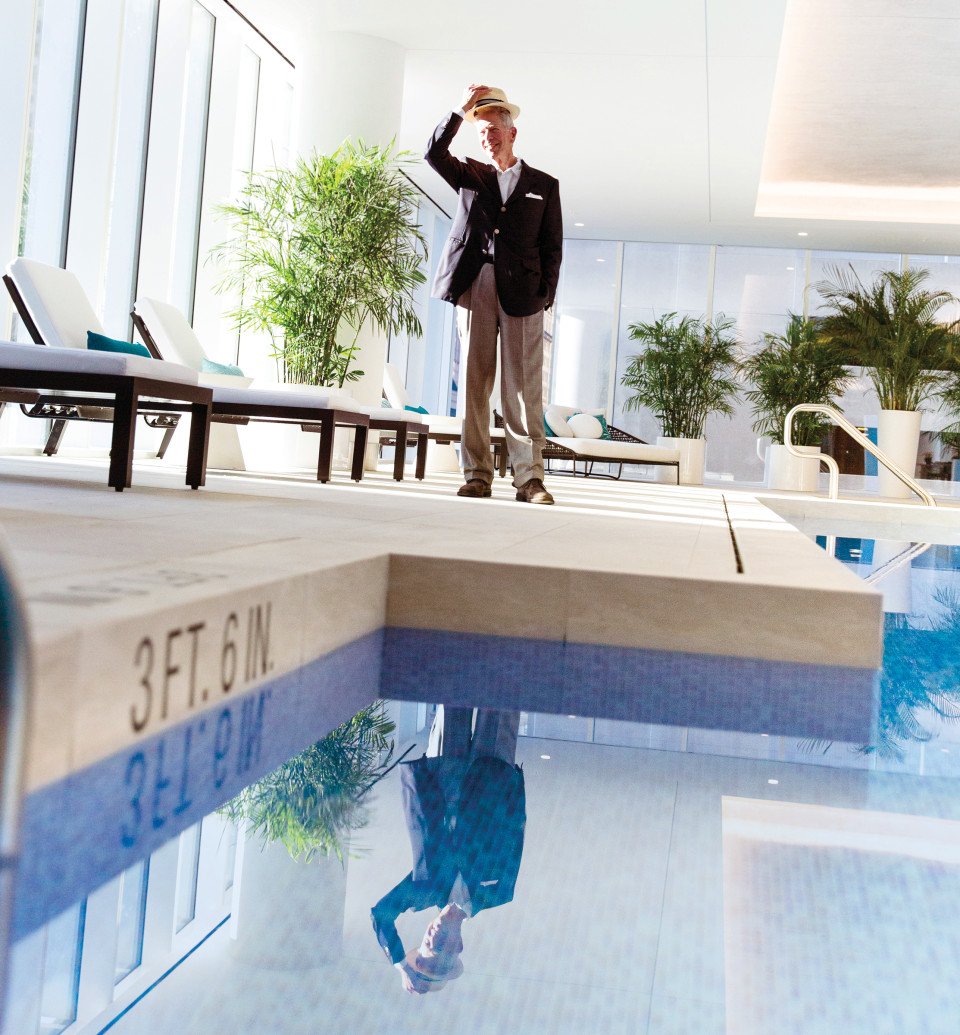
Carl Dranoff by the pool at Arthaus / Photograph by Bryan Sheffield
I can tell something is bothering Carl Dranoff.
The developer is alternately tapping and rubbing his left thumb with his right as he sits on a low, curved blue velvet couch. The soft charcoal suede of his wingtips offsets the slightly metallic gray diagonally striped slacks he’s wearing. His navy blazer has silver buttons, and its left sleeve stops at a stainless steel Rolex Submariner. Black and silver sunglasses rest to his right, on the cushion of the couch. A black-and-white pin-striped hatband circles the fedora on his head.
Each article of clothing complements the gray of his eyes and, taken in total, makes Dranoff seem an extension of the curated interior of Arthaus, his latest luxury residence project, which broke ground in 2019, welcomed its first buyers this July, and just had its grand opening.
We’re sitting in the lobby in May as the elevators are being inspected for fire safety. He should be pleased, but right now, he’s almost imperceptibly irked, and the shrieking alarm emanating from the elevator bank seems to be the cause. It’s shrill, yes, but his irritation goes beyond that. Each bleat shatters an otherwise perfectly crafted sense of serenity. When the alarm abruptly shuts off, Dranoff stops tapping his thumb, and his manner lightens.
“I designed Arthaus for people like me, people who want to live in the city, in close proximity to the arts. This project sets the table for everything happening in the future of real estate here in Philadelphia,” he says.
Arthaus is 47 stories of glass, concrete and steel springing from the corner of Broad and Spruce. It’s on the part of Broad Street willed into existence as the Avenue of the Arts back in 1993 by then-mayor Ed Rendell. It’s across the thoroughfare from the glass majesty of the Kimmel Center for the Performing Arts, for which it’s meant to serve as a funnel, the developer’s bet for bringing Main Line residents to Center City and money to Philadelphia’s arts corridor. And it’s something of a capstone to the vision of the avenue that Dranoff embarked upon in 2005 when he broke ground on Symphony House just down the way.
In the lobby, he tells me about the architects who bid on the project and that from among the many “trophies” he could have selected (Frank Gehry, ahem), he chose the global architectural mega-firm of Kohn Pedersen Fox Associates (KPF). Because, he says, Gene Kohn grew up a few blocks from this three-quarter-acre lot that once housed the legendary Philadelphia International Records.
He points to an arrangement of history-themed tchotchkes hung on the wall, with a framed photo of the iconic record-label building in the upper right. Dranoff, who grew up in Oxford Circle and went to Drexel as an undergrad (before Harvard Business School), specialized in rehabbing large-scale historic buildings early in his career, and this careful arrangement is his nod to his latest landmark’s heritage.
On its own, Arthaus is a painstakingly curated luxury residential real estate project. (The plinth blocks joining the baseboard to the door casings in the interiors, for instance, complement the exterior of the building.) The largest unit money can buy is priced just above $15 million. The smaller ones start at $2 million, with a range of price points in between. This, for anyone unfamiliar with Carl Dranoff properties, is what Carl Dranoff does.
But there’s something else going on here.
Among Arthaus’s less obvious features is that it’s been designed to maximize the benefits of natural light, fresh air and nature. It’s built to house healthy spaces inside without gobbling up all the real estate outside.
Compare it to major lifestyle real estate projects in the surrounding ’burbs and in nearby cities. This development doesn’t follow the ground-floor-retail-and-gym-with-units-above format. Arthaus doesn’t aim to increase foot traffic; the area already has plenty of that. Instead, Dranoff has created a community where just about everything anyone would ever need to feel centered and calm is already inside.
This latest project is his grandest of four on Broad Street, with at least two more in the works. But it’s also something of a new chapter for the 74-year-old developer.
In 2018, the Global Wellness Institute, a wellness-advocacy nonprofit, predicted that real estate designed to enhance the holistic health of the consumer would grow rapidly with the burgeoning wellness economy. Four years and one pandemic later, the wellness real estate sector is booming and has landed firmly in Center City.
What Arthaus brings to this corner of Broad Street isn’t just potential arts patrons. It’s part of an emerging trend that aims to provide buildings that enhance their residents’ health. With Arthaus, Dranoff just may be adopting a new mantle: wellness icon.
•
The building is Dranoff’s homage to light. I’m on the sixth floor, following him down a long, narrow hallway. The corridor is papered in Prussian blue, textured with a silvery crosshatch. Saturated photos of botanical gardens surrounded by crisp white matting stand out against all the blue and reflect the energy of the light that streams in from the windows, which are everywhere.
The hallway brings us to a 25-meter pool in a room that’s entirely encased in vertical panes of glass. The light bouncing off the water fills the room with a vapor glow. The windows look out over the city, but I can only see the sky. Dranoff calls this “a place of repose.”
“During the pandemic, people in cities felt like they had to escape — felt like they had to go to a suburban area or get out of the city,” he says. With Arthaus, he wanted to embed those amenities that people had sought out elsewhere: “You can enjoy serenity and greenness and wellness here. It is the antidote to that feeling of needing to escape.”
The wild real estate market of the past few years has been driven by a lockdown-created desire to feel … differently about our lives and our homes. According to the 2022 World Happiness Report, an annual survey of how people evaluate their own lives in 150 different countries, feeling happy is currently more important to people than income. And according to a 2022 report by market research firm Technavio, what wealthy home buyers are seeking to feel is “mental clarity.”
But how do you design for happiness, for mental clarity? In this shiniest of new projects, Dranoff is dipping into something timeless.
“Before there was air conditioning, buildings had to have cross-ventilation, and factories had enormous windows because they had to get light and air in,” he tells me. “I learned how to use light because I used to rehab historic buildings. Light is health; light is the sun. So that’s issue number one. Number two is having outdoor spaces.”
We head to the 19-plot planting garden and greenhouse, passing the standard amenities that most luxury real estate high-rises now offer — steam rooms, saunas, the ubiquitous demonstration kitchen. There’s a private salon at one end of the hallway that residents can invite their stylists in to use. It’s got pink walls and white porcelain, with gold fixtures and natural light, and everything sparkles. I laugh spontaneously upon stepping inside. It’s made me feel something, even if I can’t quite say what or why.
“That’s Carl’s magic. You can evoke emotional responses — there’s no doubt that something happens through a combination of light and color and formal design,” says Josh Chaiken, the design principal at KPF who led the design team during the Arthaus project. “When I was in architecture school, I read The Poetics of Space” — a 1958 book by French philosopher Gaston Bachelard on awareness of one’s home environment. “I think ‘engineering’ sounds too precise, but you can evoke a response through the use of light and color.”
But elevating those emotional responses is an art. “I don’t know if you can engineer happiness,” says Julia Dranoff, Carl’s daughter, who’s the managing director and chief operating officer of Dranoff Properties, and who selects the interior finishes for all of his projects. “I think that feeling comes from my father’s 40-plus years of consistently designing the next better space. How can we learn from something we saw in another city, or a trend we’re seeing?”
And the thinking behind Arthaus ties in all of that prior learning and adapts it to some of the stressors made plain by the past few years.
“I built Arthaus to offset the sensory overload of modern living, so returning home feels restorative and centering — a world away yet steps from it all,” says Dranoff. “Developing beautiful living environments that positively affect mood and erase lines between indoors and outdoors, as we did with Arthaus, will be the continued focus of Dranoff Properties.”
•
In 2020, two years after the Global Wellness Institute predicted its ascendance, wellness real estate was a full-blown economic sector — and one rapidly gaining market share. Unlike most areas of the wellness economy, wellness real estate took off in the pandemic, growing to a $275 billion market during the COVID fugue. Between 2020 and 2025, wellness real estate is expected to increase its market share by $434 billion.
Forecasters in this space are following eight firms around the world that are driving the wellness real estate trend. Of those, the three producing residential real estate developments are located in Copenhagen, Kuala Lumpur and Tokyo. They’re designing the sort of stuff that trend forecasters look to and early adopters love, a.k.a. weird shit. This particular weird shit includes detached monastery-inspired communities, a conceptual park “brand” (whatever that is) based on small-animal sightings, and a senior-living high-rise centered on leisure and health (which, okay, sounds less weird). Against the wild nature of this group, Arthaus is either an anomaly or a peek 10 years into the future at what these concepts might look like as they reach mass adoption.
That’s the context in which Dranoff is bringing this global wellness trend to Philadelphia, a place that, like other major cities, has some decisions to make regarding what kind of city it will be — can be — in a post-pandemic world. Many developers see the incredible desire American consumers have right now for a sense of well-being and think it can be filled with conspicuous luxury or rooms full of fad amenities. It’s true that Dranoff’s residences fall squarely in the luxury market, and yes, they have tons of amenities. But he insists he’s not trying to use those to sell happiness or capitalize on the desire to be healthy. He feels he arrived here organically.
“You have to design from the inside out. You talk about mental health — the social fabric of a community — and connection becomes the basis for social interaction,” says Dranoff. “Isolation was an issue in the pandemic, and people were cut off from each other.” At Arthaus, “Socialization is the designed-in component.”
Maybe the fact that Dranoff lives in his building matters. “You don’t [often] get a developer who lives in the building they built, because they have to hear all the problems,” Philadelphia City Councilmember Mark Squilla says of Dranoff. “Once he makes a promise to the community — whether it’s lighting or landscaping, trees on the little street behind Arthaus — he does it. He does it because he still lives in that neighborhood.”
While luxe amenities are to be expected in condos that start at $2 mil, Arthaus could offer a template for wellness in communities and the built environment that doesn’t require quite so hefty a down payment. If light, ventilation and color are inexpensive and make people feel at ease, can’t they be employed in environments that more of us can afford?
“We build hospitals this way — with an emphasis on color, lighting and layout and appreciation for the well-being of our patients and our staff,” says Madeline Bell, president and CEO of Children’s Hospital of Philadelphia, where Dranoff is a member of the corporate council. “At Arthaus, there are a number of things that promote well-being and fitness. It definitely produces a feeling. It makes sense that there’s a future for real estate in holistic health.”
Every child’s hospital room at CHOP has natural light, Bell says. “And we put natural light in the emergency-department rooms in the hospital we just built in King of Prussia. Light grounds people, and they’re able to see the changes in the time of day. Light brings optimism and hope — and those are the types of feelings that help healing.”
While you can’t fix the world, or a city, with hope and optimism alone, you can design with an understanding of how to foster those feelings. Dranoff, a man responsible for numerous notable buildings in Philly’s skyline, tells me, “The development or the building is often looked at from the exterior, not the interior, position. There’s no requirement to imagine yourself in the space.” That flaw extends beyond individual buildings: “I’m talking about cities here, on a large scale. Good quality of life inside creates thriving communities.”
It’s something policy makers, leaders and developers should keep in mind as Philadelphia evolves out of the pandemic, and as Center City continues to emerge as something similar to but not quite the same as what it used to be.
William Penn was America’s first real estate developer. He planned Philadelphia as a brand-new city, with five large squares. It boasts two riverfronts; residents can walk everywhere. There are plenty of opportunities for those places of repose that are so important to Dranoff. Whether he and Arthaus inspire a broader move toward wellness-focused development in the city and beyond — or whether this trend will fade with COVID — remains to be seen. But a kick-start to well-being would feel very much in line with what Penn, whose statue above City Hall you can see from Arthaus’s north-facing units, envisioned centuries ago.
Published as “Here’s to Your Health” in the October 2022 issue of Philadelphia magazine.


