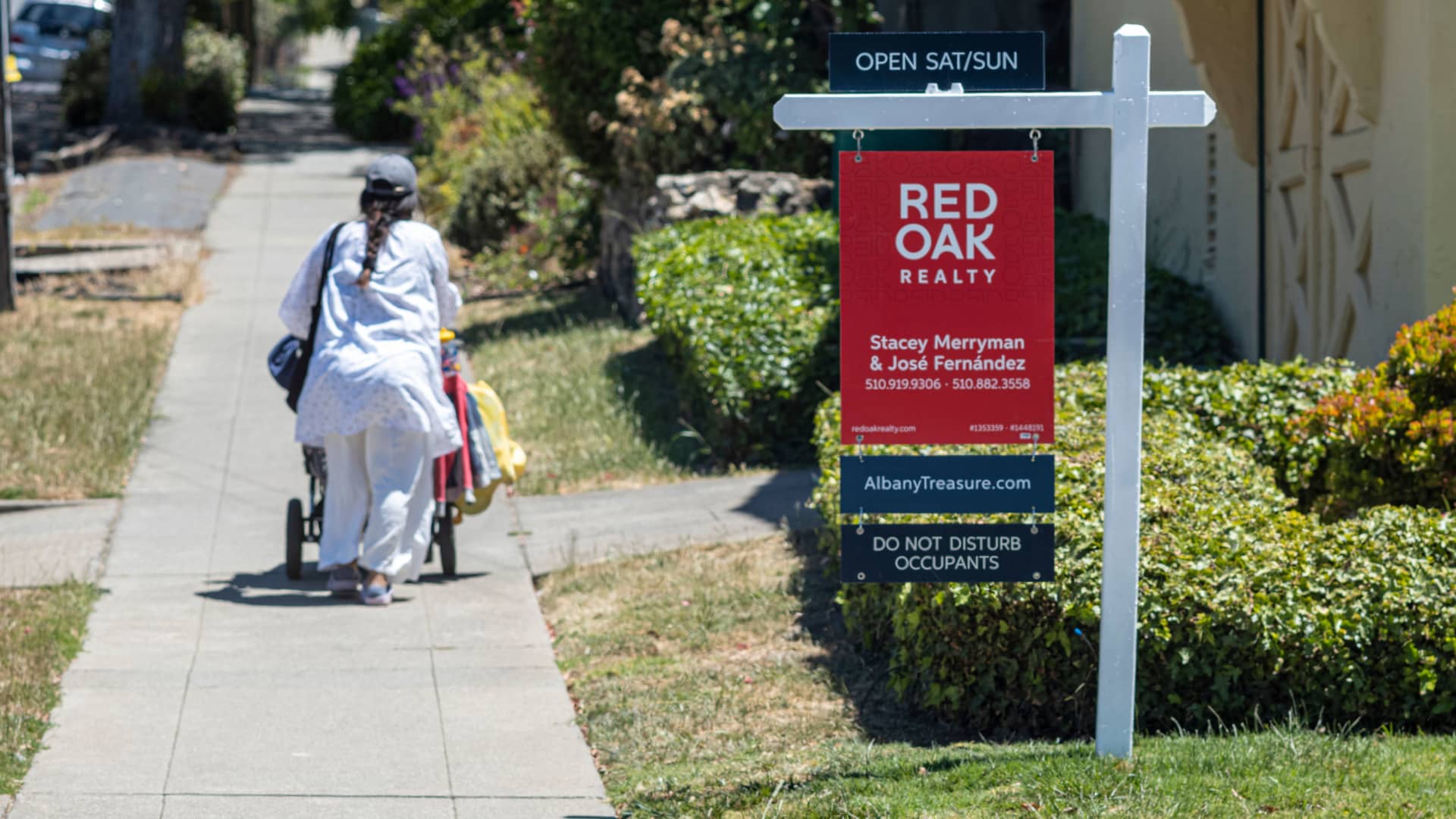
A “For Sale” sign outside a home in Albany, California, on Tuesday, May perhaps 31, 2022.
David Paul Morris | Bloomberg | Getty Visuals
Some householders are dropping wealth as significant property finance loan prices weigh on property values, at least on paper, as the once pink-sizzling housing sector cools promptly.
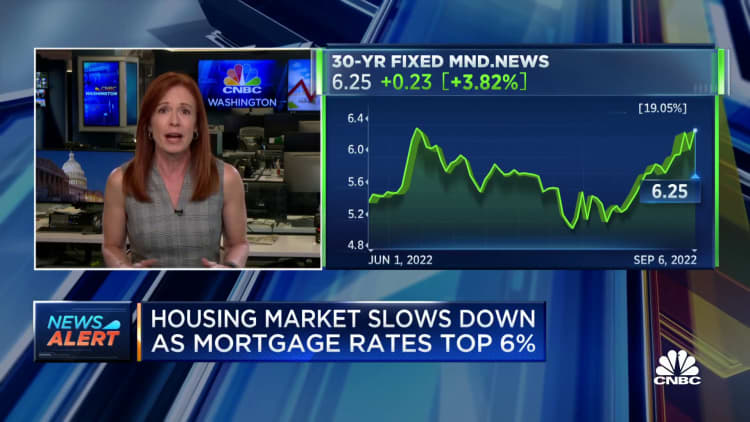
Revenue have been slowing down for numerous months, with house loan costs now double what they ended up at the start of this 12 months.
House charges, similarly, dropped .77{d4d1dfc03659490934346f23c59135b993ced5bc8cc26281e129c43fe68630c9} from June to July, according to a recent report from Black Knight, a computer software, details and analytics corporation. Although that may perhaps not sound like a ton, it was the major regular monthly drop because January 2011 and the very first regular monthly fall of any dimensions in 32 months.
“Yearly dwelling rate appreciation even now arrived in at about 14{d4d1dfc03659490934346f23c59135b993ced5bc8cc26281e129c43fe68630c9}, but in a sector characterized by as much volatility and quick improve as present day, this sort of backward-on the lookout metrics can be deceptive as they can mask far more existing, pressing realities,” wrote Ben Graboske, president of Black Knight Knowledge & Analytics.
Read through a lot more authentic estate coverage
Around 85{d4d1dfc03659490934346f23c59135b993ced5bc8cc26281e129c43fe68630c9} of major marketplaces have noticed selling prices come off peaks by means of July, with just one-third coming down a lot more than 1{d4d1dfc03659490934346f23c59135b993ced5bc8cc26281e129c43fe68630c9} and about 1 in 10 falling by 4{d4d1dfc03659490934346f23c59135b993ced5bc8cc26281e129c43fe68630c9} or far more. As a final result, soon after gaining trillions of bucks in property equity collectively through the to start with two several years of the Covid pandemic, some house owners are now shedding fairness.
So-identified as tappable fairness, which Black Knight defines as the sum a homeowner can borrow versus even though trying to keep a 20{d4d1dfc03659490934346f23c59135b993ced5bc8cc26281e129c43fe68630c9} equity stake in the assets, strike its 10th consecutive quarterly document high in the second quarter of this yr at $11.5 trillion. But data suggests it may well have peaked in May possibly.
Declining house values in June and July introduced the complete quantity of tappable equity down 5{d4d1dfc03659490934346f23c59135b993ced5bc8cc26281e129c43fe68630c9}, and offered the weakening in the housing market considering the fact that then, the third quarter of this calendar year will demonstrate a a lot more sizeable decrease.
“Some of the nation’s most equity-rich markets have viewed considerable pullbacks, most notably amid vital West Coast metros,” pointed out Graboske.
From April by way of July, San Jose, California, shed 20{d4d1dfc03659490934346f23c59135b993ced5bc8cc26281e129c43fe68630c9} of its tappable equity, followed by Seattle (-18{d4d1dfc03659490934346f23c59135b993ced5bc8cc26281e129c43fe68630c9}), San Diego (-14{d4d1dfc03659490934346f23c59135b993ced5bc8cc26281e129c43fe68630c9}), San Francisco (-14{d4d1dfc03659490934346f23c59135b993ced5bc8cc26281e129c43fe68630c9}) and Los Angeles (-10{d4d1dfc03659490934346f23c59135b993ced5bc8cc26281e129c43fe68630c9}).
House owners are nonetheless considerably a lot more flush than they have been the previous time the housing industry went by way of a big correction. All through the subprime mortgage crash, which began in 2007, and the subsequent Excellent Recession, dwelling values plummeted by virtually half in some significant marketplaces. Hundreds of thousands of debtors went underwater on their mortgages, owing a lot more than their households have been worthy of.
That is not the scenario right now. Latest debtors, on normal, owe just 42{d4d1dfc03659490934346f23c59135b993ced5bc8cc26281e129c43fe68630c9} of their home’s value on the two first and 2nd home loans. It is the most affordable leverage on record. Shedding some value on paper should not impact all those entrepreneurs at all.
There are, nonetheless, about 275,000 debtors who would tumble underwater if their households ended up to get rid of 5{d4d1dfc03659490934346f23c59135b993ced5bc8cc26281e129c43fe68630c9} of their current benefit. A lot more than 80{d4d1dfc03659490934346f23c59135b993ced5bc8cc26281e129c43fe68630c9} of all those borrowers acquired their properties in the 1st six months of this calendar year, which was the top of the market.
Even with a common 15{d4d1dfc03659490934346f23c59135b993ced5bc8cc26281e129c43fe68630c9} drop in charges, destructive equity costs would continue to be nowhere close to the concentrations noticed throughout the monetary crisis, according to the report.
The checklist of concerns can be very long when getting an revenue house in the Puget Seem area. Regardless of whether it is a multifamily, small professional or combined-applied home, earnings house buyers must realize the dangers and benefits that come with this precise kind of purchase. If that weren’t sufficient, the math on investments is transforming as The Federal Reserve proceeds to elevate fees in response to inflation and other financial inputs.
There is no concern that as the premiums for conventional mortgages are on the rise, even the boldest profits assets investors are sensation cautious about the sector.
Earnings assets traders will need not be fearful nonetheless, as the correct established of strategic resources can support make the very best of their investments. Especially for those in the sector to make investments in 1 – 4 household properties – single relatives residences, duplexes, triplexes and fourplexes – there are nevertheless competitive methods to finance your financial investment devoid of paying quality premiums.
A single consideration is the Adjustable-Amount Mortgage loan (ARM). As common rates continue on to increase, quite a few are turning to ARMs mainly because of the decreased fees they supply for a mounted time period of time – normally 5, 7 or 10 yrs – when compared to a standard 30-12 months fixed home finance loan.
Not all ARMs are designed equivalent, nevertheless, and earnings home buyers should really take into consideration some standard advice to get the most from their strategic investments.
3 key tactics for getting the most out of your ARM
Comprehend your lender’s curiosity level ceiling
A nicely-acknowledged hazard of ARMs is that at the end of the set-charge time period, ARM financial loans are matter to price changes, which can be significantly better than the first ARM level.
There is a large range of alternatives for how a loan provider will increase fascination premiums after the preliminary fastened period is full, in addition to how much the rate can change about the overall lifetime of the personal loan. Some banking companies let a modest raise at original adjustment, although some others may possibly default to an first maximize up to the lifetime cap. The life span cap is the utmost curiosity amount permitted on an adjustable-price home finance loan, which most lenders set at 5{d4d1dfc03659490934346f23c59135b993ced5bc8cc26281e129c43fe68630c9} or 6{d4d1dfc03659490934346f23c59135b993ced5bc8cc26281e129c43fe68630c9}.
Appear for a bank that keeps the preliminary adjustable desire amount ceiling lower. For illustration, some creditors cap the optimum mortgage charge boost to 2{d4d1dfc03659490934346f23c59135b993ced5bc8cc26281e129c43fe68630c9} right after the original fixed period.
Get a obvious see of pre-payment penalties
Typically situations with an ARM, traders choose to pay off their home loan early to acquire advantage of small set desire fees. If a bank loan is paid out off or refinanced in the course of the prepayment penalty period of time, traders could owe extra expenses or a penalty, which is ordinarily a proportion of the remarkable personal loan equilibrium.
Some lenders provide pricing alternatives that do not incorporate prepayment penalties. Acquire the time to comprehend your bank’s approach to pre-payment penalties in their loan agreements. If they only offer prices with a pre-payment penalty, traders have alternatives and really should search for a lending establishment that has options for penalty-free pre-payment of their loan.
Assess community and larger lending institutions
Huge, nationwide banking institutions and loan providers can contend in the consumer lending market with attractive fees. But neighborhood banking institutions, like Pacific Crest Financial savings Lender and others in our region, give a number of benefits further than charges alone for traders seeking to framework special funding deals – though also preserving the bank’s property in the area economy.
Buyers with elaborate conditions may perhaps uncover that with a community lender, the loan company may understand their clients’ desires more intuitively, and are equipped to close discounts much more speedily since determination-building occurs on a regional amount.
Local community banks also generally have flexibility to tailor their merchandise and companies to clients’ wants and are enthusiastic by working collaboratively to propel progress among smaller firms in the neighborhood region.
Even as the listing of issues for money home traders receives for a longer period, there’s nevertheless lots of possibility to be successful in the Pacific Northwest. From one spouse and children household to small business actual estate and everything in involving, there are financing alternatives that will fit both equally quick and very long-term requirements for community traders.
Written content Resource: Johnny Smith, Pacific Crest Personal savings Financial institution, Vice President and Residential Financial loan Officer
Johnny Smith
Johnny Smith is a vice president and household loan officer at Pacific Crest Price savings Lender, a nearby and independently owned savings financial institution headquartered in Lynnwood, Washington, that has served Northwest organizations and individuals with personalized banking and lending solutions given that 1984.
With knowledge in equally serious estate lending and title insurance, he delivers a important blend of perception to assistance address clients’ exceptional difficulties and possibilities. As a vice president and residential mortgage officer, he delivers portfolio financial loans for residential qualities and floating houses, tailoring the bank’s remedies to meet up with his clients’ requires.
Outside of the lender, Johnny enjoys spending time outdoor – particularly tenting with his spouse, kids and grandkids.
Come to feel free to speak to Johnny Smith at (425) 670-9624 or jsmith@paccrest.com. Remember to do not incorporate sensitive or private information in your information.
About a year after the onset of the pandemic, Kathy Lange-Novak and her husband, Frank Novak, decided it was time to update their Fitchburg home.
After 26 years, the floors, countertops and appliances were showing their age, and the couple thought they needed to upgrade before putting the house on the market.
“This is the first time we’ve remodeled anything,” Kathy said. “It needed an overhaul.”
Like so many Americans, the recently retired couple had spent most of the past year at home as COVID-19 health restrictions limited their social activities.
“It’s one thing when you go, ‘We could really use new carpeting, but we can go to the movies,’” and forget about it, Lange-Novak said. “When you have to look at it — that’s when you think, ‘I really need to do something about it.’”
P.J. Ender, lead carpenter for Degnan Design-Build-Remodel in DeForest, works in the kitchen of a Middleton home undergoing a complete first-floor remodel. U.S. homeowners are expected to spend a record $430 billion this year on renovations.
JOHN HART, STATE JOURNAL
Spurred by a housing shortage, aging structures and occupants, and months spent cooped up indoors, U.S. homeowners spent nearly $370 billion last year updating and renovating their homes, according to Harvard University’s Joint Center for Housing Studies. That record number is expected to top $430 billion this year, a whopping 28{d4d1dfc03659490934346f23c59135b993ced5bc8cc26281e129c43fe68630c9} increase from 2020 spending levels.
People are also reading…
Watch now: Madison anti-abortion headquarters hit by apparent Molotov cocktail, vandalism, graffiti
Sen. Ron Johnson says it ‘may be true’ that COVID-19 vaccines cause AIDS
County investigation of Vilas Zoo confirms ‘toxic’ work environment, blames staff not bosses
Dane County Board probe of Vilas Zoo could trigger ‘nightmare scenario,’ county attorney says
14-story housing project, outdoor plaza proposed for Lake Monona waterfront
Open Jim: Did Wisconsin men’s basketball ‘miss’ Kamari McGee and Max Klesmit the first time around?
Wisconsin men’s basketball coach Greg Gard worries about NIL, transfer portal ‘collision course’
Hands on Wisconsin: Gableman and Johnson embarrass Joe McCarthy
How this offseason adjustment could help the Wisconsin men’s basketball team in March
Lucille and Merchant’s Rule No. One Hospitality Group bringing new restaurant to Hilldale
Dog left tied to fire hydrant in Green Bay; Humane Society shares message for owner
‘Wanted fugitive’ arrested in Wisconsin Dells after multi-county police chase, authorities say
Wisconsin abortion ban might lead to Illinois border clinic, ‘clandestine’ action, provider says
Wisconsin football assistant Bill Sheridan linked to NCAA investigation at Air Force, report says
Teenage boy lured 10-year-old girl into woods before her killing, complaint alleges
“It’s a big market,” said Abbe Will, a senior researcher at the center, which has been tracking residential remodeling for nearly three decades.
While there are multiple factors, Will said lifestyle changes brought about by the pandemic have only encouraged more home improvement spending, as people seek to make homes fit their changing needs — whether that’s working from home or just spending more time there.
Will
HARVARD UNIVERSITY
“Homeowners (want) to maximize every inch of space they have when they’re spending so much more time at home,” Will said.
‘A building crescendo’
Initially, 2020 looked to be another year of modest growth for the home remodeling industry, until the shutdown of most nonessential services in March brought projects to a halt. But builders say their phones started ringing again that summer as people realized the pandemic wasn’t going away.
“It’s just been a building crescendo of work,” said Chad Speight, owner and president of Chad’s Design-Build in Madison. “We started to see an uptick in demand as people were stuck at home staring at whatever needed to be improved or replaced.”
Degnan Design-Build-Remodel employees Amy Volkmann and David Luecht hang wallpaper as part of a home remodeling project in Middleton. Builders say people are looking to expand, create spaces for work or recreation, redo bathrooms and kitchens, and generally make their homes more comfortable.
JOHN HART, STATE JOURNAL
Abe Degnan, owner of Degnan Design-Build-Remodel in DeForest, said people are looking to make their homes bigger, create spaces for work or recreation, redo bathrooms and kitchens and generally make their homes more comfortable.
“People are eating out less and cooking more,” Degnan said. “Things they used to ignore … are driving them crazy.”
The unprecedented demand, combined with labor shortages and supply chain issues, has resulted in lead times of one or even two years and project delays.
Speight said he’s basically booked through next year, even with a couple of new employees. “We would hire more carpenters right now if we could,” he said.
Jonathan Graves, co-owner of Ironwood Construction in Madison, said he’s been so busy the past two years that he’s had to turn away new clients.
“We could not keep up,” he said. “We had to pick and choose our jobs.”
Material shortages and volatile pricing have also created logistical challenges.
Lumber prices quadrupled in the spring of 2021 amid surging demand and supply chain constraints and are still more than double pre-pandemic levels. That had ripple effects on manufactured materials like windows and cabinets.
Speight said suppliers used to give contractors a month or two notice of annual price increases.
“Now we get notification on Thursday that prices are going up tomorrow,” he said. “Take it or leave it.”
Joanna Ivey used a microwave, crockpot and toaster for about six months this year while remodeling the kitchen and dining room of her Westmorland home, but she said the inconvenience “will absolutely be worth it.”
KAYLA WOLF, STATE JOURNAL
Extra incentive
Joanna Ivey and Jack Gordon got a lesson in supply-chain management this spring, midway through a major home renovation.
After nearly a decade, Ivey said 2020 was the year she finally decided to remodel her 64-year-old West Side ranch.
“We kind of had this vision since we moved in. We just didn’t have the money to do it when the kids were little,” she said. “The kitchen was literally falling apart.”
Ivey ran her graphic design firm from home even before the pandemic, but the lockdown provided some extra incentive to remodel the kitchen and living space.
“You just stare at it all the time,” she said. “We’re not having people over.”
Ivey started interviewing contractors in November 2020, and construction started in January, a full year after signing a contract. The work was supposed to be done by early April, but the cabinets didn’t arrive on time.
“They didn’t have the wood, which is nuts to me,” she said.
Ivey said the project should be done in time for her son’s graduation party in June, and despite living without a kitchen for six months, “it will absolutely be worth it.”
“It’s a ranch, so it will be great for retirement and beyond,” she said. “It’s the perfect house and the perfect location.”
Other forces
While the pandemic was a catalyst for many home renovation projects, it’s hardly the only factor.
Since the housing market crash that triggered the recession of 2008-2009, U.S. homebuilders simply haven’t kept pace with demand. In fact, spending on home repair and maintenance has outpaced new homebuilding.
“We’re not building enough to meet the demand, and that puts a lot of pressure on the existing housing stock,” Will said.
At the same time, Americans move about half as often as they did three decades ago, according to Census Bureau data. Homeowners are even less mobile, moving just once every 20 years on average.
Eppli
Paul L. Newby II
And over the past couple of years most homeowners have refinanced at historically low interest rates, creating yet another incentive to stay put, said Mark Eppli, director of the James A. Graaskamp Center for Real Estate at the Wisconsin School of Business.
That means Baby Boomers are sticking around — or “aging in place” — at a time when millions of millennials each year are reaching the traditional home-buying age, contributing to additional pressure on housing prices.
And because of soaring prices, Will said the average homeowner has accumulated hundreds of thousands of dollars in equity that they can use to finance their improvements.
Ruslans Kozloeskis, a carpenter with Degnan Design-Build-Remodel, adds hardware to new drawers at a Middleton home renovation.
JOHN HART, STATE JOURNAL
So long as the bottleneck persists, property values will continue to rise, which is good for homeowners but bad news for millennials and others who find themselves priced out of the market and unable to accumulate property wealth.
“It makes it more difficult for that first-time homebuyer to enter the market,” Eppli said. “There’s not much of a silver lining for that group.”
Driven by demographic shifts, economic forces and the societal changes wrought by the COVID-19 pandemic, Wisconsin home prices are soaring, forcing home buyers to take unprecedented risks.
The march of time
Just as more homeowners are aging in place, their homes are also aging.
Most Wisconsin homes are more than 40 years old, according to Census Bureau data, and more than a third were built before 1960. That’s a lot of roofs, siding and carpeting that needs to be replaced. And a lot of homes built for a different lifestyle.
Heidi Kent and her husband, Mark McFadden, plan to expand the kitchen and add a main-floor bathroom to make their East Side bungalow better fit their needs as they age.
KAYLA WOLF, STATE JOURNAL
Consider Mark McFadden and Heidi Kent’s Near East Side bungalow. The only bathroom is on the second floor, and the kitchen can comfortably accommodate one, which may have been fine when the home was built in 1919.
“The kitchen was treated as this very utilitarian environment,” McFadden said. “When I go over to friends’ houses … I expect to spend time in the kitchen.”
Assuming the materials are available, McFadden and Kent hope to start work this summer on a long-planned renovation to enlarge the kitchen, add a main floor bath and make the home more accessible.
An internet security consultant, McFadden has worked from home for decades and said the pandemic wasn’t really a factor in their decision, though it has affected the timing of the job.
“The planning is done. Everything is ordered,” he said. “Now it’s mostly a waiting game.”
McFadden, 66, said he and Kent love the neighborhood and want to make their home “a more wonderful place for us to spend the rest of our lives.”
Heidi Kent looks at designs for her home renovation. Kent and her husband, Mark McFadden, say they like their East Side neighborhood but want to make their 103-year-old home more comfortable.
KAYLA WOLF, STATE JOURNAL
“We’re not interested in accumulating property wealth,” McFadden said. “We’re interested in having a house that’s more comfortable … easier for older people to get around.”
Kathy Lange-Novak had different ideas when she embarked on her home renovations last year. She figured fixing up the home was a prerequisite for selling it a few years from now.
But now that the work is done, Lange-Novak said she doesn’t want to leave.
“Being home a lot made us say, ‘Let’s fix it up,’” she said. “Fixing it up has made us want to stay home more.”
Photos: Smelling a rare corpse flower bloom
Corpse flower
Meg Novich, of Madison, with daughters Ona, 4, and Milena, 7, reacts to the pungent smell of a 68-inch corpse flower that bloomed Thursday in Olbrich Botanical Gardens’ Bolz Conservatory. The plant last bloomed in 2010.
AMBER ARNOLD, STATE JOURNAL
Corpse flower
Tom Ottens, of Madison, who got off his third-shift job at 6:30 a.m., decided to stay up and see the flower that only blooms four to five times during it’s 40-year lifespan.
AMBER ARNOLD, STATE JOURNAL
Corpse flower
Uri Andrews of Middleton holds up his 4-year-old son, Benjamin, as Rafael, 2, waits to catch a whiff of the corpse flower Thursday.
AMBER ARNOLD, STATE JOURNAL
Corpse flower
Ronda and Tom Neuhauser, of Fitchburg, take their turn to get a close-up look at the corpse flower in bloom.
AMBER ARNOLD, STATE JOURNAL
2022050507CorpseFlower0190AJA-05052022140849
Visitors get a close look at the corpse flower, Amorphophallus titanum, that bloomed after reaching a heigh of just under 68-inches, at Olbrich Botanical Gardens’ Bolz Conservatory in Madison, Wis., Thursday, May 5, 2022. The plant, which was a donation from UW-Madison’s D.C. Smith Greenhouse in 2006, last bloomed in 2010 to a height of 6-feet. Corpse flowers bloom four to five times on average during their 40-year lifespan. AMBER ARNOLD, STATE JOURNAL
AMBER ARNOLD
2022050504CorpseFlower0083AJA-05052022140849
Visitors take photos of the corpse flower, Amorphophallus titanum, that bloomed after reaching a heigh of just under 68-inches, at Olbrich Botanical Gardens’ Bolz Conservatory in Madison, Wis., Thursday, May 5, 2022. The plant, which was a donation from UW-Madison’s D.C. Smith Greenhouse in 2006, last bloomed in 2010 to a height of 6-feet. Corpse flowers bloom four to five times on average during their 40-year lifespan. AMBER ARNOLD, STATE JOURNAL
AMBER ARNOLD
2022050503CorpseFlower0171AJA-05052022140849
Visitors wind around Bolz Conservatory as they wait their turn to get a look at the corpse flower, Amorphophallus titanum, that bloomed after reaching a heigh of just under 68-inches, at Olbrich Botanical Gardens in Madison, Wis., Thursday, May 5, 2022. The plant, which was a donation from UW-Madison’s D.C. Smith Greenhouse in 2006, last bloomed in 2010 to a height of 6-feet. Corpse flowers bloom four to five times on average during their 40-year lifespan. AMBER ARNOLD, STATE JOURNAL
AMBER ARNOLD
Corpse flower
Hundreds of people waited for hours Thursday to get a glimpse — and whiff — of a rare corpse flower bloom at Olbrich Botanical Gardens. The plant, one of four at the garden, last bloomed in 2010. Blooms typically last 24 to 36 hours.
AMBER ARNOLD, STATE JOURNAL
2022050509CorpseFlower0055AJA-05052022140849
Visitors get a look at the corpse flower, Amorphophallus titanum, that bloomed after reaching a heigh of just under 68-inches, at Olbrich Botanical Gardens’ Bolz Conservatory in Madison, Wis., Thursday, May 5, 2022. The plant, which was a donation from UW-Madison’s D.C. Smith Greenhouse in 2006, last bloomed in 2010 to a height of 6-feet. Corpse flowers bloom four to five times on average during their 40-year lifespan. AMBER ARNOLD, STATE JOURNAL
AMBER ARNOLD
2022050505CorpseFlower0012AJA-05052022140849
Visitors line up outside to get a close look at the corpse flower, Amorphophallus titanum, that bloomed after reaching a heigh of just under 68-inches, at Olbrich Botanical Gardens’ Bolz Conservatory in Madison, Wis., Thursday, May 5, 2022. The plant, which was a donation from UW-Madison’s D.C. Smith Greenhouse in 2006, last bloomed in 2010 to a height of 6-feet. Corpse flowers bloom four to five times on average during their 40-year lifespan. AMBER ARNOLD, STATE JOURNAL