Home renovation: Lifestyle changes, aging homes, rising prices spur record spending | Science & Environment

Home renovation: Lifestyle changes, aging homes, rising prices spur record spending | Science & Environment

About a year after the onset of the pandemic, Kathy Lange-Novak and her husband, Frank Novak, decided it was time to update their Fitchburg home.

After 26 years, the floors, countertops and appliances were showing their age, and the couple thought they needed to upgrade before putting the house on the market.

“This is the first time we’ve remodeled anything,” Kathy said. “It needed an overhaul.”

Like so many Americans, the recently retired couple had spent most of the past year at home as COVID-19 health restrictions limited their social activities.

“It’s one thing when you go, ‘We could really use new carpeting, but we can go to the movies,’” and forget about it, Lange-Novak said. “When you have to look at it — that’s when you think, ‘I really need to do something about it.’”


Home remodeling

P.J. Ender, lead carpenter for Degnan Design-Build-Remodel in DeForest, works in the kitchen of a Middleton home undergoing a complete first-floor remodel. U.S. homeowners are expected to spend a record $430 billion this year on renovations.


Spurred by a housing shortage, aging structures and occupants, and months spent cooped up indoors, U.S. homeowners spent nearly $370 billion last year updating and renovating their homes, according to Harvard University’s Joint Center for Housing Studies. That record number is expected to top $430 billion this year, a whopping 28{d4d1dfc03659490934346f23c59135b993ced5bc8cc26281e129c43fe68630c9} increase from 2020 spending levels.

People are also reading…

  • Watch now: Madison anti-abortion headquarters hit by apparent Molotov cocktail, vandalism, graffiti
  • Sen. Ron Johnson says it ‘may be true’ that COVID-19 vaccines cause AIDS
  • County investigation of Vilas Zoo confirms ‘toxic’ work environment, blames staff not bosses
  • Dane County Board probe of Vilas Zoo could trigger ‘nightmare scenario,’ county attorney says
  • 14-story housing project, outdoor plaza proposed for Lake Monona waterfront
  • Open Jim: Did Wisconsin men’s basketball ‘miss’ Kamari McGee and Max Klesmit the first time around?
  • Wisconsin men’s basketball coach Greg Gard worries about NIL, transfer portal ‘collision course’
  • Hands on Wisconsin: Gableman and Johnson embarrass Joe McCarthy
  • How this offseason adjustment could help the Wisconsin men’s basketball team in March
  • Lucille and Merchant’s Rule No. One Hospitality Group bringing new restaurant to Hilldale
  • Dog left tied to fire hydrant in Green Bay; Humane Society shares message for owner
  • ‘Wanted fugitive’ arrested in Wisconsin Dells after multi-county police chase, authorities say
  • Wisconsin abortion ban might lead to Illinois border clinic, ‘clandestine’ action, provider says
  • Wisconsin football assistant Bill Sheridan linked to NCAA investigation at Air Force, report says
  • Teenage boy lured 10-year-old girl into woods before her killing, complaint alleges

“It’s a big market,” said Abbe Will, a senior researcher at the center, which has been tracking residential remodeling for nearly three decades.

While there are multiple factors, Will said lifestyle changes brought about by the pandemic have only encouraged more home improvement spending, as people seek to make homes fit their changing needs — whether that’s working from home or just spending more time there.


Abbe Will

Will


“Homeowners (want) to maximize every inch of space they have when they’re spending so much more time at home,” Will said.

‘A building crescendo’

Initially, 2020 looked to be another year of modest growth for the home remodeling industry, until the shutdown of most nonessential services in March brought projects to a halt. But builders say their phones started ringing again that summer as people realized the pandemic wasn’t going away.

“It’s just been a building crescendo of work,” said Chad Speight, owner and president of Chad’s Design-Build in Madison. “We started to see an uptick in demand as people were stuck at home staring at whatever needed to be improved or replaced.”


Home remodeling

Degnan Design-Build-Remodel employees Amy Volkmann and David Luecht hang wallpaper as part of a home remodeling project in Middleton. Builders say people are looking to expand, create spaces for work or recreation, redo bathrooms and kitchens, and generally make their homes more comfortable.


Abe Degnan, owner of Degnan Design-Build-Remodel in DeForest, said people are looking to make their homes bigger, create spaces for work or recreation, redo bathrooms and kitchens and generally make their homes more comfortable.

“People are eating out less and cooking more,” Degnan said. “Things they used to ignore … are driving them crazy.”

The unprecedented demand, combined with labor shortages and supply chain issues, has resulted in lead times of one or even two years and project delays.

Speight said he’s basically booked through next year, even with a couple of new employees. “We would hire more carpenters right now if we could,” he said.

Jonathan Graves, co-owner of Ironwood Construction in Madison, said he’s been so busy the past two years that he’s had to turn away new clients.

“We could not keep up,” he said. “We had to pick and choose our jobs.”

Material shortages and volatile pricing have also created logistical challenges.

Lumber prices quadrupled in the spring of 2021 amid surging demand and supply chain constraints and are still more than double pre-pandemic levels. That had ripple effects on manufactured materials like windows and cabinets.

Speight said suppliers used to give contractors a month or two notice of annual price increases.

“Now we get notification on Thursday that prices are going up tomorrow,” he said. “Take it or leave it.”


Home remodeling

Joanna Ivey used a microwave, crockpot and toaster for about six months this year while remodeling the kitchen and dining room of her Westmorland home, but she said the inconvenience “will absolutely be worth it.”


Extra incentive

Joanna Ivey and Jack Gordon got a lesson in supply-chain management this spring, midway through a major home renovation.

After nearly a decade, Ivey said 2020 was the year she finally decided to remodel her 64-year-old West Side ranch.

“We kind of had this vision since we moved in. We just didn’t have the money to do it when the kids were little,” she said. “The kitchen was literally falling apart.”

Ivey ran her graphic design firm from home even before the pandemic, but the lockdown provided some extra incentive to remodel the kitchen and living space.

“You just stare at it all the time,” she said. “We’re not having people over.”

Ivey started interviewing contractors in November 2020, and construction started in January, a full year after signing a contract. The work was supposed to be done by early April, but the cabinets didn’t arrive on time.

“They didn’t have the wood, which is nuts to me,” she said.

Ivey said the project should be done in time for her son’s graduation party in June, and despite living without a kitchen for six months, “it will absolutely be worth it.”

“It’s a ranch, so it will be great for retirement and beyond,” she said. “It’s the perfect house and the perfect location.”

Other forces

While the pandemic was a catalyst for many home renovation projects, it’s hardly the only factor.

Since the housing market crash that triggered the recession of 2008-2009, U.S. homebuilders simply haven’t kept pace with demand. In fact, spending on home repair and maintenance has outpaced new homebuilding.

“We’re not building enough to meet the demand, and that puts a lot of pressure on the existing housing stock,” Will said.

At the same time, Americans move about half as often as they did three decades ago, according to Census Bureau data. Homeowners are even less mobile, moving just once every 20 years on average.


Mark Eppli

Eppli


And over the past couple of years most homeowners have refinanced at historically low interest rates, creating yet another incentive to stay put, said Mark Eppli, director of the James A. Graaskamp Center for Real Estate at the Wisconsin School of Business.

That means Baby Boomers are sticking around — or “aging in place” — at a time when millions of millennials each year are reaching the traditional home-buying age, contributing to additional pressure on housing prices.

And because of soaring prices, Will said the average homeowner has accumulated hundreds of thousands of dollars in equity that they can use to finance their improvements.


Home remodeling

Ruslans Kozloeskis, a carpenter with Degnan Design-Build-Remodel, adds hardware to new drawers at a Middleton home renovation.


So long as the bottleneck persists, property values will continue to rise, which is good for homeowners but bad news for millennials and others who find themselves priced out of the market and unable to accumulate property wealth.

“It makes it more difficult for that first-time homebuyer to enter the market,” Eppli said. “There’s not much of a silver lining for that group.”


In 'frenzy' of housing market, buyers take risks or risk losing out

Driven by demographic shifts, economic forces and the societal changes wrought by the COVID-19 pandemic, Wisconsin home prices are soaring, forcing home buyers to take unprecedented risks.

The march of time

Just as more homeowners are aging in place, their homes are also aging.

Most Wisconsin homes are more than 40 years old, according to Census Bureau data, and more than a third were built before 1960. That’s a lot of roofs, siding and carpeting that needs to be replaced. And a lot of homes built for a different lifestyle.


Home remodeling

Heidi Kent and her husband, Mark McFadden, plan to expand the kitchen and add a main-floor bathroom to make their East Side bungalow better fit their needs as they age. 


Consider Mark McFadden and Heidi Kent’s Near East Side bungalow. The only bathroom is on the second floor, and the kitchen can comfortably accommodate one, which may have been fine when the home was built in 1919.

“The kitchen was treated as this very utilitarian environment,” McFadden said. “When I go over to friends’ houses … I expect to spend time in the kitchen.”

Assuming the materials are available, McFadden and Kent hope to start work this summer on a long-planned renovation to enlarge the kitchen, add a main floor bath and make the home more accessible.

An internet security consultant, McFadden has worked from home for decades and said the pandemic wasn’t really a factor in their decision, though it has affected the timing of the job.

“The planning is done. Everything is ordered,” he said. “Now it’s mostly a waiting game.”

McFadden, 66, said he and Kent love the neighborhood and want to make their home “a more wonderful place for us to spend the rest of our lives.”


Home remodeling

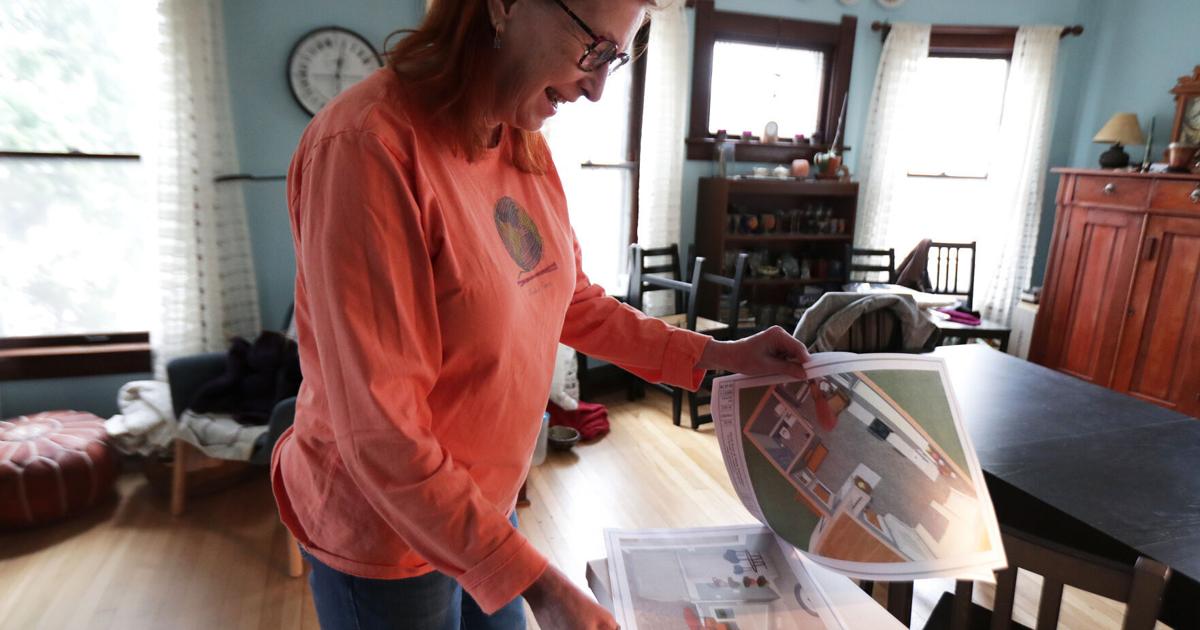
Heidi Kent looks at designs for her home renovation. Kent and her husband, Mark McFadden, say they like their East Side neighborhood but want to make their 103-year-old home more comfortable.


“We’re not interested in accumulating property wealth,” McFadden said. “We’re interested in having a house that’s more comfortable … easier for older people to get around.”

Kathy Lange-Novak had different ideas when she embarked on her home renovations last year. She figured fixing up the home was a prerequisite for selling it a few years from now.

But now that the work is done, Lange-Novak said she doesn’t want to leave.

“Being home a lot made us say, ‘Let’s fix it up,’” she said. “Fixing it up has made us want to stay home more.”

Home Improvements That Are Not Legal To Do Yourself

Home Improvements That Are Not Legal To Do Yourself

Shutterstock.com

Shutterstock.com

Spending so much time at home during the past two years has exposed the pluses and minuses of our properties. The main living space might shine and sparkle, but the bathrooms look old and dreary by comparison. You’ve probably also noticed deficiencies in some of its core systems, such as heating, plumbing and electrical.

Read: Unplug These Appliances That Hike Up Your Electricity Bill
Check Out: 50 Ways You’re Throwing Money Away

The desire to repair, update or bring more comfort to our spaces led to a push in home improvement projects in 2020 that has dipped only slightly to start 2021, according to the nonprofit Home Improvement Research Institute. In fact, a recent report from the Harvard Joint Center for Housing Studies said that Americans spent nearly $420 billion on projects in owner-occupied and rental properties in 2020 Homeowners are expected to spend record numbers on improvements through the middle of 2022. Between a hesitancy to bring strangers into their homes as the virus spread and a desire to save money, do-it-yourselfers tried to give many projects a try themselves.

But that might prove illegal.

“The legality of the repairs you perform on your property are subject to the rules and regulations of your local building department,” said Bill Samuel, who runs Blue Ladder Development in Chicago. “The rules will vary from each town but in general you will be required to pull a permit for any property alterations beyond basic cosmetic improvements. Not pulling the required permits is considered performing illegal work. Many villages also require specific work to be performed by a licensed professional.”

Before you strap on your tool belt, read the wise words that home improvement pros and others have to share about the dangers of DIY projects.

travelif / iStock.com

travelif / iStock.com

Cutting Down Large Trees

“One of the things we deal with regularly in our line of work is homeowners that are wanting their landscapers to remove large trees or that want to remove them on their own. We’re told this is fine to do if you’re careful and have the right tools. Maybe not the smartest idea, but perfectly legal if it’s your property,” said Dan Bailey, president of WikiLawn Lawn Care.

“This isn’t always true, though. In some states, it’s illegal to cut down large trees if you’re not an arborist or don’t have [the] certification to do so…So if you’re wanting to clear out large trees, definitely don’t do it yourself. It’s dangerous to self and property, and in many cases, it will get you fined.”

According to Forbes, the cost can vary based on how large the tree is and how old it is. Smaller trees can cost around $400, while larger trees cost about $2,000 to remove. The average cost for tree removal is $1,200.

POLL: What Do You Think of Elon Musk Buying Twitter?

powerofforever / Getty Images

powerofforever / Getty Images

Replacing an Electrical Panel

The cost of replacing an electrical panel depends on the amperage and whether new wiring is required, but HomeAdvisor puts the average price at about $1,199.

“Some of the worst things and illegal things I have seen homeowners and unlicensed contractors attempt to do is replace their main electrical panel,” said Christopher Haas, the owner of Haas & Sons Electric in Pasadena, Maryland. “This poses many dangers from injuring themselves, the home, and the occupants. … I have seen people unknowingly hook up the ground and power wire backward — reverse of what they should have done — which can cause injury or death to any unsuspecting person or animal that touches the now electrified ground.”

yocamon / Getty Images/iStockphoto

yocamon / Getty Images/iStockphoto

Converting Your Stove From Electric to Gas

The concept of moving from electric to gas cooking sounds simple, but it isn’t.

“Switching your stove from electric to gas is a complicated process that requires permits and a professional’s assistance,” said Emily Perez, head of design and digital PR at Kitchen Infinity. “You’ll need to have a gas line installed and the electrical circuits adequately closed off. This ensures that the final product is safe and functional.”

The website, Angi, estimates that the cost for this job ranges anywhere from $125-$2,000.

BanksPhotos / Getty Images

BanksPhotos / Getty Images

Taking Out a Wall

“You’d love to have an open floor plan. Before you take a sledgehammer to that wall, you need to talk with an expert,” Perez said. “Some walls in your home are cosmetic, and others are supporting your roof. Knockdown a supporting wall, and you’ve compromised the integrity of your home.”

The cost to remove a wall varies widely, depending on whether it’s cosmetic or load-bearing, the size and whether it’s on the first or second floor. It can run from $300-$10,000, per HomeAdvisor.

Maudib / iStock.com

Maudib / iStock.com

Repairing or Replacing HVAC

If there’s a problem with your heating and air conditioning, it’s always best to call a professional, Perez said.

“There are possible gas leakages that can cause dizziness, asphyxia and other respiratory problems,” she said. “It is because of these health risks it is illegal to fix or replace your HVAC system by yourself. If a manufacturer finds out about your efforts to fix the system yourself, they may even cancel out your warranty.”

It’s always a good practice to have your HVAC system serviced regularly, which costs $75-$200, according to HomeAdvisor.

JulNichols / Getty Images/iStockphoto

JulNichols / Getty Images/iStockphoto

Installing a Water Heater

“You’re either dealing with 220 volts of electricity or a live gas line with the possibility of carbon monoxide poisoning looming in the air,” said Ralph Severson, owner of Flooring Masters and Professional Remodelers. “It is very dangerous for a DIY-inclined homeowner to do this replacement themselves, but there is no shortage of people with a lot more confidence than skill.

“I once got a call from a friend to go look at a new water heater that wasn’t working. The person who installed it for my friend did it for free. They ran a 110-volt line to the heater instead of 220. Needless to say, I didn’t touch it and told them to call both a plumber and electrician immediately.”

Count on paying about $1,200 for the unit and installation.

sonsam / Shutterstock.com

sonsam / Shutterstock.com

Pumping a Septic System

This is another thing that is taboo for a DIY project, Severson said.

“This waste must be disposed of properly,” he said. “I have heard stories of … people pumping or even siphoning systems themselves. Undoubtedly straight into the yard or a creek.”

HomeAdvisor finds that this costs about $400 on average to have done.

knape / Getty Images

knape / Getty Images

Building a Deck

“The biggest DIY safety issue is, without a doubt, self-built decks,” said Welmoed Sisson, a licensed home inspector in Maryland. “Just about every jurisdiction requires permits for deck construction, but we still see decks that were built by a homeowner with a hammer in one hand and a copy of ‘Family Handyman’ in the other. Not knowing the fundamentals of safe deck construction can lead to disaster.”

An average deck costs $7,720, according to HomeAdvisor.

BanksPhotos / Getty Images/iStockphoto

BanksPhotos / Getty Images/iStockphoto

Adding On

“The add-on will be a different level from the original home, and the roof line might be odd,” said Luke Smith from We Buy Houses Louisville.

“On top of that, many homeowners trade speed and convenience for adherence to the law. We’ve found many homeowners failed to get permits for add-ons or home renovations that they conducted. This hurts everyone in the long run. If the add-on wasn’t permitted and properly inspected by the city, it’s essentially worthless and it can’t be factored in for the value of the home as it might not pass inspection.”

Shutterstock.com

Shutterstock.com

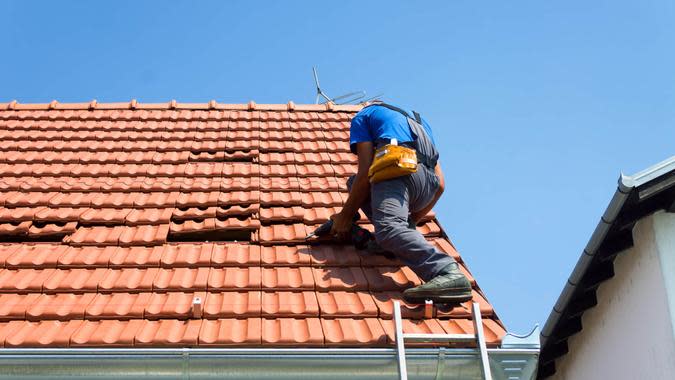
Roofing

Many local building departments require roofers to be licensed with the state.

“Roofing is a good example of a project that if not done correctly can cause leaks into your home, causing additional damage,” said Bill Samuel of Blue Ladder Development. “Roofing is also a dangerous job that requires specific safety gear and has a high risk of injury for someone new to the job.”

Including materials and labor, a roof costs an average of $8,764, HomeAdvisor reports.

More From GOBankingRates

Sam DiSalvo contributed to the reporting for this article.

This article originally appeared on GOBankingRates.com: Home Improvements That Are Not Legal To Do Yourself

What Do You Know About PACE, A Once Fast-Growing Home Improvement Loan?

What Do You Know About PACE, A Once Fast-Growing Home Improvement Loan?

Rate is not minimal to thoroughly clean energy nor is Pace a good healthy for each home owner.

If you are a property owner residing in California, Florida or areas of Missouri and have not already experienced put in solar panels or new roofing with a Pace personal loan, there is however a excellent prospect that you know a close friend or neighbor who has, or you have been pitched by private contractors selling Pace.

Pace is an abbreviation for Home Assessed Cleanse Energy. As the name indicates, Tempo provides financing for inexperienced and renewable strength household improvements, even though it is not limited to these. Retrofitting properties with electrical power upgrades is pricey, and Tempo presents incentives these types of as 100{d4d1dfc03659490934346f23c59135b993ced5bc8cc26281e129c43fe68630c9} lengthy-phrase funding. In addition, Tempo does not involve month-to-month loan payments but is structured as a exclusive tax evaluation or tax lien hooked up to the property and onto a homeowners’ tax monthly bill. At present, local municipalities across California, Florida and St. Louis county and the City of St. Louis in Missouri have partnered with private loan providers and contractors to deliver homeowners accessibility to Tempo financial loans.[1]  

Spend-As-You-Go Loan: Incentivizing Non-public Initiatives on Clear Vitality

Given that a Pace mortgage is connected to the property as a tax lien, they can further incentivize expenditure in cleanse energy as property owners are responsible for the price of the investment – though also reaping the rewards – only for the duration of proudly owning the residence.  When a change of assets possession happens, the price tag or any remaining obligation of the exceptional Rate total could be handed on to present-day owners. 

Speed is Not Limited to Clean Vitality

Despite the fact that the Tempo acronym denotes thoroughly clean electrical power, Rate systems are not constrained to funding clean or renewable power.  A range of electricity-similar home improvements – including alternative of heating and cooling methods or scorching drinking water heaters, air sealing and insulation, Strength STAR home windows, doors and roofing, Strength STAR appliances, LED lighting or HVAC upgrades – are all suitable under Rate.[2]

Nor Is Speed A Great In shape  for Just about every House owner

Whilst Pace financing can be a fantastic resource for a wide range of strength upgrades, it is undoubtedly not a excellent suit for all people.  For householders who have nicely-set up credit history record, a household equity or household fairness line of credit rating (HELOC) personal loan is a much less highly-priced resource of financing.  On the other hand, Tempo may well satisfy the requirements of householders who would otherwise have trouble securing a household fairness financial loan or HELOC from financial institutions or property finance loan businesses. For these householders, Rate presents added added benefits these types of as extensive-term funding to stretch the loan to 20 to 30 several years, creating the reimbursement additional reasonably priced.

Sticker Shock

The special tax evaluation on Rate financial loans normally occur as a shock to homeowners when the tax bill arrives. Pace bank loan payments are due together with annual home taxes, so either when a year (Florida, for instance) or in two installments (in California).  A disadvantage of rare Pace financial loan payments is that each individual installment will be larger than if unfold more than 12 months or when as opposed to the regular monthly payment on a property equity or HELOC bank loan, producing it more difficult to spending budget.

Determine 1 exhibits the usual or median amount of money of special tax assessment attached to Speed liens for California home owners.  Annual Speed tax assessment operates ordinarily in the $2,600-$2,700 assortment, dropping only slightly in 2020 and 2021 as fascination prices hit historic lows. The large boost to the total taxes owed could become notably burdensome for debtors with very low- to reasonable-money and confined credit score record and who find Pace financing accessible but may have difficulty securing financing with a residence fairness or HELOC loan.

&#13
&#13

Figure 1: Regular Exclusive Tax Assessment On Tempo Liens&#13

&#13

&#13
&#13
&#13

New Demand for Tempo Funding in Retreat

In accordance to PACENation, the nationwide trade affiliation that encourages Rate funding, the Rate packages in CA, FL and MO have supplied owners obtain to $7.7 billion in funding for endeavor more than 323,000 vitality-preserving or power-resilient house improvements, averaging $24,000 for each financial commitment.

To present a gauge of how need for Speed has progressed around time, Determine 2 disaggregates the cumulative data from PACENation to present yearly volume in Pace funding. With just about no current market penetration in 2012, Speed funding began to consider off and emerged as the speediest-increasing lending vehicle concerning 2013 and 2016.  At its peak need in 2016, Rate financial loans supplied $1.7 billion financing for roughly 71,250 residence improvement assignments.

&#13
&#13

Determine 2: Residential Speed Bank loan Originations (in millions), 2012-2021&#13

&#13

&#13
&#13
&#13

Homeowners’ participation in Pace has considering that slowed noticeably, declining calendar year more than yr starting in 2017 with the newest disaggregated 2021 info exhibiting a fall of 35{d4d1dfc03659490934346f23c59135b993ced5bc8cc26281e129c43fe68630c9} from 2020.  About $543 million, or about 22,625 loans, were being built in 2021, a decline of just about 70{d4d1dfc03659490934346f23c59135b993ced5bc8cc26281e129c43fe68630c9} from its heyday.

It is probable that some of the retreat in Tempo need could be thanks to soaring market place saturation as many earlier or current home owners have manufactured the investment decision.  In the meantime, refreshing new desire could arise from house owners in states that presently have handed Tempo laws (38 states and counting) to aid implementation of Rate plans.

Issues to Current and Potential Rate Applications

Client advocacy groups have termed for improved shopper safety on Rate lending.[3]  Speed loans have been criticized for charging higher curiosity costs and costs and placing uninformed home owners at the risk of owing additional taxes they could not manage. Quite a few Tempo financial loans have been produced to lower- to reasonable-cash flow house owners who locate Speed funding accessible but if not have trouble securing traditional funding with a dwelling equity or HELOC personal loan. With extra annual tax assessment in the 1000’s, some homeowners may wrestle to make payments.

Speed loan providers are not classic house loan creditors but private financial investment firms, enterprise capitals and other non-public traders.  At the federal amount, Tempo loans are currently not issue to client security laws as needed of banks and home loan corporations engaged in household mortgage lending.[4]   In addition, advertising and marketing of Tempo loans is commonly via doorway-to-door revenue, giving rise to concerns on proper disclosure of the expense of the financial loans or possible strength financial savings to justify the charges.

Lastly, the FHA and the GSEs prohibit Speed liens on homes and mortgages they insure or promise, producing it burdensome for property owners when promoting the property irrespective of Rate becoming touted as transferrable at the sale of the home.[5]

[1] When only a few states (CA, FL, MO) launched household Tempo plans, 28 states and the District of Columbia have launched business Tempo applications. At this time, 38 states have handed Tempo legislations. Supply: https://www.pacenation.org/

[2] Source: https://www.energy.gov/eere/slsc/assets-assessed-cleanse-electrical power-plans.

[3] See Rate Vitality Performance Loans: Excellent Intentions, Huge Pitfalls for Customers – National Buyer Law Centre (nclc.org)

[4] In 2019, the Shopper Monetary Defense Bureau issued an Advanced Observe of Proposed Rulemaking on applying Reality-in-Lending Act to residential Tempo financial loans.

[5] Rate encumbered properties may be qualified for VA-assured funding supplied that creditors can satisfy a selection of underwriting needs established out by the VA. For additional facts, see https://www.positive aspects.va.gov/HOMELOANS/files/circulars/26_16_18.pdf

© 2022 CoreLogic,Inc., All rights reserved.

Gordon Haskett says home improvement sector has pre-2008 feel (NYSE:HD)

Gordon Haskett says home improvement sector has pre-2008 feel (NYSE:HD)

Gordon Haskett says home improvement sector has pre-2008 feel (NYSE:HD)

phillyskater/iStock Editorial through Getty Visuals

The pattern in household advancement stocks is bringing again some lousy reminiscences, in accordance to Gordon Haskett analyst Chuck Grom.

In a notice to purchasers on Friday broadly downgrading the sector, he described that though there is rationale to continue being constructive on a lot of names, the quick improve in uncertainty pervading the market place has fully upended his prognostications.

“Over the past couple of months, the policies of engagement have plainly adjusted,” Grom wrote. “We are obtaining some déjà vu back again to 2006/2007 before the GFC.”

He stated that a confluence of growing charges, a reversion to pre-pandemic home improvement tendencies, a shopper that might not be eager to consider persistent price increases, and probably margin erosion portends improperly for the house.

“While most merchants have but to encounter any inelasticity troubles on passing together cost increases…it’s probable that at some issue in the coming months the shopper is likely to balk,” Grom wrote, incorporating that tendencies from the restaurant place have telegraphed this transform.

As such, even at reduced valuations relative to historical developments, Grom does not see significantly attractiveness in the sector. Even further, he expects a lot more incremental sellers versus incremental prospective buyers in coming months and rallies are reined in.

In the sweeping sector evaluation, Grom downgraded shares of House Depot (NYSE:High definition), Lowe’s (NYSE:Very low), Tractor Offer (TSCO), Flooring & Decor Holdings (FND), Restoration Hardware (RH), Wayfair (W), and Williams-Sonoma (WSM).

Downgrade to “Accumulate”

  • Property Depot (High definition), price concentrate on slash from $355 to $330

  • Lowe’s (Lower), cost focus on minimize from $255 to $225

  • Tractor Supply (TSCO), selling price target reduce from $260 to $230

  • Ground & Decor Holdings (FND), price tag focus on lower from $100 to $90

Downgrade to “Hold”

  • Restoration Components (RH), value goal reduce from $465 to $330

Downgrade to “Reduce”

  • Williams-Sonoma (WSM), value focus on reduce from $200 to $130

  • Wayfair (W), selling price concentrate on slash from $80 to $60

Speaking to the distinctions, Grom advised that the “Accumulate” grouping represents organizations that are structurally audio and extensive-phrase prospects continue being optimistic. The stocks are simply victims of the aforementioned macroeconomic and earnings problems and as a result rangebound.

For Restoration Hardware (RH), which stands on your own as a “Hold,” need traits were being cited as possible to disappoint when production difficulties persist as nicely. The company is also noteworthy for its early connect with on inflation impacts to its business.

Last but not least, Williams-Sonoma (WSM) and Wayfair (W) ended up downgraded to a promote-equivalent centered upon “demand destruction from larger prices” and the anticipation of promotional activity as supply chain dynamics shift.

“Home furnishing suppliers and merchants are now in an above-provided situation with far too significantly stock now in the channel,” Grom stated. “This will 100{d4d1dfc03659490934346f23c59135b993ced5bc8cc26281e129c43fe68630c9} guide to a significantly greater advertising cadence over the stability of 2022.”

He expects that this action will strike margins as oversupply very likely will come to bear.

Shares of just about each title downgraded are nearing its 52-week nadir, with the noteworthy expectation of Tractor Supply Organization (TSCO).

Read additional on the latest down-development throughout the retail sector.

Lafayette trustee charged $36K to home improvement stores

Lafayette trustee charged $36K to home improvement stores

EDITOR’S Take note: This is one of various experiences on court docket-requested launch of Fairfield Township’s credit score card data and what these credit card statements expose. However, Trustee Taletha Coles did not turn above the receipts for the credit rating credit rating card buys and there are missing statements..

LAFAYETTE, Ind. — Fairfield Township Trustee Taletha Coles chalked up her $113,259 in credit rating card expenses over 3 several years to her renovations at the township’s business office on Wabash Avenue, but only $36,691.51 can be immediately tied to property improvement purchases.

A Journal & Courier’s ongoing assessment of the court-ordered launch of the township’s credit card statements confirmed that in between January 2019 and July 2021, Coles charged $36,691.51 to regional dwelling advancement suppliers, as very well as to Just Blinds, Best Purchase, and Cork Floors.

Lafayette trustee charged $36K to home improvement stores

Nonetheless, there are numerous months that do not have credit score card statements, and there are statements that are only two pages. The files suggest there are several lacking pages that were not provided to the community.

The Journal & Courier emailed Coles for remark about the spending, including additional than $2,000 of buys at Finest Get in March 2020. Coles did not respond.

In May well 2019, Coles billed $984 to Just Blinds, presumably for the township’s office. She also billed extra than $1,300 that month to National Organization Furnishings. In June 2019, Coles billed $2,652.59 to Cork Flooring and $700 to Kirklands in Lafayette.

Planning a home improvement project? A kitchen renovation can increase your home’s value by 20{d4d1dfc03659490934346f23c59135b993ced5bc8cc26281e129c43fe68630c9}, according to Royal LePage experts

Planning a home improvement project? A kitchen renovation can increase your home’s value by 20{d4d1dfc03659490934346f23c59135b993ced5bc8cc26281e129c43fe68630c9}, according to Royal LePage experts

Survey highlights:

  • Royal LePage professionals say, on average, bathroom renovations can increase the value of a home by 16{d4d1dfc03659490934346f23c59135b993ced5bc8cc26281e129c43fe68630c9}

  • Finished basements and basement apartments have the potential to increase a home’s value by 15{d4d1dfc03659490934346f23c59135b993ced5bc8cc26281e129c43fe68630c9}, according to survey results

  • Outdoor entertaining space and landscaping have the potential to increase a property’s value by an average of 10{d4d1dfc03659490934346f23c59135b993ced5bc8cc26281e129c43fe68630c9}, according to respondents

  • For Canadians looking for general guidance on where to invest in their home renovation projects, 87{d4d1dfc03659490934346f23c59135b993ced5bc8cc26281e129c43fe68630c9} of surveyed experts recommend interior renovations

TORONTO, May 5, 2022 /CNW/ – According to a recent Royal LePage survey of 340 real estate professionals across the country, a kitchen renovation is the most worthwhile home improvement project. Respondents say that, on average, a kitchen renovation has the potential to increase a property’s value by 20 per cent. A bathroom renovation ranked second, with the potential to increase a home’s value by an average of 16 per cent.

“Kitchen renovations typically yield the greatest return on investment, as this space is most frequently used, and is perceived as the gathering place and the heart of the home,” said Mike Heddle, broker and team leader, Royal LePage State Realty. “When a potential buyer views a home for the first time, the one thing that will stand out – for better or worse – is what the kitchen looked and felt like. They may not remember the size of the bedrooms or the colour of the walls, but they will remember the kitchen.”

Heddle noted that investing in upgrades to your home can be beneficial whether or not you are planning to sell in the short term.

“During the pandemic, many Canadian homeowners used built-up savings to make improvements to their homes. Whether it’s a new kitchen or upgrading your outdoor space, home renovations are a worthwhile investment, as you and your family will enjoy the new space, in addition to the potential increase to the overall property value.”

Exterior projects such as an outdoor entertaining space or landscaping have the potential to increase a property’s value by an average of 10 per cent.

The survey showed that basement renovations ranked third (finished basement) and fourth (basement apartment). Royal LePage experts say that finished basements and basement apartments have the potential to increase a home’s value by an average of 15 per cent.

“In today’s market, investing in a basement apartment can greatly increase the value of a home, largely because it can help offset mortgage costs with a rental unit, or appeal to newcomers looking for multigenerational homes,” said Heddle. “Since the onset of the pandemic, we are also noticing senior homeowners looking at multigenerational opportunities to live under the same roof. Having an additional fully livable unit allows for more privacy for those families.”

According to survey respondents, window replacements can increase the value of a home by 13 per cent, and interior painting can increase the value of a home by 12 per cent, on average.

“While updating the kitchen or a bathroom can increase your sales price more significantly, minor upgrades such as interior painting can be a simple and cost-effective option to increase the value of the home.”

For Canadians looking for general guidance on where to invest in their home renovation projects, the vast majority of surveyed experts (87{d4d1dfc03659490934346f23c59135b993ced5bc8cc26281e129c43fe68630c9}) recommend interior renovations.

The majority of surveyed experts (59{d4d1dfc03659490934346f23c59135b993ced5bc8cc26281e129c43fe68630c9}) say that prospective sellers have been less inclined to renovate their homes prior to listing since the onset of the pandemic, due to sustained seller’s market conditions. Additionally, 57 per cent say that sellers may choose not to renovate, due to recent increases in the cost of construction materials and labour.

“Properties that are turnkey with modern finishes spend less time on the market,” said Heddle. “However, the timeframe and logistics for delivery of goods and materials may be a deterrent for many sellers, especially with the rising costs associated with renovation projects.”

Investing in a pool is considered the least worthwhile renovation to increase a property’s value. According to the survey, a pool can increase a home’s value by an average of only six per cent.

Royal LePage Survey: Home Renovation ROI – Data chart: rlp.ca/chart-home-renovation-ROI

Royal LePage Royalty-Free Media Assets:

Royal LePage’s media room contains royalty-free assets, such as images and b-roll, that are free for media use.

About the Home Renovation ROI Survey

A national online survey of 340 Royal LePage brokers and sales representatives in real estate markets across Canada was conducted between February 17th, 2022, and March 14th, 2022. Each respondent was asked to complete an online survey composed of seven questions pertaining to the value of popular home renovation projects.

About Royal LePage

Serving Canadians since 1913, Royal LePage is the country’s leading provider of services to real estate brokerages, with a network of more than 19,000 real estate professionals in over 600 locations nationwide. Royal LePage is the only Canadian real estate company to have its own charitable foundation, the Royal LePage Shelter Foundation, dedicated to supporting women’s and children’s shelters and educational programs aimed at ending domestic violence. Royal LePage is a Bridgemarq Real Estate Services Inc. company, a TSX-listed corporation trading under the symbol TSX:BRE. For more information, please visit www.royallepage.ca.

SOURCE Royal LePage Real Estate Services

Cision

Cision

View original content: http://www.newswire.ca/en/releases/archive/May2022/05/c4938.html