GARDEN COLUMN: Seasonal decorations | Home & Garden

GARDEN COLUMN: Seasonal decorations | Home & Garden

The weather has turned seasonably cold with the first frost being seen by most of us. For most of the holiday season, our thoughts tend to be inside with family and indoor plants, some of which are popular as part of our seasonal decorations. Poinsettias, cacti and amaryllis are just some of the plants that we find in the stores right now.

Poinsettias: The traditional Christmas poinsettia has been popular for decades with the bright red leaves still being the most popular color with shoppers. New colors such as variegated leaves or light-colored leaves dyed blue were a fad a few years ago and can still be found in florists or nurseries if you like them. If you kept your poinsettia from last year, you might find some red leaves starting to appear though nursery grown plants tend to be brighter with more flowers. Just as a note though, the red color is actually from bracts, or modified leaves around the small yellow flower that is in the middle. Once the color is set, the plant can be kept in shade or sun for the holiday season.

Christmas Cacti: There are a few different cacti on the market and all flower around this holiday season – one closer to Thanksgiving and one nearer Christmas/New Year. All are tender succulents rather than true cacti, so they can dry out quickly in your home. Water well in the sink and let it drain before putting back into the decorative container. These plants all survive well outside in summer and once the temperatures sink into the 40s and the daylength gets shorter, they produce bright red, white or salmon pink flowers. They do prefer full sun but will be fine for a few weeks in a partly sunny position. Keep the plant on the dry side but repeat the ‘water in the sink’ when the top of the soil is dry. For the rest of the year, keep the cacti in a sunny south facing window and place on your patio in late spring.

People are also reading…


GARDEN COLUMN: Spring bulbs: 50 is the magic number

Rosemary Topiary: These delightful plants are closely cropped to form a pyramid or other formal shape. The plant containers tend to be full of roots and difficult to water, but without water they go brown and die in days. The best remedy is to remove the outer pretty covering, leaving just the root ball and water like the succulents – in the sink. If the roots are too dense, take a knife and make a few slits in the root ball so that water can penetrate into the center as well as the outside. The rosemary is the same as a culinary rosemary but resist trimming the stems for your kitchen for a while – the nurseries use chemicals to keep away bugs and fugal issues and to keep the plant looking healthy. These chemicals are not safe to ingest. If your rosemary does survive the holidays, keep it slightly moist and in a cool room until spring when it can be planted in the garden. Give the plant at least a year to minimize contamination before using in your culinary dishes.

Amarylis: The amaryllis bulb is a popular hostess gift for seasonal parties and come in box or container. Read the instructions to prompt the amaryllis to produce a flower stalk. Once the stalk begins, it grows rapidly and finally produces the beautiful flowers a few weeks later. The bulb can be put into the garden for summer, then placed in a dark location until the leaves die and the plant is fully dormant. Give the bulb about a month of dormancy then bring back into the home and water well.


GARDEN COLUMN: Fall attraction in the garden

We have such a long growing season that winter flowers indoors are not required to last months, but for the holiday season they are certainly an addition to your decorations.

Wishing everyone a Happy, Healthy Thanksgiving and holiday season.


TheTandD.com: $5 for 5 months

Kate Copsey is a garden author, writer and speaker now living in eastern Orangeburg County. Her book “The Downsized Veggie Garden” is available from bookstores everywhere as well as her webpage www.katecopsey.com.

Vertical Focus | Home Improvement

Vertical Focus | Home Improvement

Tags: Retail, Materials Handling, Demand Planning

Vertical Focus | Home Improvement

Pre-Orders Build Up Home Improvement Inventory

Many manufacturers have discontinued their less-popular products or increased prices across product categories as ships wait off the California coast, truck drivers face long wait times, and rail yards remain backed up.

AAA Distributor, however, has all its kitchen cabinetry, shower doors, vanities, and flooring products ready to ship from its 120,000-square-foot warehouse in Philadelphia.

The home improvement store placed pre-orders to avoid running out of goods during the pandemic, and the strategy paid off. It started to receive containers in early 2021 and accumulated more than twice its 2020 inventory. The inventory arrived just in time to meet increased demand for summer home improvements.

AAA Distributor is now able to ship all kitchen and bath products within 48 hours. It also launched a new website, where all the products can be purchased and shipped directly to customers’ job sites.

The Home Depot Nails Down Same-Day Delivery

Do-it-yourself retailer The Home Depot’s online sales almost doubled in 2020, and it is investing $1.2 billion in its supply chain. As part of that investment, the company will expand its e-commerce delivery services and offer same-day or next-day delivery to 90{d4d1dfc03659490934346f23c59135b993ced5bc8cc26281e129c43fe68630c9} of the U.S. population by using Walmart’s GoLocal delivery service.

The Home Depot will launch the service at select stores in New Mexico, Texas, and Arkansas, before expanding to other markets by the end of 2021. Walmart will deliver smaller items that can fit into a car, such as tools, paint, and other supplies, for The Home Depot.

Walmart launched GoLocal in August 2021 as a byproduct of its e-commerce infrastructure and network of stores across the United States.

Patio Contractors Play Catch Up

Installing new patios was a big trend during the pandemic, as consumers built out their yards for at-home activities such as gardening, cooking, entertaining, and swimming. At the same time, restaurants and bars installed outdoor seating areas to allow for social distancing and keep their businesses open.

As a result, the demand for pavers—a popular hardscaping product used in outdoor installations—jumped nearly 7{d4d1dfc03659490934346f23c59135b993ced5bc8cc26281e129c43fe68630c9} in 2020, and many projects were delayed due to labor shortages, long wait times, and supply chain slowdowns, says a Freedonia Group analysis.

While supply chain challenges have persisted through 2021, they continue to become less of a factor, allowing more delayed projects to be completed. Near-term sales of pavers will remain elevated as pent-up demand for large-scale hardscaping installations is fulfilled, the report says. However, growth will moderate through 2025, with most of the gains stemming from price increases.

Construction Will Cost You

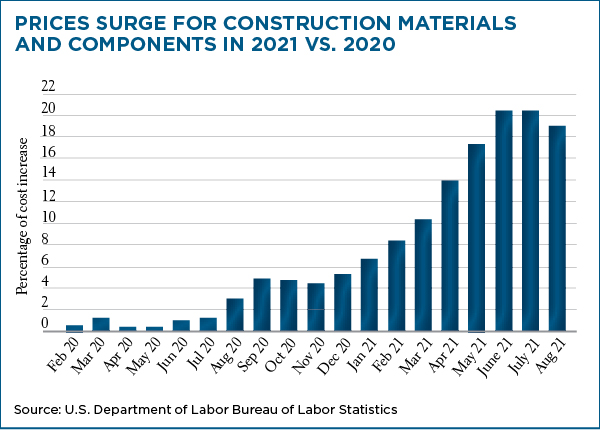
The cost of raw materials for U.S. firms is rising at its fastest rate in 40 years, with some of the higher costs making their way to consumers, says a Fitch Ratings analysis. Costs of construction materials and components have increased at a double-digit year-over-year rate since March 2020 (see chart).

The high demand for building materials persists due to new home construction and remodeling combined with government infrastructure and commercial construction spending, the report says. However, supply chain challenges in the building materials sector are taking longer than expected to normalize, hampering companies’ ability to benefit from that demand.

Production capacity was constrained early on in the pandemic due to labor shortages, facility closures, and social distancing protocols. Port congestion and adverse weather events have exacerbated these challenges. As a result, building materials companies look to price increases, surcharges, and capacity expansion to compensate. Still, 2021 revenue growth remains within expectations, due largely to higher pricing, the report says.

Ikea Constructs a Plan

Swedish home furnishings retailer Ikea expects container shortages and port congestion to remain an issue through mid-2022, as consumers working from home continue to renovate. Here are four ways Ikea plans to pick up the pieces:

1. Focus its product offering on its most popular products.

2. Take other measures to get products shipped to its stores, such as renting its own containers and finding alternative routes on trains.

3. Absorb costs to accommodate price spikes for transportation and raw materials rather than passing them on to consumers.

4. Make products even more affordable and get a bigger share of revenue from its lower-price products.

Paint Demand Spills Over

Producer prices for paint and coating rose 10.6{d4d1dfc03659490934346f23c59135b993ced5bc8cc26281e129c43fe68630c9} in August 2021 from the previous year—the biggest annual jump since January 2009—as consumers change up their wall colors.

The deep freeze in the South has slowed production of petroleum, a critical ingredient for paint, and store owners have struggled to keep product on the shelves. Demand, however, isn’t slowing down. The following home projects have been the most popular during the pandemic, adding to the supply chain strain, a HomeAdvisor report says:

1. Interior painting

2. Bathroom renovations

3. Flooring

4. Landscaping

5. Kitchen renovations

6. Exterior painting (tie)

7. Smart home devices (tie)

8. Roofing

9. Fencing

10. Deck or porch

Lessen, Property Services Startup, Scores Unicorn Valuation

Lessen, Property Services Startup, Scores Unicorn Valuation

Newest unicorn is property-services startup Lessen

Lessen CEO Jay McKee and Fifth Wall managing partner Brendan Wallace (LinkedIn, Fifth Wall, iStock)

A historic year for proptech fundraising has produced another unicorn.

Lessen, a real estate management platform that connects property owners and operators to electricians, cleaners and other service providers, raised $170 million in a Series B round, pushing its total funding so far to $214 million — nearly quadruple its previous fundraising — and valuing the two-and-a-half year-old company at more than $1 billion.

Proptech venture capital firm Fifth Wall, which led Lessen’s $35 million Series A round in June, returned to lead the new round. Khosla Ventures, General Catalyst and Navitas Capital were also repeat investors.

The Series B was oversubscribed, Lessen CEO Jay McKee said, and the company plans to detail additional investment from special purpose vehicle partners before the end of the year.

Lessen’s fundraise comes at a pivotal time for the U.S. housing market, with an unprecedented combination of high demand and low supply driving home prices to record highs as developers, owners and operators grapple with labor shortages and supply chain disruption.

“Lessen is seeing a difficult hiring environment, complicated materials procurement system, and increased appetite for portfolio scaling all at the same time,” McKee said by email.

McKee’s experience is not limited to tech. He previously founded the single-family rental company Colony American Homes, which merged with a Starwood Capital Group affiliate in 2015.

Scottsdale, Arizona-based Lessen’s client base, which spans 30 U.S. markets, includes large multifamily and single-family rental REITs, who use the platform to source more than 2,000 plumbers, electricians, cleaners and other servicers. Users can manage multiple work orders as well as bill and analyze data from previous jobs.

McKee said Lessen’s transparency, comprehensive data and ability to “optimize workflows” improve the “timing, quality and pricing of jobs,” and set the platform apart in a crowded field.

“We believe that we are approaching the property-services industry in a unique way that combines tech and field delivery in a way that no one has done before,” McKee said.

Lessen, which also has offices in Seattle and Miami, plans to launch its platform nationwide soon and triple its employee count in the coming months, McKee said. “Eventually, we believe there is opportunity for international expansion,” he said.

Proptech investors have produced a few unicorns over the last year. The most recent was Place, a technology and business services platform for agents, which achieved a $1 billion-plus valuation with its first funding round this month.

Luxury real estate booming on Upper East Side in NYC

Luxury real estate booming on Upper East Side in NYC

The once sedate Upper East Side is suddenly sizzling as luxe home sales are surging after being cratered by the pandemic.

More contracts for homes priced at $4 million and up were signed on the Upper East Side than in any other Manhattan neighborhood during the first week of November, according to a report compiled by Donna Olshan of Olshan Realty.

Among the eye-popping deals were two penthouse units combined into one with an asking price of $66.5 million. The apartments are in The Bellemont, a condo building at 1165 Madison Ave. designed by famed architect Robert A.M. Stern.

An undisclosed buyer snatched up what will become the 13,011-square-foot home off of floor plans, according to Olshan’s report. The building’s amenities include a roof terrace, screening room and squash court.

A deal on another penthouse with a $27 million asking price, and also designed by Stern, was inked at 200 East 83rd St. It has a 41-foot great room and a 40-foot loggia with “glimpses” of Central Park. The building includes a swimming pool and movie theater.

A penthouse at 1010 Park Ave. with a $35 million asking price went to contract during the second week of November, which saw 60 luxury deals in Manhattan, the most of any week during the year, according to Olshan.

An aerial general view shows Central Park and Upper East Side of New York City on August 5, 2021.
Real estate prices are resurging in the Upper East Side after a severe decline in 2020.
AFP via Getty Images

Olshan told The Post that there was lots of pent up demand after the market stalled last year and that new buyers in the neighborhood were moving away from glass towers toward more traditional buildings.

“This is classic architecture, not pushing the design edge. Beautifully crafted and it’s found a big audience,” Olshan said.

The big sales were in condos which skirt the “tyranny” of getting co-op board approval and in large units, likely so families had room to spread out while working from home.

The Upper East Side still doest have “the cool factor” of a Williamsburg, but nonetheless is “very, very livable,” Olshan said.

“Maybe people are leaning to the more practical,” she said. “The pandemic has created a more practical buyer.”

Susan Hess, 42, moved uptown from the East Village six years ago to be close to her workplace and agreed that newcomers will notice an ease of living in the neighborhood.

“After I moved here, I noticed how much quieter it is here than the East Village. You can actually get your sleep here,” Hess said.

Excellent Guide For People Looking To Buy Property This Year

Excellent Guide For People Looking To Buy Property This Year

Excellent Guide For People Looking To Buy Property This Year

If we are being honest, nobody wants to work for their life. Passive income appeals to many people in the current generation, and real estate investments are an opportunity to realize your dream if you want to generate passive income. 

However, the real estate industry also comes with several risks, and it can milk you dry if you make any mistakes when buying an investment property. One of the biggest mistakes you can make when looking for investment property is rushing to purchase without considering the different aspects that regulate the real estate industry. 

This article has put together some of the critical factors you need to consider when looking for an investment property to ensure that you find one that can help you achieve the return on investment you are looking at.

  1. Choose the Right Property

Real estate investment revolves around capital growth which is why you should prioritize finding a property that you will most likely appreciate. Therefore, you need to make sure that you buy at the right price. Do some research about the local market to determine the value of the different properties available in that specific area. This way, you can quickly identify a bargain and separate it from an overpriced property. Mortgage insurance and lenders can provide you with little information regarding different locations and Property developments to help you pick the right property for your next investment.

If you spend money on a property just because it has tax deductions, it may not offer the return on investment you are targeting. Also, consider the different classes of residential properties since they often outperform each other as time passes. For instance, vacant land appreciates faster in areas with limited supply even though it does not generate any rental income. On the other hand, a home unit comes with fewer maintenance costs than a freestanding weatherboard house. You have to do your homework to determine what works best for you before commenting.

  1. Explore Financing Options

Before you can venture into real estate as an investor, you need to have a solid financial plan. You can get an investment property loan. If you are looking to buy an investment property, you can either go for the cash or no money down options. You present a certified check to the title company reflecting the agreed price before closing the purchase when paying in cash. If you choose the no money down option, you will have to hold the mortgage and commit to monthly payments to the bank or seller. Getting a mortgage makes more sense since many people rarely have the entire amount in cash when buying an investment property.

  1. Decide if You Can Handle The Responsibilities of Being a Landlord

Being a landlord is one of the best ways to generate real estate income, but it is not as glamorous as some people make it. You have to deal with the hassle of finding the right investment property, prepping the rental units, and finding ideal tenants. Additionally, you must constantly worry about maintenance since you want to keep the unit in good condition for maximum ROI.

If you cannot put up with this, you can hire a property manager to assume these responsibilities, but that means you would have to part with a fraction of your rental income. If you own one or two rental properties, you can easily manage the property on your phone, but things change as you add more properties to your portfolio.

  1. Clear Personal Debt

The most seasoned real estate investors can comfortably add debt to their portfolio investment strategy. However, you cannot afford to make this mistake if you are only getting started. If you have any student loans, pending medical bills, or children about to join college, venturing into real estate investment may not be the right decision. However, you can make exceptions in cases where the return from your real estate investment is higher than the total cost of your current debt. Do not invest in real estate if it puts you in a position where you do not have enough cash to honor your payments.

To summarise, investing in real estate is a great way to generate passive income, provided that you get everything right. Before buying an investment property, you should fast determine if you have everything it takes to be a good landlord. Also, clear your debt unless the return from your investment exceeds the total cost of your current date. Additionally, if you need to look at different financing options, especially if you cannot afford to pay me in cash, find the right property depending on your investment goals and budget.

See how the Bidens have decorated for their 1st White House Christmas : NPR

See how the Bidens have decorated for their 1st White House Christmas : NPR

A Christmas tree stands in the Red Room during a press preview of White House holiday decorations on Nov. 29.

Andrew Caballero-Reynolds/AFP via Getty Images


hide caption

toggle caption

Andrew Caballero-Reynolds/AFP via Getty Images


A Christmas tree stands in the Red Room during a press preview of White House holiday decorations on Nov. 29.

Andrew Caballero-Reynolds/AFP via Getty Images

For their first Christmas in the White House, the Biden family will celebrate with the theme of “gifts from the heart” for their holiday decor.

In unveiling the theme on Monday, President Biden and first lady Jill Biden explained:

“The things we hold sacred unite us and transcend distance, time, and even the constraints of a pandemic: faith, family, and friendship; a love of the arts, learning, and nature; gratitude, service, and community; unity and peace. These are the gifts that tie together the heart strings of our lives.”

An ornament with a portrait of President Biden and first lady Jill Biden hangs on a Christmas tree in the State Dining Room of the White House during a press preview of holiday decorations on Nov. 29.

Alex Wong/Getty Images


hide caption

toggle caption

Alex Wong/Getty Images


An ornament with a portrait of President Biden and first lady Jill Biden hangs on a Christmas tree in the State Dining Room of the White House during a press preview of holiday decorations on Nov. 29.

Alex Wong/Getty Images

In just one week, over 100 volunteers from the local area decorated the outside and inside of the White House with 41 Christmas trees, 6,000 feet of ribbon and over 78,750 holiday lights.

Every room in the White House celebrates a different gift

In the East Colonnade and East Landing, doves and shooting stars adorn the hallways. The decorations honor the service of COVID-19 front-line workers and first responders. Featured here is a Christmas tree that honors military members “who have laid down their lives for our country, and the families who carry on their legacies.”

The library is decorated with stacks of books, as well as birds and butterflies created out of recycled newspaper; it represents the gift of learning. The Vermeil Room is decorated with colorful paint swatches and paintbrushes and represents the gift of the visual arts.

Wreathes decorate the backs of chairs in the room that displays the White House’s collection of state china. The holiday decorations symbolize the gift of friendship and sharing.

Andrew Caballero-Reynolds/AFP via Getty Images


hide caption

toggle caption

Andrew Caballero-Reynolds/AFP via Getty Images


Wreathes decorate the backs of chairs in the room that displays the White House’s collection of state china. The holiday decorations symbolize the gift of friendship and sharing.

Andrew Caballero-Reynolds/AFP via Getty Images

The East Room, the largest room in the White House, represents the gift of gratitude. It is decorated with a Neapolitan crèche that includes over 40 figurines from the 18th century; the crèche has been displayed every holiday season since 1967.

A White House military social aide stands near the official White House Christmas tree in the Blue Room during a press preview of the White House’s holiday decorations on Nov. 29.

Andrew Caballero-Reynolds/AFP via Getty Images


hide caption

toggle caption

Andrew Caballero-Reynolds/AFP via Getty Images


A White House military social aide stands near the official White House Christmas tree in the Blue Room during a press preview of the White House’s holiday decorations on Nov. 29.

Andrew Caballero-Reynolds/AFP via Getty Images

The Blue Room, where the official White House Christmas tree stands, represents the gift of peace and unity. Doves carrying a banner embossed with every U.S. state and territory cascade down the tree.

The Red Room, decorated to represent the gift of the performing arts, includes brass instruments hanging from the mantel. Ballet slippers, tap shoes and musical notes are strung around the tree.

A gingerbread White House is seen in the State Dining Room during a press preview of the White House’s holiday decorations on Nov. 29.

Andrew Caballero-Reynolds/AFP via Getty Images


hide caption

toggle caption

Andrew Caballero-Reynolds/AFP via Getty Images


A gingerbread White House is seen in the State Dining Room during a press preview of the White House’s holiday decorations on Nov. 29.

Andrew Caballero-Reynolds/AFP via Getty Images

The State Dining Room represents the gift of family. It features a gingerbread White House made of 55 sheets of baked gingerbread. It has eight detailed replicas of community buildings to honor front-line workers, including a hospital, police station and fire station.

Members of the U.S. Marine Band play holiday music during a press tour of White House Christmas decorations on Nov. 29.

Andrew Caballero-Reynolds/AFP via Getty Images


hide caption

toggle caption

Andrew Caballero-Reynolds/AFP via Getty Images


Members of the U.S. Marine Band play holiday music during a press tour of White House Christmas decorations on Nov. 29.

Andrew Caballero-Reynolds/AFP via Getty Images

The Grand Foyer and Cross Hall represent the gift of faith and community. The area is decorated with floating candles. The hallway alcoves and tree displays depict wintry scenes of towns and cities, representing the bonds of communities.

Tien Le is an intern on NPR’s News Desk.