Home Improvement: 6 Times The Show Was Dangerously Flawed

Home Improvement: 6 Times The Show Was Dangerously Flawed

One of the most iconic sitcoms ever made, Home Improvement is a show everyone loves and adores. But there were times Home Improvement was super flawed.

The Incompetent Husband Stereotype

Home Improvement

The concept of a bumbling and clumsy husband that has trouble handling his family life is something we only see in animated shows now. But Home Improvement did it way early as a live action series. Family Guy and The Simpsons only learnt how to further this stereotype from Tim. His clumsiness and incompetence almost got himself and his family killed multiple times. He knew his way around the garage shed but cannot handle an ordinary family life? That’s something Home Improvement is infamous for popularizing first.

Jill Of Home Improvement Became the Nagging Spouse No One Likes

Jill

Tim Allen is somewhat known to find himself in the middle of such controversies around his shows. Most of the female characters in his shows somehow adhere to a certain stereotype. Take Jill. Tim’s wife for example. She had her work cut out for her. With a husband that kept going to the ER for the most ridiculous of reasons to a trio of rowdy children who are almost on the verge of running wild. Jill had to be strict and strong. But Home Improvement turned her character into a nagging, suspicious wife that keeps asking too much every time.

Men Are All Beers & Bait. Liking Stuff Like Dancing Or Singing Is For Women
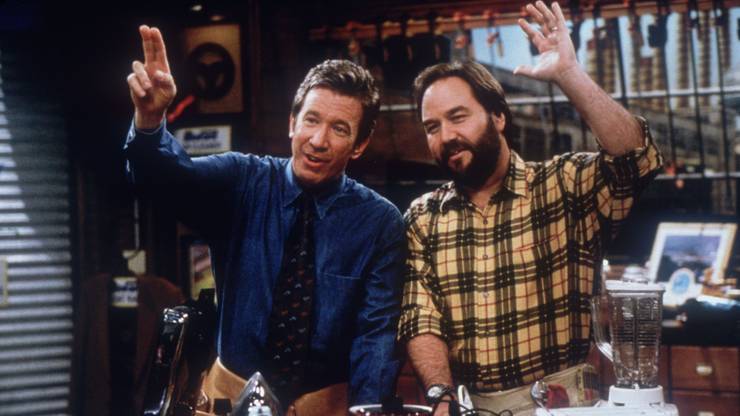
Tim – Home Improvement

Toxic masculinity is a term used to define social standards for traits and hobbies that ‘define’ a man. For years, we believed that men should act in a certain way and any stray outlier is not “masculine” enough to be a man. Home Improvement showcased that popping a bear bottle open with your teeth and watching the game is what makes you a man. When Tim’s son was practicing his Peter Pan dance in the house, Tim almost fainted because he was thinking his son is turning into a woman.

Pamela Anderson’s Lisa Was All About Female Objectification

Lisa

Lisa was the hit tool girl that was played by Pamela Anderson in the show within the show – Toom Time. She was basically the person responsible for giving out any tool that Tim needed at that moment. This was before Pamela Anderson’s tenure in Baywatch. The actor had no other role that using her body for objectifying women. The producers just wanted her to be on the show because she was a hit after her Playboy stint. She was literally given zero intelligent things to say in the show.

The Body Shaming In Home Improvement

Al

Body positivity, whether you want it or not, is here to stay. All bodies are beautiful and there’s no other way around it. The ’90s were not that great a time for the body positivity campaign. But that does not excise the excessive fat-shaming that happened in Home Improvement. When Al, who likes to cook, got commented on by Tim, the former took it as a sport. But everyone who was suffering with obesity felt bad. We all stayed quiet but we could have done without the body shaming jokes in Home Improvement.

Commenting On His Son’s Wardrobe Choices Was Not Cool

Mark

When the youngest of Tim’s sons, Mark, decided to become the text-book version of a Goth kid, no one was more unamused as his father. Tim kept referring to Mark’s goth looks as just a “phase.” Commenting on people’s wardrobes and to not confirm to established standards is not a crime. And one should never be ashamed to take that road.


Commercial real estate faces .5 billion in flood damage in 2022: Report

Commercial real estate faces $13.5 billion in flood damage in 2022: Report

A satellite image shows TD Bank Ballpark submerged in flood, after Hurricane Ida swept through the Bridgewater Township in New Jersey, September 2, 2021.

Maxar Technologies | Handout via Reuters

The commercial real estate industry faces an intensifying threat from flooding, which is likely to lead to billions of dollars in increasing costs, a new study says.

Approximately 730,000 retail, office and multi-unit residential properties face an annualized risk of flood damage in the United States. The structural damage from flooding is projected to cost $13.5 billion in 2022, increasing to over $16.9 billion by 2052, according to the First Street Foundation, a nonprofit research and technology group, and global commercial engineering firm Arup.

The research incorporated sea-level rise, but focused more on flash floods, also known as pluvial flooding.

“It absolutely will have an impact on the value of these structures because you’re increasing the risk and the known risks to these buildings, which then has a negative impact on the value of them today,” said Matthew Eby, founder and of First Street Foundation.

“We have companies like Nuveen or Morningstar or these large institutional investors that are looking at our data to understand what’s at risk today and over that period of ownership,” Eby added. “How do you plan against these things or ensure that you’re buying into the right commercial real estate assets?” 

First Street partnered with Arup in order to go beyond simple flood risk, which it has already done for residential properties. By matching its flood modeling on commercial properties with Arup’s knowledge of structure and architecture, the two were able to understand the impact of flood risk on each specific type of commercial building in the country. Then they could determine the economic consequences of a flooding event given the specific building type.

“As climate change continues to accelerate, flood risk will pose an economic threat to commercial properties across the country,” said Ibbi Almufti, the leader of Arup’s risk and resilience team in San Francisco. “This new report will serve as a guidebook for understanding building-specific risk and for taking action to mitigate the effects of climate change.”

They also factored in the downtime damage estimate, as in how long the building would be inoperable after a flooding event, given the specific structure.

The researchers also put a price tag on potential damage to come that factors in the damage to local economies and productivity. The cost of that impact is expected to grow to $63.1 billion in 2052 from $49.9 billion in 2022 due to worsening flood risks associated with climate change, according to the report.

In total, local businesses in the United States stand to lose the equivalent of 3.1 million days of operation next year alone. By 2051, that could grow to 4 million. That would, in turn, increase the economic impact from lost productivity and lost output for all these properties.

Last year, First Street partnered with Realtor.com to put a flood score on every house in America. That score could warn homeowners who might not have flood insurance that they should consider getting it. Federal flood maps are often outdated, and until very recently did not factor in the effects of climate change.

The nation is seeing far heavier rainfall now, because as the atmosphere warms it holds more water. The remnants of Hurricane Ida unleashed unprecedented flooding in the Northeast, costing billions of dollars in damage and resulting in nearly 50 deaths.

The risk of flooding to commercial real estate affects not only the property owners and the tenants of the buildings, but the investors in those properties.

“The people that actually own these buildings are your average American in a 401k plan, or these commercial real estate investors that own these $100, $200 million buildings,” said Eby, who added that once they see that risk now and into the future they can better understand how to mitigate the risk and potential costs involved.

Boutique Real Estate Brokerage The Agency Aims for International Growth

Boutique Real Estate Brokerage The Agency Aims for International Growth

Boutique Real Estate Brokerage The Agency Aims for International Growth

Vice Chairman Billy Rose, Chief Executive Mauricio Umansky and President Rainy Hake Austin.

What started as a small residential real estate brokerage based in Beverly Hills has grown to more than 800 agents and 50 markets with plans to expand further.  

In the 10 years since luxury boutique brokerage The Agency was founded by real estate veterans Mauricio Umansky and Billy Rose, the company has been on a rapid growth trajectory, but Rose and Umansky said it has stayed true to its roots as a boutique brokerage focused on culture and giving its agents and clients a different experience from other brokerages.

 
“I felt that the industry was very archaic and ancient in the way that they were working and didn’t feel that there was innovation happening in the industry,” Umansky said of why he started the company. He added that he felt he could teach others what he learned in his years as an agent.


Rose had started a networking group before launching The Agency after working as an entertainment lawyer and talent agent before getting into real estate. He said he moved “from one company to another” and “observed that the brokerage itself had become meaningless.”


“Brokerages had become WeWorks,” he said, adding that oftentimes agents at the same brokerage competed with each other.
When Umansky, who was in the networking group, had the idea for The Agency with the goal of making the overarching brokerage mean something, Rose said, “Let’s do it.”


One big change for the company happened last year when Rainy Austin was hired as president.


“When we started, I was wearing so many different hats — general counselor, broker of record, COO, recruiter — we’ve been and I have been fortunate that we’ve been able to expand and become large enough that we’ve been in a position to hire people to wear all those various hats,” Rose said.


He added that neither he nor Umansky had run a large-scale company before, something Austin was able to do.
Austin has been involved in real estate for more than 25 years, most recently working at Compass as head of western operations.


Austin said she missed working at a boutique firm and wanted to have a greater impact on overall strategy, which is why she joined The Agency. Under her leadership, the company has continued to grow and open more franchised locations.


Selling through showcasing

From the beginning, Umansky said, The Agency separated itself through its use of technology and a collaborative culture.

The Agency’s software, he said, allows agents to be more efficient, such as by using artificial intelligence to help people make smarter choices, according to Austin.
The brokerage also stressed the importance of showcasing an aspirational lifestyle buyers would have at the homes they were showing.


Instead of just a mailer, this meant throwing open houses that resembled lavish parties and finding creative ways to show off the home.
“We started selling real estate through storytelling,” Umansky said. “We created a dynamic change in the way that we built the company and the way that we marketed and advertised real estate.”


The company also stresses culture and collaboration.
“You can help someone who’s less experienced or moving into a new marketplace or needs a leg up by credit enhancing them by what we do as a collective agency,” Rose said. “At the other brokerages, they would kill you if you talk about one of their sales.”
High-ranking agents like Umansky often co-list with newer agents and share their big sales as an accomplishment of the brokerage and not just the individual, Austin said. Umansky added that he thinks The Agency wins listings because its agents team up rather than fight for listings.

 
“When you’re able to all work together … you’re obviously going to do a lot better than if you are doing everything on your own,” Rose said. “We’ve been able to really elevate younger agents by providing them with lots of resources.”

 
Umansky said he places a lot of importance on market share rather than the number of agents as a measure of success and works on only adding people to the company who are a good fit rather than filling a quota on numbers of agents to hire.
Austin said The Agency now has “a waiting list of individuals who reach out to us and love the brand.”


“Finding the right fit takes time and making sure the right individual is the one we bring on the first time,” she added.
And while in recent years there have been a number of agents moving from one brokerage to another, The Agency is working to retain talent by “re-recruiting our existing agents” and not just focusing on growth, according to Austin. This includes showing the value of the brokerage.

 
One big name to join The Agency early on, in 2014, was Santiago Arana. He spearheaded the company’s expansion on the Westside, running the Brentwood and Pacific Palisades offices and opening others on the Westside.
“For me, it was important to be part of building something that was great,” Arana said of why he joined, adding that he thought the traditional brokerage model “was broken.”


Arana said when he joined the company, he brought a large market share west of the 405 and a number of agents.
“From that point, it just exploded,” he said.


Growing through franchising

The company historically has not used outside capital or had private equity growth mandates or debt and has instead grown from its profit. But that strategy could change.

“We’re very excited about going forward and looking for some growth capital moving forward and are excited about bringing that in but want to be strategic about what we are bringing in,” Umansky said.
And as it eyes future growth, the company is also looking at growing through franchised offices.


It launched its first franchise office in Los Cabos, Mexico, in 2016.
Today, the company is 50{d4d1dfc03659490934346f23c59135b993ced5bc8cc26281e129c43fe68630c9} franchises and 50{d4d1dfc03659490934346f23c59135b993ced5bc8cc26281e129c43fe68630c9} company-owned and operated with about 25 of each. Umansky said he expects that to continue as the company grows.
Company executives jokingly say they want to be in cities where Umansky likes to vacation.


“We want to be in luxury locations where our clients are likely to be,” Rose added. “We want to be in places where there is movement, there’s mobility, there’s luxury.”
Company-owned and -operated locations will be in California and New York City while other areas will be franchise locations.


“We’ve found that if we’re able to find like-minded individuals … that we could create something very synergistic,” Austin said. “We are able to leverage the luxury lifestyle brand.”

 
The company’s goal now is to open new franchise locations around the world. It opened its first European office in Amsterdam this year and has additional locations planned overseas for next year.
The franchise locations are given the same technology and culture as the company-owned locations.


And looking forward, executives agree that the company is poised for continued growth.


“It’s a very, very exciting time at The Agency right now,” Rose said. “We’re seeing a consolidation within the brokerage industry right now, bigger companies gobbling up smaller ones. We’ve gotten to a place of critical mass at The Agency where there’s greater global awareness than ever.”

For reprint and licensing requests for this article, CLICK HERE.

Considering a Cash-Out? Now is a Great Time as Equity Skyrockets!

Considering a Cash-Out? Now is a Great Time as Equity Skyrockets!

Record home price appreciation in the last few years has pushed tappable home equity to new heights!

According to a report published by data vendor Black Knight this week, the third quarter of 2021 saw a nearly $250 billion increase in tappable equity—a record. With record high tappable home equity, now is a great time to consider a cash out refinance to fund those projects or repairs around the house, start an addition, consolidate high interest debts, or whatever you need the extra cash for.

The report from Black Knight also sheds light on the fact that the aggregate total of $9.4 trillion is up an astonishing 32{d4d1dfc03659490934346f23c59135b993ced5bc8cc26281e129c43fe68630c9} from the same time last year and nearly 90{d4d1dfc03659490934346f23c59135b993ced5bc8cc26281e129c43fe68630c9} higher than the pre-great recession peak in ’06.

That works out to roughly $178,000 available to the average homeowner in tappable equity!

Did you know you can use a cash-out refinance as a way to put a down payment on an investment property? With Griffin Funding Bayside’s DSCR no income investment property loan, you don’t have to show your personal income or tax returns. Qualify simply off the rental income of the investment property.

Considering a Cash-Out? Now is a Great Time as Equity Skyrockets!

Overall, mortgage holders withdrew more than $70 billion in equity in the third quarter, equivalent to just 0.8{d4d1dfc03659490934346f23c59135b993ced5bc8cc26281e129c43fe68630c9} of available equity entering the quarter, the report said. Year-over-year, more than a million cash-out refis were originated. It’s also notable the the share of cash-out refinances is poised to rise further if mortgage rates continue to trend upward in the next few quarters.

Some cities with the highest concentration of tappable equity in the nation are Los Angeles, San Francisco, San Jose and Seattle. Additionally, the report by Black Knight said that the monthly principle and interest payment to purchase an average-priced home with 20{d4d1dfc03659490934346f23c59135b993ced5bc8cc26281e129c43fe68630c9} down increased by close to 25{d4d1dfc03659490934346f23c59135b993ced5bc8cc26281e129c43fe68630c9} since the start of 2021.

The shortage of housing inventory continues to put pressure on home prices, and they will likely continue to rise in the foreseeable future. Even if home prices hold steady, a rise in 30-year rates to 3.5{d4d1dfc03659490934346f23c59135b993ced5bc8cc26281e129c43fe68630c9} will result in the tightest affordability since 2009.

Here are just a few ways to utilize a cash-out refinance:

  1. Build emergency savings
    Having emergency funds can turn a potential disaster into an inconvenience. Emergency examples include an unexpected job loss, car repairs, medical emergencies, or home repairs. Many experts recommend having at least three to six months of living expenses in an emergency fund. Having this amount avoids the stress of scrambling for funds or borrowing money.
  2. Pay off high-interest debt
    With a cashout refinance, you can get funds to pay off your high interest debts. Target the debts with the highest interest rate. The more equity you have, the more cashout you can use. The earlier you pay off debt, the less interest paid over the long run. See how inexpensive it could be to take cash out below.
  3. Increase retirement contributions
    The longer retirement funds are in the market, the more they will compound and grow. So the sooner and more you contribute, the better. By using the equity in your home to take cash out at a low interest rate, you can then invest that money in faster, higher returning investments.
  4. Invest in education
    Getting additional training, education, and professional licenses could make you a strong candidate for getting that next big promotion or raise. You can also use the cash to save or pay for your children’s education. Education isn’t inexpensive, but it’s highly valuable.
  5. Home improvements
    Strategic renovations and upgrades can increase the value of a home. Maybe you have been waiting to start that kitchen remodel or adding on an addition- now is a great time to use the equity you have while rates are still low. Start those much needed renovations or repairs today.
  6. Buy an investment property
    You could use cash from refinancing your primary residence to buy more real estate, such as a rental or investment property. As an asset class, real estate can build wealth quickly because you can leverage your purchase. This is a great way to expand your real estate portfolio. In many cases, homeowners take a cash-out loan on their home and buy a rental property with cash.  When they want to invest again, they do a cash-out refinance on their existing investment property to buy another one. The result is a robust collection of rentals that produce ongoing income and tend to hold their value historically.

If you haven’t already considered a cash-out refinance, now is a great time while rates are historically still very low.

Griffin Funding Bayside is licensed in: Arizona, California, Colorado, Florida, Georgia, Hawaii, Idaho, Maryland, Michigan, Montana, Tennessee, Texas, Virginia, and Washington!

Specializing in VA and Non-QM loans, we have access to wholesale rates and offer to beat or match any rate on the market! Want to learn more? Contact us online or call us at 619-393-8458 to receive your no-obligation consultation.


National Fire Protection Association urges added caution to avoid fire tragedy during holiday season

National Fire Protection Association urges added caution to avoid fire tragedy during holiday season

Many hallmarks of the holiday season, including Christmas trees, holiday decorations, cooking and baking, present potential fire hazards that contribute to an annual increase in U.S. home fires during the winter months. According to the National Fire Protection Association (NFPA), Christmas Day and Christmas Eve are among the leading days of the year for home fires (topped only by Thanksgiving Day).

“December is a leading month for home fires, in large part because many of the activities we engage in during the holiday season reflect leading causes of home fires year-round,” said Lorraine Carli, NFPA vice president of Outreach and Advocacy.

Fortunately, Carli notes, the majority of winter fires can be prevented with a little added awareness and planning.

“By knowing where potential fire hazards exist and taking some basic safety precautions to prevent them, people can enjoy a festive, fire-free holiday season,” said Carli.

The NFPA Winter Holidays page offers a wide variety of tips and resources to reduce the risk of fires, while the latest NFPA statistics underscore the increased risk of fire during the holiday season:

National Fire Protection Association urges added caution to avoid fire tragedy during holiday season

(NKyTribune file)

Christmas Trees

• An estimated average of 160 home fires that began when Christmas trees caught fire caused an average of two civilian deaths, 12 civilian injuries, and $10 million in direct property damage per year between 2015 and 2019.

• Some type of electrical distribution or lighting equipment, including decorative lights, was involved in almost half of these fires. Nearly one in five Christmas tree fires were started by decorative lights.

• Eight percent of Christmas tree fires were started by candles.

• In nearly one-fifth of Christmas tree fires, the tree was too close to a heat source, such as candle or heating or lighting equipment.

Decorations

• An estimated average of 790 home fires that began when decorations (other than Christmas trees) caught fire caused an average of one civilian death, 26 civilian injuries and $13 million in direct property damage per year between 2015 and 2019.

• One in five home decoration fires occurred in December.

• Year-round, 35 percent of home decoration fires began with candles; in December, the number jumped to 45 percent.

• In more than two of every five fires (44 percent) involving decorations, the decoration was too close to a heat source such as a candle, cooking or heating equipment.

Candles

• An estimated average of 7,400 home fires (2 percent) started by candles caused an average of 90 civilian deaths (three percent), 670 civilian injuries (six percent), and $291 million (four percent) in direct property damage per year between 2015 and 2019.

• Candle fires peak in December and January with 11 percent of candle fires in each of these months.

• In three of every five candle fires, the candle was too close to something that could catch fire.

• Christmas is the peak day for candle fires with roughly 2.5 times the daily average; Christmas Eve ranked second.

• Falling asleep was a factor in 10 percent of the home candle fires and 12 percent of the associated deaths.

Cooking

• Cooking is the leading cause of reported home fires (49 percent) and home fire injuries and the second-leading cause of home fire deaths.

• Unattended cooking is the leading cause of home cooking fires.

• Thanksgiving is the peak day for home cooking fires, followed by Christmas Day and Christmas Eve.

Fires caused by heating equipment, the second-leading cause of U.S. home fires year-round, peak during the winter months, when temperatures drop and more people use heating equipment to keep their homes warm. Put a Freeze on Winter Fires, an annual NFPA campaign with the U.S. Fire Administration (USFA), works to better educate the public about ways to stay safe during the colder months, offering tip sheets and other resources to help reduce the risk of heating fires and other winter hazards.

National Fire Protection Association

Santa Rosa’s Luther Burbank Home and Gardens welcomes visitors

Santa Rosa’s Luther Burbank Home and Gardens welcomes visitors

Step back into a 19th-century Christmas with a visit this weekend to the Luther Burbank Home & Gardens.

This historical landmark, where renowned horticulturist Luther Burbank lived and worked, is once again holding its Holiday Open House on Saturday and Sunday, Dec. 4 and 5, with tours of the home decked out for Christmas, special activities for children and unique gifts for holiday shoppers.

Botanical illustrator Amber R. Turner will sign copies of her new book, “Eye Spy a Tree: Welcome to the Arboretum,” an introduction to the trees of Burbank’s downtown Santa Rosa property.

Visitors can hop on Rosie the Trolley for free round-trip rides to the Handmade Holiday Crafts Fair at the Finley Community Center across town. The trolley will make regular trips back and forth throughout the day.

10 a.m. to 4 p.m. $3. Children 12 and under free. Corner of Santa Rosa and Sonoma avenues, Santa Rosa. 707-524-5445 or burbankhome@lutherburbank.org

Learn basic basketry skills

Spend a day working with your hands and learning the fundamentals of basketry in the natural setting of the Laguna Environmental Center on Dec. 11.

Charlie Kennard of San Anselmo, a longtime basket weaver and student of California Indian and other traditional basketry techniques, will lead the Cordage-making Materials and Techniques workshop. He will show how to make string and rope from native and nonnative plants, each with a distinctive appearance, fragrance and strength. The class will cover the different types of fibers, and participants will work with several techniques and a variety of plants used by California Indians and others. 9:30 a.m. to 3:30 p.m. $100 per person, and advance registration is required.

This workshop is suitable for adults and teenagers and will follow all current Sonoma County COVID-19 safety guidelines. Unvaccinated participants must wear a mask. All cordage-making materials are included in the registration fee. Participants should bring a small water bowl, pocket knife and scissors, as well as a snack and lunch. Hot water and tea will be provided.

Kennard has taught at the Point Reyes Field Institute, East Bay Regional Parks Botanic Garden, the Laguna Center in Santa Rosa and in many schools. You can see tule boats made in his workshops at the Bay Model in Sausalito.

900 Sanford Road, Santa Rosa. For registration information, call 707-527-9277 or email info@lagunafoundation.org.

Submit home and garden related news at least three weeks in advance of an event to meg.mcconahey@pressdemocrat.com.