Could Zillow or Redfin buy up all the homes — or the whole real estate market?

Could Zillow or Redfin buy up all the homes — or the whole real estate market?

Anything can be done online. Some tech companies, like Zillow and Redfin, think they can even buy and sell houses online, and are dreaming of becoming the Amazon of what has come to be known as ‘‘iBuying.” But they’re finding out that buying and selling assets worth hundreds of thousands of dollars is a bit harder as an online industry than buying and selling books.

Last week, Zillow made a startling announcement that it would stop buying homes for the rest of the year, self-reportedly due to a “backlog of renovations and operational capacity constraints” that it blamed on the supply chain issues plaguing the economy.

This news made a splash in the world of iBuying, a relatively new industry in which companies like Zillow, Redfin, OfferUp, and Opendoor allow homeowners to avoid the tedious process of listing and staging homes by selling directly (and quickly) to them. But it also caught traction on TikTok where Sean Gotcher, a Las Vegas real estate agent, posted a video with Zillow’s news laughing at the company’s troubles.

Gotcher had already achieved the sort of brief internet fame one can most easily get on TikTok when he posted a video in September that has now received more than 3 million views. In it, he insinuates that iBuyer companies are manipulating the market by intentionally overpaying for some homes in order to sell others that they’ve already bought in nearby areas for a higher price.

While some of Gotcher’s claims are far-fetched and verge on conspiracy theories (and since real estate agents directly compete with iBuyers, you should take claims either entity makes about the other with a grain of salt), the video went viral because it struck at the heart of a growing fear that housing is becoming less like shelter and more like a risky financial asset traded on Wall Street. This anxiety is not new but has become electrified over the course of the pandemic as a hot housing market and a historic undersupply of housing have locked out young and first-time homebuyers. Earlier this year, fears that BlackRock and other institutional investors were responsible for current market conditions were rampant despite a lack of evidence for the claim.

iBuyer companies make up a very small share of the market — roughly 1 percent of home sales in the second quarter of 2021, at what is their peak so far — but it’s important to take concerns about their growth seriously. While iBuyers contend that they are offering a clear solution to reducing the stress of the home-selling process, US policy has predicated financial security on homeownership, and the introduction of large firms into the space raises fears of potential anti-competitive and predatory behavior.

The Amazon of real estate?

The process of selling a house is stressful, to say the least. On top of the general concern —about getting the best price for the most expensive thing you have ever owned and in which you have likely already invested tens of thousands of dollars and countless hours — is all the logistical stuff. As a part of staging the house, sellers may have to do front yard work, repaint the interior and exterior, replace the carpets, hire a professional photographer for the listing, keep the interior clean in preparation for showings, figure out where to take the home’s dogs and children when there are showings, hire a real estate agent, the list goes on.

This doesn’t even include trying to time your home sale to coincide with the move-in date of your new home or city. Often, people will need to have sold their home in order to buy a new one, which means there can be additional transaction costs there too if you have to put all your things in storage and live at a family member’s place or a rental while you look for your new home.

This is the problem iBuyer companies say they are looking to solve. Instead of having to go through the hassle of this entire process and potentially incur some costs, homeowners can take an iBuyer’s offer — and then the company does the work of staging, listing, and selling the house to someone else.

There are are a couple of ways these companies can turn a profit: first, the difference between what they purchased the home for and what they are able to sell it for (minus any costs for renovations, upkeep, and selling), and second, the fees they charge homeowners to sell the property.

Whether any of them are actually turning a profit is a whole other matter.

iBuyers are growing quickly. According to University of Colorado Boulder’s scholar-in-residence Michael DelPrete, in 2018 iBuyer companies made up roughly 0.2 percent of the market; in 2019, his numbers show that iBuyers accounted for roughly 31,000 purchases or 0.5 percent of the U.S. market. According to research by Zillow, in Q2 of this year iBuyers’ market share reached 1 percent for the first time.


Two people stand in the side yard of a single-story house and look up at its roof.


Employees of Zillow Offers evaluate a home for possible purchase by Zillow in Lauderhill, Florida, in August 2019.
Joe Raedle/Getty Images


But according to research by DelPrete, the profit margins in this industry are narrow. Looking at this past quarter, Opendoor and Zillow were posting net losses (-$144 million and -$59 million, respectively). While Offerpad did post a profitable quarter ($9 million), DelPrete notes that “the overwhelming majority of profits are coming from record home price appreciation, which is temporary, and appears to be falling.”

Though these numbers are small in the context of the national housing market, iBuyers have historically been relatively concentrated in specific regions like the Sun Belt where there’s more new single-family construction, since it’s easier to accurately price new, relatively similar homes. In 2019, DelPrete’s research showed that in the largest iBuyer market, Phoenix, they’d reached a 5.5 percent market share. However, Zillow data from Q2 of this year indicates that that number hasn’t shifted much with market share at 5.7 percent in Phoenix. Other cities with a relatively high share include Atlanta (5.3 percent), Charlotte (5.3 percent), and Raleigh (5.0 percent).

Redfin, despite expanding its iBuying business, is still heavily committed to its traditional real estate model. In a statement, Jason Aleem, vice president of RedfinNow (the iBuying arm of Redfin) said: “Part of what makes RedfinNow different is our ability to educate sellers on all of their options in a single conversation. … Many are drawn to the certainty of our competitive cash offers, but those who still want to list on the open market for the lowest fee can do that with a local Redfin agent.”

But are these companies big enough to manipulate the market?

Taking concerns about market manipulation seriously

Despite Gotcher’s TikTok video claims, I’m very skeptical that iBuyers could manipulate the market to systematically undercut homeowners on the initial price of their homes and then set higher prices when they return to the market.

Take the first part of that plan — to systematically buy homes for less than they’re worth. There’s simply too much competition to be able to do that reliably. For one, there are other iBuyer companies that compete against one another. They find themselves in bidding wars with the other companies not infrequently, and some research indicates that the price they’re willing to pay is going up faster than the rest of market. And it’s not just iBuyers competing against one another — there are also thousands of real estate agents who would be happy to sell your home for you.

These companies simply don’t have the power to consistently drive up prices on homes they sell. Let’s break down exactly what would have to happen for an iBuyer to be able to do something like that. First, they would need to buy a significant number of homes within a given market. What a market is is up for debate, but you’d need to get enough market share to shift prices — courts have defined monopoly power as greater than 50 percent. To emphasize how far away iBuyers are from this, in the markets where they are most active that have achieved roughly 5 percent of sales, not even all the homes, just the ones that are selling. And that’s all iBuyers, not one specific company.

But that’s not even the hard part. The hard part would be that they’d need to hold onto the homes until they’d achieved a high enough market share. iBuyers are usually putting houses back on the market in a matter of a few months. They’d need instead to pay upkeep costs, property taxes, and take on the huge risk that all the homes that they are holding onto within a given area don’t tank in value because of something unrelated like an economic downturn or changing living preferences or a hurricane.

This strategy quite evidently has some major downside risks. There’s only so much that even a regionally monopolistic firm would be able to charge before people would choose to live elsewhere.

It would also require that these companies can accurately price homes. Failing to accurately build an algorithm is very costly — Bloomberg reported that when Zillow “tweaked the algorithms that power its home-flipping operation to make higher offers … it had to stop making new offers” after winning too many bids. The market is appreciating more slowly than earlier this year, which means when you take into account the renovation costs and selling costs, Zillow could end up selling those homes at a loss.

It seems as though iBuyers are not resting their business model on selling homes. Instead, as the Wall Street Journal reports, they’ve “been clear that their businesses are built to mostly make money off of ancillary services like mortgage, title insurance and escrow.”

But not all the worries about these firms’ power can be brushed away easily.

To start an iBuying company, you need to be able to raise a lot of money. That means it’s hard for new competitors to join the market. It costs hundreds of millions of dollars in order to be a serious competitor — you have to be able to buy a lot of homes, hire contractors to do the necessary renovations, and also have all of the employees and independent agents to sell the homes as well. That doesn’t even include all the work needed to accurately build an algorithm that prices the homes accurately.

It’s possible that iBuyers could have downstream effects not just on homebuyers, but renters too: They’re not just putting the homes on the market for regular people to buy; they are often selling directly to institutional investors (like private equity firms) instead. According to Desiree Fields, assistant professor at UC Berkeley, there is a “growing role for iBuyers” observed in institutional investor activity in the market. She cites reporting from Business Insider that one CEO expects that up to 20 percent of homes his firm is buying for an institutional investor will come from iBuyers.

While the impact of institutional investors is contested, Fields says that these firms are more likely to pursue eviction than smaller landlords and some even practice predatory “serial eviction filings,” a tactic that disempowers tenants from “reporting problems to their landlords and fosters housing insecurity by adding late fees, attorney fees, and other costs to rent arrears.”

The bottom line: iBuyers are providing a service. It’s not clear they’ve really figured out how to make money. Understanding it as a fledgling industry in need of oversight rather than a behemoth manipulating the housing market is important to understand where the power really lies: in the hands of regulators.

Whether iBuyers end up being an option for homeowners or usher in an institutional investor frenzy that harms renters too is a regulatory question.

First, the underlying reason that home prices have skyrocketed is because of historic undersupply. Experts are clear that issue is largely the result of exclusionary zoning laws that have made it impossible to build sufficient homes to meet demand, and in particular demand for starter homes for first-time homebuyers and lower-income homebuyers. Because there is artificially constrained supply, investors hungry for quickly appreciating assets have turned to the housing market.

Second, lack of protections for low-income tenants was an emergency long before iBuyers or institutional investors ever became a presence in the American housing market. While this past year has pushed governments to be more willing to enact tenant protection measures like eviction moratoria and rent relief, tenants often lack basic protections from landlords who openly flout even the few laws that are enacted, due to lack of consistent enforcement.

People aren’t irrational to fear what increased investor activity in housing could mean. But it’s important to accurately diagnose what’s going on here and the actual range of potential harms. If not, the policy solutions designed by the government could fail to protect the people who need it the most.


Zillow ranks Cleveland second hottest real estate market in the U.S. for 2023

Zillow ranks Cleveland second hottest real estate market in the U.S. for 2023

CLEVELAND — It is no mystery that Cleveland rocks.

Just talk to anybody who life right here.

But our hometown is in the nationwide spotlight earning major marks when it will come to the actual estate market and people today wanting to purchase a residence.

Serious estate site “Zillow” just named the CLE a single of the hottest housing marketplaces in the United States.

Cleveland ranked range 2 in the top 10.

Charlotte nabbed the range 1 location.

Pittsburgh took 3rd location (Check out out the comprehensive listing listed here: https://www.zillow.com/exploration/2023-most popular-marketplace-31982/).

In accordance to Zillow, the things behind the rankings consist of anticipated property price progress, projected change in operator-occupied households and task growth compared to new construction.

Nearby serious estate professionals say just obtaining the word out on a countrywide scale entices possible dwelling prospective buyers to invest and plant roots in Northeast Ohio.

Cleveland is also having main notice due to the fact the city presents all the facilities at a fraction of the cost of other big Metropolitan towns, according to gurus.

Generate around any Cleveland community, and you’ll most likely place just one “For Sale” signal after the following.

Even with financial uncertainty, the housing industry in Northeast Ohio carries on to entice prospective buyers.

Zillow appeared at purchaser demand from customers, envisioned home worth advancement and affordability when it compiled the 2023 rankings.

“I guess that is great for Cleveland, suitable?” Matt Stevens mentioned.

Berkshire Hathaway Stouffer Realty agent Sarah Halsey states the marketplace has definitely absent through a changeover time period, but the last 8 many years have been continually chaotic, whether you’re a initially-time purchaser, transient or looking to downsize your space as a retiree.

“I feel that people are continue to intrigued in the Cleveland marketplace for a couple distinctive factors. A single becoming the charge of living. Two, the position prospects. And three, the new housing developments.”

Halsey claims the market place has progressed and designed additional of an even, good enjoying discipline for everyone more than the very last year.

It’s not like it was in the course of peak pandemic, exactly where realtors ended up getting a number of features $50 thousand pounds around asking cost and waiving house inspections, Halsey said.

Halsey states curiosity costs have also adjusted the match.

“Fees a calendar year or so in the past, even fewer than a year back ended up about 2-3{d4d1dfc03659490934346f23c59135b993ced5bc8cc26281e129c43fe68630c9}. We have not witnessed low fees like that at any time, really. And now fees are about 5-6{d4d1dfc03659490934346f23c59135b993ced5bc8cc26281e129c43fe68630c9},” Halsey explained.

And as for why so quite a few men and women are hunting to settle down listed here as opposed to a additional year-spherical hotter climate–

“I comprehend men and women require affordability, and I would live some place with my spouse and children that was like this,” Barbara Cossey explained.

Halsey says despite the fact that rent selling prices are high just about everywhere–they’re manageable right here.

And if you obtain a house, your mortgage—will likely be much less expensive.

“The expense of living in Cleveland is drastically fewer than other spots. It is really 11{d4d1dfc03659490934346f23c59135b993ced5bc8cc26281e129c43fe68630c9} under the national common, and rentals are 11{d4d1dfc03659490934346f23c59135b993ced5bc8cc26281e129c43fe68630c9} down below the Ohio common, getting a massive city by a large physique of water,” Halsey reported.

The median listing selling price for a property in Cleveland is all-around $110-$115 thousand dollars.

Serious estate officers say it is engaging to initially-time residence prospective buyers.

As for the coolest or worst marketplaces to get a home– Zillow ranked San Jose, Minneapolis and Sacramento.

I’m a senior economist at Zillow. Here are 3 things home buyers should know about the housing market now

I’m a senior economist at Zillow. Here are 3 things home buyers should know about the housing market now

In this sequence, we ask a assortment of authentic estate economists what they assume potential buyers and sellers should really know about the housing sector now.


Jeff Tucker

House charges have been on a continuous climb upward, as have property finance loan premiums (you can find the cheapest fees you might qualify for listed here), and several People who are pondering about shopping for are no doubt wondering: What ought to I anticipate? So, as portion of our sequence the place we communicate to genuine estate economists about the housing marketplace now, we requested Zillow’s senior economist, Jeff Tucker — who has put in the the past 10 years studying the forces shaping the American housing market, like domestic formation, homeownership and housing offer — to share his perspective.

Prospective buyers need to put together for higher month-to-month expenses

There’s no question that home finance loan prices are climbing immediately just after hitting a file small in 2020 and remaining around 3{d4d1dfc03659490934346f23c59135b993ced5bc8cc26281e129c43fe68630c9} for a 30-12 months home loan for substantially of the earlier two yrs, holding payments in examine. But 3{d4d1dfc03659490934346f23c59135b993ced5bc8cc26281e129c43fe68630c9} mortgages are a detail of the earlier. “Now the normal 30-yr level is over 5{d4d1dfc03659490934346f23c59135b993ced5bc8cc26281e129c43fe68630c9}, which usually means much bigger month to month costs for any provided acquire value. Browsing around for a home loan to come across the finest fee can bring sizeable price savings and employing a property finance loan calculator can assistance a buyer keep up to date on what they can afford,” suggests Tucker. (You can find the cheapest home loan rates you may qualify for in this article.)

Even with growing charges, there is nevertheless a large amount of levels of competition in the current market

Certainly, need is still sky superior. The median vendor is accepting a acquire offer you considerably less than one particular 7 days just after listing their home for sale, says Tucker. “There will be a place when the charge of acquiring a dwelling deters adequate prospective buyers to carry price tag expansion back again down to Earth, but for now there’s lots of fuel in the tank,” states Tucker. 

What’s far more, need should continue being significant thanks to generational demographics, he says. “There’s a significant wave of millennials ageing into their prime residence-getting many years and newborn boomers are additional energetic in the housing market than earlier generations. And stock has a extensive way to capture up from a lot more than a ten years of less than-creating next the mid-2000s housing crash, which means source and desire realities will keep pressure on charges for the foreseeable long run,” suggests Tucker.

He provides that even even though the spring home buying time is here and extra households are staying detailed, inventory is continue to exceptionally low. The lengthy-awaited seasonal inventory increase at last arrived in March just after six consecutive months of slipping inventory, he claims: “But inventory was much less than 50 percent what it was in March 2019.”

For the reason that it’s still a seller’s market, purchasers should really anticipate level of competition for residences they’re intrigued in. “Being well prepared with financing and ideally receiving pre-accepted from a loan company not only can give a purchaser additional certainty about what they can find the money for but it presents sellers more self-confidence in the offer which can thrust that offer you above the major in a competitive condition,” suggests Tucker. (You can obtain the least expensive home finance loan fees you might qualify for here.)

Property selling prices may possibly amazing, but they probably won’t fall

Nonetheless, he states this is not a bubble and he does not assume residence costs will drop. “The mix of more new residences becoming developed, bigger rates and rising home loan prices should really assist toss chilly h2o on the market in the around foreseeable future.” claims Tucker. This will direct to a cooldown in rate expansion, but not a selling price drop, he predicts.

If you are seeking to acquire now, Tucker claims it is important to determine out a funds for the utmost total you ready to shell out on a residence. “The the greater part of residences are now offering previously mentioned checklist cost, so customers really should give on their own some area to escalate from competing gives if required. Usually, they threat getting shut out repeatedly, losing valuable weeks of difficult property browsing hard work,” states Tucker.

Housing market experts forecast limited inventory, high home prices through 2024: Zillow

Housing market experts forecast limited inventory, high home prices through 2024: Zillow

A new Zillow study of housing authorities forecasts 9{d4d1dfc03659490934346f23c59135b993ced5bc8cc26281e129c43fe68630c9} countrywide household value advancement in 2022 thanks to substantial acquire desire and minimal stock. (iStock)

Irrespective of hopes that growing home finance loan rates will cool off the aggressive serious estate current market, housing supply and listing price ranges it may not return to pre-pandemic ranges at any time quickly.

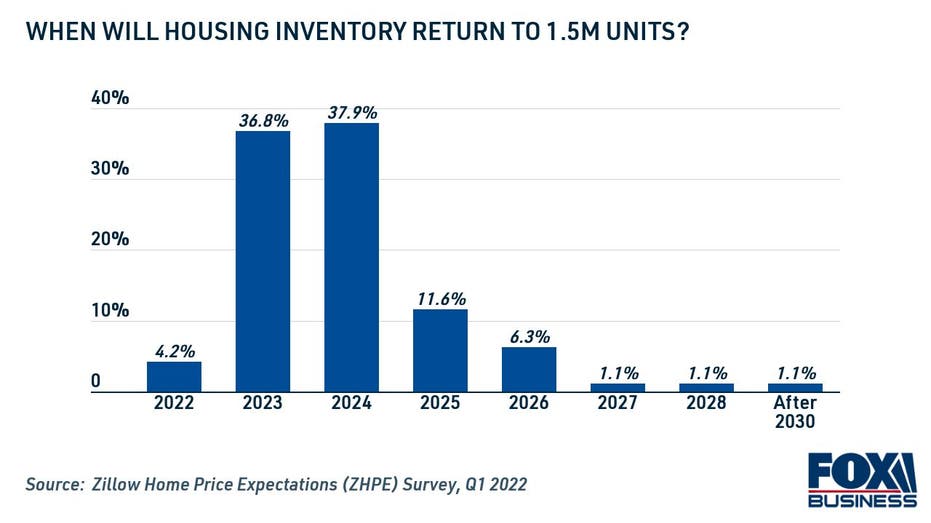
Serious estate specialists polled in the most current Zillow Home Cost Anticipations Survey (ZPHE) think that housing stock will not return to a every month common of at minimum 1.5 million readily available models right until the conclusion of 2024. Economists also concur that property cost appreciation will sluggish down but go on to mature in excess of the next numerous several years.

When will housing inventory return to 1.5M units?

THE METRO Spots In which Us residents MOVED TO — AND Absent FROM — IN 2021

“We are viewing new listings returning to the market, gradually, as we enter the most popular advertising season of the year, but this source deficit is heading to get a extensive time to fill,” Zillow Senior Economist Jeff Tucker said.

Keep studying to master more about Zillow’s most recent housing marketplace forecast. And if you might be looking at shopping for a house or refinancing your property finance loan this yr, you can take a look at Credible to compare fascination fees for free of charge without impacting your credit score score.

NEW Home loan PAYMENTS Leap 8{d4d1dfc03659490934346f23c59135b993ced5bc8cc26281e129c43fe68630c9} IN FEBRUARY AMID SOARING Costs, Residence Prices

Household value appreciation fees may slow, but yearly will increase to keep on being significant

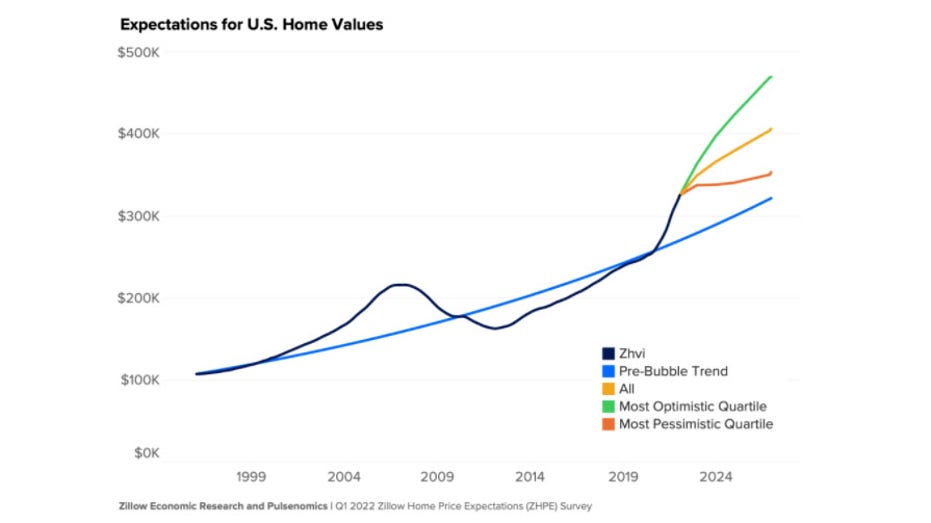
Household value appreciation was 19{d4d1dfc03659490934346f23c59135b993ced5bc8cc26281e129c43fe68630c9} in 2021 owing to confined provide coupled with sturdy demand from customers from homebuyers seeking to consider edge of minimal house loan prices. And though surging fascination rates may well cause need to gradual down, gurus surveyed by Zillow still assume median prices to continue on soaring 9{d4d1dfc03659490934346f23c59135b993ced5bc8cc26281e129c43fe68630c9} in 2022 as inventory struggles to rebound. 

On average, survey respondents forecast 26.8{d4d1dfc03659490934346f23c59135b993ced5bc8cc26281e129c43fe68630c9} residence selling price gains about the next 5 years. The most bullish respondents assume property selling price gains of 46.5{d4d1dfc03659490934346f23c59135b993ced5bc8cc26281e129c43fe68630c9} by the end of 2026, while conservative estimates forecast a 10.3{d4d1dfc03659490934346f23c59135b993ced5bc8cc26281e129c43fe68630c9} amount of appreciation in that time.  

Expectations for US home values, Zillow

Greater Academic Accomplishment Will increase HOMEOWNERSHIP Chances

Despite the fact that this might appear intimidating for to start with-time consumers, this healthful prolonged-time period progress forecast features a glimmer of hope for these who are enthusiastic plenty of to get a property in modern competitive market place.

“Inventory and mortgage rates will identify how far and how quick household rates will rise this year and outside of,” Tucker claimed.

If you might be looking at getting a household when mortgage charges are edging higher, it can be significant to store all around across multiple lenders. You can compare home finance loan rates on Credible to discover the least expensive amount probable for your economical circumstance.

FANNIE MAE TO Look at ON-TIME Rent PAYMENTS WHEN UNDERWRITING Mortgages

Recent house owners may well profit from amplified household fairness

Homebuyers usually are not the only shoppers who really should be using notice of soaring residence values. Recent property owners may take into consideration getting gain of report-superior home fairness with a cash-out home finance loan refinance.

Cash-out refinancing is when you get out a larger home loan sum than what you at present owe, pocketing the variance in cash. This might let house owners to spend off substantial-interest debt or finance residence renovations at a reduced fascination level than what is actually offered by an unsecured personalized personal loan.

It truly is significant to take note that refinancing a house loan arrives with closing charges, normally in between 2{d4d1dfc03659490934346f23c59135b993ced5bc8cc26281e129c43fe68630c9} and 5{d4d1dfc03659490934346f23c59135b993ced5bc8cc26281e129c43fe68630c9} of the total mortgage total. Furthermore, you are going to want to make sure you are equipped to even now get a competitive mortgage loan amount compared with what you are presently paying.

While home finance loan desire fees are on the rise, some home owners may perhaps however benefit from refinancing. You can see existing mortgage charges in the desk down below to decide if refinancing is worthwhile. Plus, you can get in touch with a well-informed personal loan professional at Credible to establish if property finance loan refinancing is the appropriate financial strategy for you.

FREDDIE MAC TO Bolster Reasonably priced HOUSING Application

Have a finance-associated question, but really don’t know who to question? E-mail The Credible Funds Skilled at moneyexpert@credible.com and your concern may possibly be answered by Credible in our Money Skilled column.

Zillow helped drive up Triangle real estate prices, but its decision to exit could lead to deals :: WRAL.com

Zillow helped drive up Triangle real estate prices, but its decision to exit could lead to deals :: WRAL.com

— Zillow is seeking to market hundreds of residences it owns throughout the Triangle as the enterprise will get out of the fast house getting, or iBuying, organization.

The on the web true estate marketplace cited “unpredictability” in forecasting charges for its choice to halt iBuying.

WRAL Information searched on line residence data and identified Zillow mentioned as the owner of 211 homes in Wake County, 62 in Durham County, 41 in Johnston County and 10 in Orange County.

Zillow has been acquiring and marketing homes in the Triangle for 3 decades, and some in the genuine estate industry say the firm has aided drive up house charges by routinely flipping residences days immediately after buying them – from time to time for tens of thousands of dollars in excess of what it compensated.

“There has been a selection of households, most likely the large greater part of them, that have been a little bit overpriced,” Raleigh real estate agent Steve Gunter stated.

Triangle real estate market reaching fever pitch

Jeff Simerson marketed his three-bed room, a few-rest room house south of Garner to Zillow a month ago for $563,000, and the internet site now lists the house for $578,900.

“Everyone kind of looked at me humorous when I claimed I offered my residence to Zillow. They were being like, ‘I didn’t know they were being in true estate.’ I did not, possibly,” Simerson explained.

He claimed his relatives necessary to promote quickly to relocate to Florida, and Zillow designed a funds supply $37,000 over his inquiring selling price.

“We just couldn’t understand wherever they were coming up with that range, simply because the comps in the space didn’t assistance the benefit they were being featuring me,” he mentioned. “If I was heading to however keep in Raleigh, I would have moved down the street to market it for what they were offering us.”

Two other large iBuyers, Opendoor and Offerpad, have far more than 400 households put together in the Triangle, and a 3rd, Redfin, not long ago introduced strategies to enter the sector.

“They are heading to want to be quite thorough about how lots of properties they are getting for each thirty day period and exactly where they are promoting those homes from a selling price standpoint,” Gunter said.

Zillow officials mentioned the houses it owns or is less than agreement to acquire in the spot will go by way of the company’s common process to get them prepared to listing and provide.

But Gunter is telling his shoppers they could get a deal as Zillow winds down its sales operations.

“When we have purchasers looking to place presents in on those qualities, we have just explained to them we’re going to need to give much less,” he reported. “They are starting to promote all those residences for much less than what they have paid for.”

Simerson claimed he is happy he shut on the sale to Zillow when he did.

“If they buy it inflated in the to start with position,” he stated, “they’re going to drop the rate to what the market will sustain.”

Zillow, facing big losses, quits flipping houses and will lay off a quarter of its staff.

Zillow, facing big losses, quits flipping houses and will lay off a quarter of its staff.

Zillow, the real estate internet site identified for estimating property values, explained on Tuesday that it would exit the business of promptly obtaining and providing properties amid heavy losses and that it planned to let go about just about 25 percent of its personnel.

The announcement was a big strategic retreat and a black eye for Richard Barton, Zillow’s main government, who established the business 16 yrs ago and has extensive talked about transitioning Zillow’s common web-site into a marketplace. Final year, Mr. Barton predicted Zillow Delivers, which created instant gives on houses in a practice acknowledged as iBuying, could produce $20 billion a yr.

On Tuesday, Zillow, which explained it has 8,000 personnel, explained the division experienced been the resource of large losses and had created the company’s general base line unpredictable. Zillow Delivers misplaced far more than $420 million in the 3 months ending in September, about the similar amount that the firm had gained in whole for the duration of the prior 12 months.

“We’ve identified the unpredictability in forecasting household rates significantly exceeds what we expected,” Mr. Barton mentioned in a statement accompanying its quarterly financials.

Mr. Barton, speaking on a conference call with analysts on Tuesday afternoon, reported the decision had “weighed heavily” on him. “We could blame the present losses on exogenous marketplace functions,” Mr. Barton claimed. “But it would be naïve to predict that unpredictable functions will not transpire in the foreseeable future.”

In all the corporation dropped just about $330 million in the third quarter, which was much even worse than Wall Road analysts experienced predicted. The business built a $40 million revenue in the similar period of time a 12 months ago.

Shares of Zillow have fallen more than 50 percent from a significant of nearly $200 in February, when it was however a darling of investors as the housing sector heated up. The inventory dropped 11.5 percent on Tuesday to about $85.50 just before it launched its financials, and a even more 7.5 per cent in after-hrs trading. (Even so, Zillow’s shares are value double what they have been at the starting of the pandemic.)

3 many years in the past, the organization introduced strategies to employ its pricing estimates to get and provide properties. Now, Zillow is sitting down on thousands of homes value a lot less than what the firm compensated for them. Final month, Zillow announced it would temporarily end obtaining new households. At the time, it blamed a lack of workers to deal with up and sell the homes it experienced bought. But on Tuesday, Mr. Barton mentioned using its algorithm to get and market properties experienced not developed predictable gains. It is now looking to offload its remaining 7,000 homes.

It appears the corporation underestimated the possibility of keeping houses in concerning transactions, which was a departure from the lower-possibility, superior-margin advert company. And it tried using to rapidly ramp up its home-flipping company to 5,000 transactions a month, which Mr. Barton set as a goal, in a housing sector that was presently reduced on inventory and was commencing to cool off.

Zillow’s stumble also raises questions about its core merchandise, which is developed all-around its price estimates. Aaron Edelheit, who commenced acquiring residences in the wake of the Great Economic downturn, tweeted his thanks to Zillow for shelling out “such an very higher price” for just one of his houses this summer months. “It appeared they ended up stress purchasing,” Mr. Edelheit, who is leaving the authentic estate current market to emphasis on cannabis, advised The New York Times’s DealBook e-newsletter. “I didn’t get it. I should have shorted the inventory.”