Going for walks into this 3,000-square-foot Manhattan apartment a little bit previously mentioned Madison Square Park’s tree canopy, a person can sense that they are walking into the cozy dwelling of a seasoned traveler and collector, who has perhaps occupied the area for many years. But even although it is not tough to ascribe the traveler and collector descriptors to the photographer and mental overall health youth advocate who lives listed here, she only moved into her new property this previous summer season.
That lived-in perception is partly thanks to a syncopated mix of cultures, texture, coloration, and time, courtesy of designer Aamir Khandwala, the former head of decoration at Robert Couturier, with whom the owner has worked for 20-additionally several years, and who now runs an interior style organization of his have.
Right after her spouse handed away and her son moved into his have spot in SoHo, the home owner was completely ready to “just see how a solitary individual lives,” a little something she hadn’t accomplished in a extensive time. That meant minimizing her serious estate portfolio and paying out most of her time in New York Town. To “help relieve the transition” of rediscovering existence on her individual, she wanted to incorporate the amazing recollections of her earlier into her new home’s decor. “I wished to use a handful of items that I normally beloved, that I’ve lived all around. But I didn’t want to use a complete ton I wished a fresh feeling,” she claims.
Immediately after performing on a number of households jointly in excess of the many years, and acquiring an personal information of her feeling of interior fashion, Khandwala describes his key challenge as: “How do you edit everything and curate it in a way the place it appears to be new? Where by it actually looks like it has not been performed before?” The designer and his team layered their way by means of that obstacle, selectively integrating the homeowner’s present selection with new items, ensuing in a room that is sophisticated without having getting unapproachable, maximalist with no staying chaotic, and decidedly female.
“The bedroom, for me, is incredibly significantly Hollywood 1930s and ’40s. It’s glamorous and comfortable,” Khandwala says. Apart from the major bed room, pops of pink can be observed in the living space, principal lavatory mosaic operate, and a lacquered office. “This is the very first time I have been in a position to do all pink. Without having a husband you can start out pinking it out,” the homeowner jokes.
Part of Khandwala’s process was to build a space reflective of areas his customer had traveled to—New York, Paris, California, and Morocco—which proved to be no simple endeavor. Tadelakt, a standard Moroccan complete that lends moderate texture to its surfaces and plays properly with normal gentle, bathes the partitions of the dwelling room. Custom handmade mosaic tiles in the kitchen, the powder place, and the bogs make for a identical reference. “New York and Paris arrive in the layering of the apartment,” Khandwala states. “When you imagine of that black lacquer kitchen area with the brass components, with the mixture of the metals,” he elaborates, referring to the unheard of but strikingly sophisticated end selected for the kitchen area, “to me, that speaks of becoming outdated-earth New York. When you imagine of individuals stunning old properties in Paris, they are layered between shades, textures… 17th-century with the present-day.”
Those people layers are represented all over the Manhattan condominium, where by eight vintage Kaare Klint purple chairs sit easily on major of a present-day personalized silk rug with leather hexagon patches. Elsewhere, the eye can travel from a very hot pink mohair velvet-coated daybed to a pistachio-toned pair of Louis XV giltwood armchairs to colourful present-day shades made by Khandwala’s studio.
“It was an interesting task due to the fact it was just Aamir and myself this time,” the house owner recounts. In the stop, “I was pretty delighted with the consequence. I can be definitely inventive with Aamir he offers me a broad berth. He is as adventurous as I am as much as mixing designers and aspects.”
“The gist of our perform is nevertheless really a great deal centered on collaboration, and that is the element we seriously love the most,” Khandwala chimes in. “That is what helps make our do the job incredibly abundant.”
Nir Meir, Ziel Feldman, and Helene Feldman. Photo-Illustration: Curbed; Photos: Shutterstock/Getty Images
This article was featured in One Great Story, New York’s reading recommendation newsletter. Sign up here to get it nightly.
Ziel Feldman is in good company. At least that’s what the real-estate developer at the center of one of the most spectacular meltdowns in recent memory has been telling himself. The Manhattan real-estate industry is a game of winners and losers, Feldman says, and even titans lose big sometimes. Over the past 18 months, Feldman’s firm, HFZ Capital Group, has been obliterated by foreclosures and investor lawsuits, a collapse that has dredged up unflattering details about the company’s inner workings. Which is why Feldman, on a cloudy afternoon earlier this year, ticked off the names of prominent developers who have, at one point or another, stared down the barrel of bankruptcy. Stephen Ross, Arthur Zeckendorf Sr., Harry Macklowe.
“Every single one — bar none — has run into potentially career-ending roadblocks,” Feldman says, sitting at a coffee table in his corner office, which, despite the imperiled state of his business, overlooks the Plaza Hotel and Central Park beyond. “It’s not for the faint of heart,” he says. “Most successful ones have been bankrupt.”
Though the tabloids and real-estate journals have covered HFZ’s fall with a journalistic fervor usually reserved for war and the Kardashians, this is the first time Feldman has spoken to the press about his company’s implosion. He’s clean shaven and his hair, a jet-black bouffant before the pandemic, is trimmed short and gray.
That Feldman can so easily string together a list of billionaires who have bounced back from financial ruin probably says more about the ludicrous nature of the Manhattan real-estate business than it does Feldman’s own circumstances. In truth, it’s hard to compare any other builder’s misfortunes with the enormous pile of rubble through which Feldman is presently wading. In addition to losing its portfolio, HFZ has been sued by a slew of contractors, lenders, and investors. Lawsuits are to be expected during bankruptcy proceedings, but the allegations of impropriety within some of the suits — including accusations that Feldman and his partner skimmed millions to fund their extravagant lifestyles — are not.
To make matters worse, last year, one of HFZ’s key investors, an Israeli diamond magnate, was convicted of bribery and sentenced to five years in a Swiss prison. And the company’s former managing director of development — someone Feldman employed for more than 20 years — was arrested and sentenced to prison for awarding contracts to the Mafia. Last year, the New York State attorney general confirmed her office was reviewing a fraud complaint against HFZ, though to date, nothing seems to have come of that investigation.
Manhattan has always been a playground for the rich, and the decade-long all-they-can-eat asset buffet that followed the Great Recession nurtured a fresh crop of luxury developers including HFZ, who soaked the city with units that advertised floor-to-ceiling windows and hotel-quality amenities. The boom was fueled in part by overseas buyers — from Russia, China, Latin America, and the Middle East — who stashed their money in those units, investments that offered stability and, thanks to the city’s tolerance of LLC property owners, anonymity. That influx of extreme wealth transformed New York. In little more than a decade, the city’s median sale price nearly doubled, driven by luxury condos in neighborhoods essentially invented by property developers and their marketing teams: West Chelsea along the High Line and Billionaires’ Row, a neighborhood with a boundary primarily defined by its being above everyone else.
Luxury developers raced to keep up with demand, and HFZ was among the splashiest of the bunch. By the mid-2010s, the firm was responsible for a significant percentage of the luxury condos coming to market. By 2015, HFZ’s two top executives, Feldman and managing director Nir Meir, were appearing on lists of the most powerful developers in the city. Their rise culminated with HFZ’s announcement that it was building the XI, a $2 billion megadevelopment along the High Line. The XI, which Feldman called his “shining star” during our conversation, should have bumped Feldman and Meir into the highest echelon of builders, masters of the most recognizable skyline on the planet. Instead, over the course of a single real-estate cycle, their company went from being the industry’s darling to its biggest bust.
Insiders and former employees say there is no one reason HFZ imploded, pointing to an array of issues — poor decision-making, a chaotic work culture, extravagant spending, spreadsheets that said whatever the bosses wanted to hear. Even those who didn’t have a front seat to the turbulence sensed something was awry.
“I would never in a million years do a deal with Ziel,” said one major developer. “He had too many deals, too much leverage, too much razzle-dazzle.There was always a sense that things weren’t what they seemed to be. The pandemic was like that Warren Buffett line: Only when the tide goes out do you see who’s swimming naked.”
For a time, Feldman also blamed the pandemic for HFZ’s woes. In December 2020, HFZ filed a notice with the New York State Department of Labor indicating it had laid off 31 people, almost its entire staff, because of “unforeseeable business circumstances prompted by Covid-19.” But sitting in his office, the 63-year-old trains his ire on one person: his former partner, Meir.
Feldman and Meir worked together for 20 years and, according to former colleagues and friends, never seemed to have any issues until everything came crashing down. Since then, the two have been engaged in an ugly, very public divorce.
“We were like his family. I always said I have three children and that I gave them an older brother, Nir,” says Feldman’s wife, Helene, who is sitting beside him in his office. A former prosecutor in the Brooklyn district attorney’s office, Helene served as HFZ’s “design and creative” principal. She has blue eyes and platinum-blonde hair and wears black leather platform shoes she designed herself. “Ziel really took him in as a son.”
In August, Feldman filed a lawsuit against Meir accusing him of engineering a “Machiavellian scheme to enrich himself through theft, deception and ‘charm.’” Feldman alleged that Meir diverted millions away from HFZ accounts into his own pockets. The lawsuit seeks $688 million in damages. (Meir would not speak to me on the record for this story.)
“With Nir at the helm, we were doomed from the beginning,” Feldman says when he’s done listing formerly bankrupt billionaires. “I’m not aware of any other developer who relied so heavily on a person who turned out to be a very talented sociopath.”
The XI in April 2022. Photo: Gary Hershorn/Getty Images
A Queens native, Feldman started his career as a real-estate attorney in the mid-1980s, a time when, as the journalist Jerry Adler observed, “real estate replaced sex as the venue for the everyday fantasies of most Americans.” Sex never reclaimed the top slot, and in the wake of the 1987 stock-market crash, Feldman sensed there was more money to be made as a developer than as a developer’s attorney.
Eventually, Feldman co-founded a development firm, Property Markets Group, with a banker named Kevin Maloney. There was no shortage of opportunity in the early ’90s. PMG went after SROs, troubled walk-ups, and neglected buildings it could afford to buy and refurbish before raising rents. As a young start-up, PMG’s partners prided themselves on keeping overhead low, stuffing employees into a cramped office with space heaters. Everyone except Feldman worked off cheap folding tables.
“At one end, there was Ziel with his leather-topped partner’s desk, and at the other end, there was me with my card table,” said Maloney. “Ziel liked to have a higher standard of living than I did. That was important to him.”
In 1994, Maloney and Feldman partnered with Gary Barnett, who today runs Extell Development, one of the most successful luxury-condo developers in the city, to purchase the Belnord, a sumptuous Beaux-Arts building on the Upper West Side. The building had been neglected, and its tenants were locked in a bitter fight with their landlord. Barnett and PMG paid $15 million for the building, funded largely by the secretive Israeli diamond dealer Beny Steinmetz, and promised tenants they would spend $5 million on renovations in exchange for the right to increase rents. The project would serve as a blueprint for Feldman for two decades.
Feldman earned a small fortune at PMG. He and Helene built a mansion in Englewood inspired by a Fontainebleau chateau they’d toured on their honeymoon. But by the early aughts, Maloney, who continues to run PMG, wanted to spend more time concentrating on deals in Florida, while Feldman was eager to expand in Manhattan.
People who knew and worked with Feldman say he seemed to be driven by an unspoken desire to reach the penthouse of Manhattan real estate: the dynastic families — Durst, Zeckendorf, Speyer, LeFrak, Rose, et al. Feldman liked to talk about what made a successful developer, and more than anything, he thought of himself as a tastemaker attuned to the city’s trends and needs. In 2005, Feldman started HFZ (Helene, Feldman, Ziel) and brought with him a few PMG employees including Meir, whom Feldman tapped to be HFZ’s managing principal. In his 20s at the time, Meir was younger than Feldman. He had short, dark hair and the chiseled jaw of an action figure. He’d grown up between Israel and Paris, and he told people he served in the Israel Defense Forces before moving to New York in the early aughts.
In Meir, Feldman found someone whose skill and ambition matched Feldman’s own desire to grow HFZ. Meir was excitable, a fast-talking bulldog who dug into the minutiae of every project. During the day, he pored over spreadsheets, adjusting projections and timetables, and at night, he’d hit the town to develop relationships with lenders and investors. In that way, Meir complemented Feldman, who increasingly enjoyed playing the part of the elder statesman, providing big-picture strategy.
After the real-estate bubble burst in the late ’80s, Feldman learned a frustrating truth about postrecession markets: While there was no better time to buy real estate, there was also no harder time to find investors and lenders. To Feldman’s great satisfaction, Meir proved to be particularly adept at raising money from both institutional lenders and overseas investors. “JPMorgan loved him,” Feldman says.
According to Feldman and former colleagues, Meir had a magnetism that drew in wealthy investors, people he would wine and dine at Carbone or La Esquina before taking them to clubs. With their backing, HFZ went on a buying spree that resembled deals Feldman made in the ’90s with PMG, snatching up distressed buildings other developers wouldn’t touch. The press took notice. “Developer turns flops to gold,” read a 2013 Crain’s headline that referred to Feldman as the “man of the hour.” The Observer published a feature on Feldman, saying he’d “emerged out of nowhere” to rescue One Madison Park, the all-glass residential tower with a penthouse that would serve as Rupert Murdoch’s postdivorce bachelor pad. The Daily News called him the “modern-day John Jacob Astor” for his renovation of prewar apartments on the Upper West Side.
“These guys were magicians about playing the capital markets. They knew there was so much capital in the world and that banks and bankers were hungry to put that money to work,” said someone who worked with Feldman and Meir. “But they were the step-kids trying to get into the world of the big families controlling real estate. They were successful, but they were doing it in a shady way.”
Historically, the families haven’t needed to rely on foreign money to fund their projects. They are so obscenely rich that they can, for the most part, afford to play the game on their own. But if Feldman’s goal was to establish a dynasty, he needed to do so with other people’s cash.
By the late aughts, Steinmetz’s fortune had ballooned to make him one of the richest people in Israel, and he was pumping hundreds of millions of dollars into real-estate projects around the globe. It was an open secret among HFZ employees that Steinmetz, who is intensely private about his business and personal life, was a major HFZ backer. But when a reporter from The Real Deal asked HFZ about its relationship with the diamond dealer in 2016, a spokesperson emphatically denied any personal or professional connection to him.
Emails, text messages, and interviews with former HFZ employees show Steinmetz was intimately involved with HFZ. In fact, at one point, Steinmetz had employees based inside HFZ’s office. Multiple former HFZ employees recalled Meir taking last-minute trips to the Mediterranean to meet with Steinmetz. According to emails made public in court proceedings, Steinmetz would email Meir to discuss details of deals. Once, Steinmetz’s lawyer emailed Meir to ask him to scrub the diamond dealer’s name from an investment organization chart. Meir dutifully agreed.
Feldman denies ever lying about his connection to Steinmetz. He claims Meir erected a firewall between Feldman and the diamond dealer, as he did with most foreign investors. But HFZ and Steinmetz had good reasons to conceal their relationship. In 2009, Steinmetz’s company won the rights to mine the Simandou mountains in Guinea, one of the most prized mining contracts in the world. A year later, Steinmetz sold half of those rights to the Brazilian mining firm Vale for $2.5 billion. Then, in 2014, the Guinean government revoked Steinmetz’s rights, alleging his company had bribed the youngest of the late Guinean president’s four wives to secure the deal. In 2021, a Swiss criminal court found Steinmetz guilty of corruption and forgery related to the Simandou deal, sentencing him to five years in prison. (Steinmetz, who lives in Israel, has indicated he intends to appeal the decision. Last year, Steinmetz was briefly detained in Greece on an Interpol red notice related to a 2020 bribery case in Romania in which he was found guilty and sentenced to five years in prison.)
For years now, Vale has been trying to recoup its initial $1.25 billion payment to Steinmetz. As part of that action, Vale’s attorneys have traced money from the Simandou deal to investments Steinmetz made in HFZ projects including the XI. (HFZ isn’t the only developer Vale’s attorneys are interested in; they’ve also subpoenaed Aby Rosen’s RFR Holding.)
Helene, the daughter of a Holocaust survivor, and Ziel, whose father ran a family textile business, often talk about their humble roots in Queens. But as HFZ’s portfolio grew, so did the Feldmans’ presence in watermarked photos taken at New York society parties. They attended galas from Palm Beach to Antibes, were staples at Art Basel in Miami, and hosted charity fundraisers at their 8,000-square-foot home on Dune Road in Bridgehampton, where guests mingled between an infinity pool and a pool-size infinity hot tub. They chipped in $25,000 for Donald Trump’s 2016 presidential campaign and sat on the board of directors of a hospital in Israel. Acknowledging a connection to Steinmetz, a controversial figure by Feldman’s own admission, may have put his success in a new light.
“Ziel is a very high-flying guy, but he was never in the families,” said a former colleague. “He wanted to establish that for his family. He wanted a generational business. But Rob Speyer is not in bed with Steinmetz.”
The opening of the XI gallery on April 25, 2018. Photo: Craig Barritt/Getty Images for XI Gallery
In 2015, HFZ made its most aggressive move yet, purchasing the empty 1.75-acre lot at 17th Street and 11th Avenue with a plan to build a large luxury condo and hotel. Before the sale, the lot had an unremarkable history, hosting a few houses, a string of gasworks facilities, a rail yard, and Edison Properties parking lots. But in 2009, the neighborhood around the lot started to change. Thanks to a Bloomberg-era rezoning and the reinvention of the High Line, West Chelsea very quickly became an Eden for high-profile architects looking to leave a mark on Manhattan. In little more than a decade, Frank Gehry, Thomas Heatherwick, Renzo Piano, Jean Nouvel, Zaha Hadid, and others planted expensive buildings that crisscrossed the High Line with shadows. Property values skyrocketed, and by the time Edison put the lot at 76 11th Avenue on the market in 2014, it was a very valuable tract of land. When the dust settled, HFZ had the highest bid: $870 million. It remains one of the largest residential-land sales in New York City history.
“Everybody gasped. No one could believe the price they paid for the land,” said Andrew Gerringer, a veteran real-estate marketer who has worked with HFZ on a number of projects. “Everybody thought it was a good area, but those of us in the development business were like, Jeez, this is a really high number.”
Feldman’s willingness to pay stemmed, in part, from his vision for the building he planned to erect there. Feldman believed the XI (variously pronounced ex-eye, eleven, eleventh, zee, or shee, like the general secretary of the Chinese Communist Party, depending on whom you ask) would be so spectacular that it would woo one-percenters away from the Upper East Side and Billionaires’ Row. The XI would embody what Feldman believed to be the ultimate 21st-century fantasy: a self-contained urban-resort life with spaces and amenities that made residents feel as if they were living in a hotel — a 75-foot swimming pool, a sauna, a wine-tasting room, and an art gallery.
Luxury-condo sales were booming in 2015, but even the most data-driven developers were rolling the dice. By spending $870 million just for the land, HFZ was starting in a very deep hole, and it would need to sell the XI’s 576,551 square feet of residential units for roughly $4,000 per square foot, a price rarely secured in neighborhoods that don’t abut Central Park. And that was assuming the market kept apace.
“Very few people in the office thought that the XI was a smart deal,” said a former employee. “There was no ability for any of us below Ziel and Nir to influence this decision. My guess is that Ziel liked the idea of it. He liked the attention it brought him, and Nir needed to grow the company and get big deals and keep money coming in the door.”
Developers are by nature optimists, and Feldman was no exception. When The Real Deal’s Hiten Samtani asked Feldman about criticism of the $870 million price tag, Feldman balked at the question, saying he had too much experience to let naysayers influence him. “It meant nothing to me,” Feldman replied. “It was actually kind of humorous.”
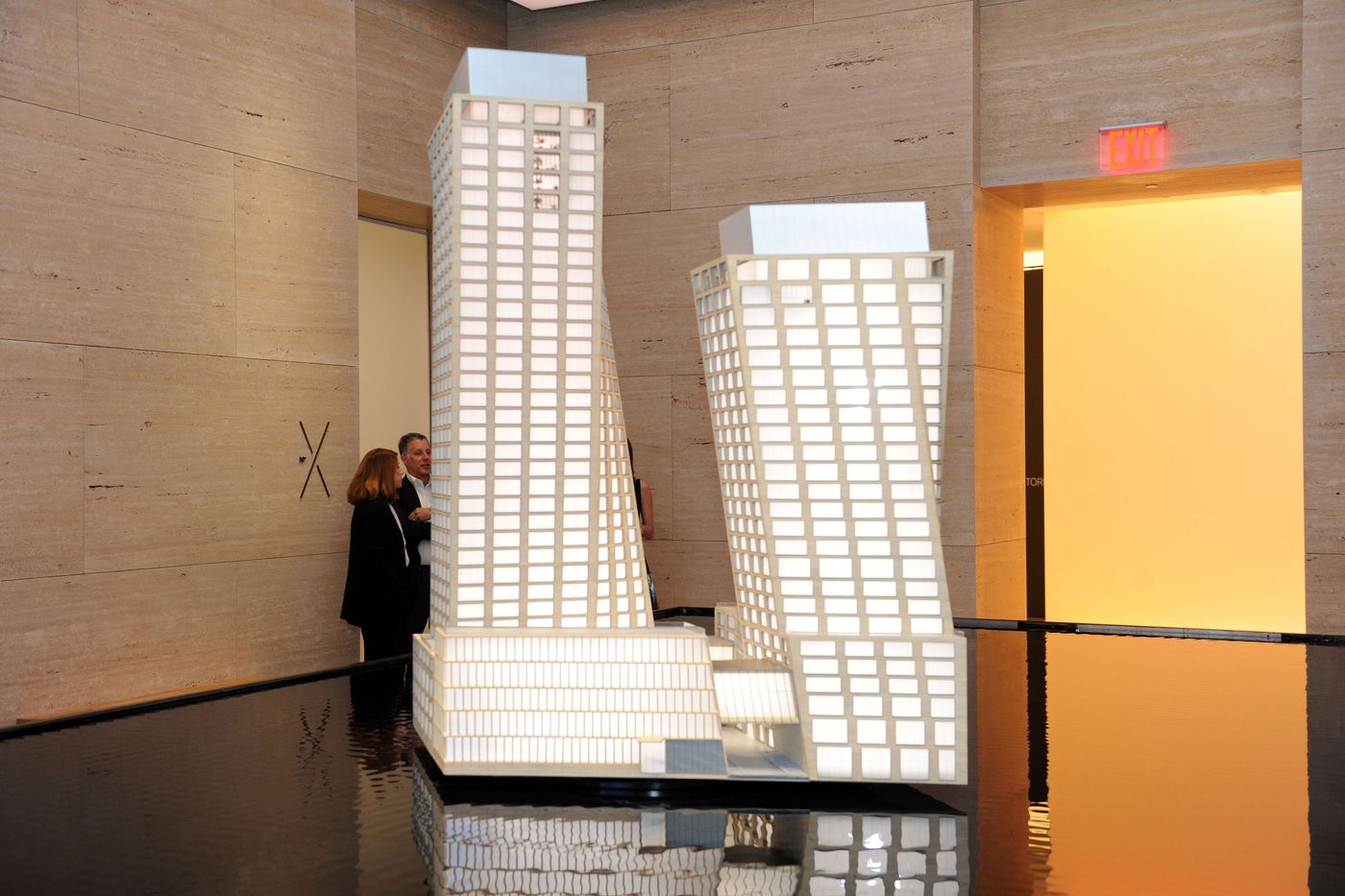
One reason Feldman shrugged off naysayers was because he had bagged Bjarke Ingels, one of the most sought-after architects in the world, to design the XI. Starchitects can charge as much as 25 to 30 percent more than their lesser-known colleagues, and Ingels was all but guaranteed to deliver a complicated, expensive design, but that didn’t matter to Feldman. Partnering with the young, swaggering Dane would send a message to the entire industry: HFZ was ready to leave its mark on the Manhattan skyline. The final plans called for the top floors of the XI’s two towers to cantilever over the shared base by 50 feet, so they seemed to be leaning, unnervingly, like the Tower of Pisa. Engineering reports talked of “torsional irregularity” and “gravity load induced lean,” which added to the “inter-story seismic drift.”
By January 2018, some 800 workers were employed at the site. Rebar shot out of the ground like fingers poised to pull the rest of the building up behind it. After the concrete was poured, Ingles’s design took shape, and the first of the building’s 11,000 travertine panels, imported from a quarry in Tivoli, was put in place. Someone called 311 to report “a building that is leaning south.”
From the start, some HFZ employees expressed apprehension about bringing Ingels onto the project. They knew Ingels would deliver a complicated — and expensive — design that would have a greater likelihood of hitting snags than a conventional building. And when the XI’s concrete settled, it did so in such an unpredictable way that the initial batch of windows didn’t fit into their frames, triggering one of a number of costly delays that befell the project.
“The true risk to a developer is the time and the cost of funds. That’s for the good developers who estimate everything properly and don’t take too much for granted,” said Barnett, who partnered with Feldman on the Belnord in the early ’90s and whose company, Extell, is responsible for two of the twiglike towers swaying over Billionaires’ Row. “There are cautious developers and there are ultracautious developers, and Ziel has never been either.”
Es Devlin’s “Egg” on display in the XI gallery in 2018. Photo: Johannes Schmitt-Tegge/picture alliance via Getty Image
By 2016, HFZ had grown to employ more than 100 people, and its Madison Avenue offices reflected the company’s fast success, looking more like a modern-art gallery than a real-estate development firm. Feldman regularly talked about the connection between art and real estate. “Artists tend to be frustrated developers,” he told Artnet in 2018. “Architects think they’re artists. Developers, we think we’re all of those things.” (He and Helene say some version of this to me again during our interview.) Employees and visitors alike rolled their eyes at some of the over-the-top pieces from the Feldmans’ collection on display at the office — including Patricia Piccinini’s The Student, a hyperrealistic pig-baby made with actual human hair, a Gimhongsok dog made of stuffed garbage bags cast in bronze, and the George Condo portrait Girl With Green Hair, which was auctioned at Christie’s for $437,500 after HFZ’s downfall.
Former employees’ descriptions of the art ranged from “zany” to “so, so, so terrible.” Everyone believed the art was an extension of their bosses’ approach to development. Feldman’s obsession with art, and the status his proximity to the art world conferred upon him, frustrated some. “Ziel was always focused on stuff that didn’t matter,” said a former employee. “He thought he was an arbiter of design, style, and taste. He’d sit in architecture meetings and bring his wife in and think that that was the important part of the business.”
The art wasn’t the only disconcerting presence in HFZ’s offices. Feldman and Meir, employees say, ran HFZ as a diarchy in which they shared total power. Employees who expressed professional opinions — or, several claimed, facts that contradicted the leaders’ points of view — were disregarded or ridiculed. One former employee, talking about her experience on a recent wellness podcast, described HFZ’s atmosphere as “icky,” “Wolf of Wall Street-y,” and “Machiavellian.”
Former employees said it was Meir, more than Feldman, who set the tone. By the time HFZ broke ground on the XI, Feldman was hardly involved in his own company’s day-to-day operations. Meir floated around the hallways, popping into people’s offices to grill them about HFZ projects. In addition to his talent for raising capital, Meir had a gift for numbers. At times, former employees said, it was as if the company’s true ledger existed only in Meir’s head. HFZ proposals were not submitted to investors until Meir looked over the numbers. Sometimes, Meir would ask employees to juice spreadsheets so projects looked better on paper. Occasionally, if an employee refused to alter a projection, Meir would ask the employee to send him the Excel spreadsheet, presumably so he could make the adjustment.
In the spring of 2018, HFZ opened the XI Visionaries Gallery, a 12,000-square-foot salesroom located in a storefront a few blocks from the XI. The space was unlike any sales gallery anyone in the industry had ever seen before. At its center were “multi-sensory installations” by Es Devlin, a British artist known for designing elaborate stage sets for Kanye West, Lady Gaga, and the Weeknd. At the gallery’s opening, men in black suits poured complimentary glasses of Macallan 25, which retails at $1,999 a bottle. One former employee estimated the total cost of the sales gallery to be at least $25 million. Units went on sale in the fall of 2018. Jeff Bezos reportedly showed interest in a penthouse before opting for a Madison Avenue spread. Graeme Hart, the richest person in New Zealand, snatched up one of the XI’s penthouses for $34 million.
Then the luxury-condo market started to strain under the weight of excess inventory. A 2019 analysis by StreetEasyestimated that a quarter of all new luxury apartments built after 2013 had not found buyers, an inauspicious indicator for a developer that had recently brought 236 glistening units to market. (Filings would later show that just 38 of those units, or 16 percent, were sold by the time HFZ went bust.) Feldman remained optimistic that his brand of luxury was strong enough to buck market trends. “It’s about the buildings — you can’t broad-stroke an entire market,” he told the New York Times.
Yet HFZ was already showing signs of distress. In October 2019, HFZ failed to pay an $8.2 million invoice to Pioneer Window, which had a $98 million contract for work on the XI. Initially, executives at Omnibuild, the construction firm overseeing the XI, weren’t surprised by the unpaid invoice. “We knew through the industry that they may be a little bit of a crazy bunch, but I guess everybody’s crazy in this business,” Omnibuild COO John Mingione told Crain’s. But not all of HFZ’s contractors could afford to be so patient. “GUYS — CABINETS ARE READY — I NEED ‘my’ MONEY,” Jan Efraimsen wrote in an email in November. Efraimsen’s company had been producing millwork for an HFZ building on the Upper West Side, and Efraimsen was trying to collect an outstanding balance of $163,652.90, a lot of money for his small operation. “I am desperate for money right now–anything will work,” he wrote in a follow-up email. “Unfortunately we just don’t have answers,” David Szczapa, a project manager at HFZ, wrote back to Efraimsen, who was later forced to lay off three of his carpenters. Szczapa’s hands were tied. By the end of 2019, it seemed as if all payments depended on Meir’s approval. According to three former HFZ employees, project managers would tell Meir that some contractor was complaining because they hadn’t been paid only to be told that he would handle it.
The unpaid invoices were the first flutters of HFZ’s tailspin. At the end of 2019, the FBI arrested John Simonlacaj, HFZ’s managing director of development, for offering lucrative XI contracts to Gambino associates in exchange for free work on his Westchester home. (He eventually pleaded guilty to filing a false tax return and was sentenced to four months in prison last summer.) This wasn’t Simonlacaj’s first arrest. In 2015, he had spent three months in prison for tax fraud. Simonlacaj had worked for Feldman going all the way back to PMG, and when he finished his prison sentence, Feldman allowed him to return to work, a decision Feldman now calls “a big mistake.”
“They just let him show back up. It was mind-blowing that they never acknowledged it,” one former HFZ employee said. “Why would they let a convicted criminal come back?”
Then COVID-19 hit, and a wave of existential dread swept through the real-estate industry. “We were overleveraged even before COVID,” said a former HFZ employee in the accounting department. “They were depending on acquisitions to pay the payroll, insurance, everything. So there was suddenly no money.” HFZ’s foreign investors were getting agitated. Yoav Harlap, an Israeli car importer and art collector who had given HFZ more than $20 million for a development on the Upper East Side and a $10 million investment in the XI, began pestering Feldman and Meir about repayment. Meanwhile, the Los Angeles–based hedge fund CIM Group, which had loaned HFZ $90 million to convert four prewar buildings on the Upper East Side, was pestering Meir about a late payment. “What’s the latest? Running out of time,” wrote Adam Gibbons, a managing director at CIM, one afternoon in July. “On it. 2 min,” Meir wrote back. Four hours later, Meir sent Gibbons a confirmation code showing he’d initiated a payment. The code turned out to be fake, according to CIM, as The Real Dealwould later report.
In the early days of the pandemic, Meir and his family, like many Manhattanites, decamped to the Hamptons. In 2013, Meir had knocked down a ten-bedroom beachfront “cottage” on Southampton’s Meadow Lane and built a modern 6,600-square-foot mansion. The home had been a gathering place for friends, family, and the occasional HFZ employee. Meir and his wife, Ranee Bartolacci, regularly hosted omakase nights, bringing a sushi chef from Manhattan for private dinners. Sometimes omakase nights would be followed on Sundays with pizza catered by Nolita’s Pasquale Jones.
“Nir spent more money than God,” said a former HFZ employee. “No one was clear where the money was coming from. What success had the company realized that we were unaware of?” Feldman’s complaint against Meir alleges that Meir’s monthly American Express bill often exceeded $400,000. Meir spent hundreds of thousands on wine and kept a stable of luxury cars including five Mercedes G-Class wagons and a 1996 Porsche 911 Turbo valued at $300,000.
Back at the office, I ask the Feldmans why they never questioned Meir’s spending. In retrospect, Feldman says, he knew very little about Meir’s personal life. He and his wife claim they’d assumed the money had come from Bartolacci’s grandfather, not from HFZ. That assumption might be plausible if Meir had merely been someone they occasionally bumped into at Hamptons parties and not someone with whom Feldman had entrusted his multibillion-dollar business or someone whom Helene, minutes earlier, called an adopted son.
“It’s hard to describe,” Helene pleads. “You have to start with the mind-set that there was no reason not to trust him.”
According to Feldman, a series of incidents in the fall of 2020 tipped him off to how bad things had gotten at his company. One day at the office, Feldman said he checked in on a group of accountants carrying out an audit for an HFZ investor. When Feldman asked if they had everything they needed, the accountants told him Meir had instructed them not to bother Feldman because he’d recently had open-heart surgery. (He had not.) Then Feldman said he was alerted to documents bearing his signature, which he alleges Meir forged. Feldman also found out about a term sheet that he claims Meir doctored to look as if HFZ had received a $900 million loan from JPMorgan Chase in 2020. (HFZ had received the loan in 2019.) The final straw came when Feldman spoke to an investor who said Meir had fabricated a Korean investor, even enlisting someone with a Korean accent to dial into a phone meeting, according to Feldman’s complaint. Feldman fired Meir in December 2020. It was the last time the two spoke.
Former HFZ employees were quick to cast Meir as a rogue, but their descriptions of Feldman were more complex. He was aloof or asleep at the wheel. No one could say how much Feldman did or didn’t know about the way Meir was handling HFZ’s business. But they agreed that Feldman reveled in the success Meir brought to HFZ, and they blamed him for the company’s downfall just as much as they blamed Meir.
“You get complacent. Of course I’m to blame,” Feldman says, admitting for the first time that he made mistakes beyond trusting Meir. “But there really is no scenario, if you really study it, where it turns out to say that Ziel may have known, should have known, or was involved with it.”
That line of defense hasn’t played well in court. In March, the Appellate Division of the New York State Supreme Court said Feldman was fully aware of Meir’s role and authority at HFZ, ruling that he was liable for the claims brought by Harlap, the Israeli car importer. “For several months, Feldman had notice of all the underlying transactions, as well as the default thereunder and negotiations to resolve it,” the court wrote. “He then received actual copies of the allegedly unauthorized agreements, signed by Meir and one bearing his own ostensible signature, but conducted no investigation and made no objection for three months prior to being sued.”
Because Feldman offered personal guarantees on HFZ projects — risking his net worth, some $110 million — the company’s collapse has come at considerable personal cost. A year ago, the Feldmans sold their mansion in the Hamptons for $50 million, and they recently reduced the asking price for their 6,100-square-foot, black-marbled penthouse at the Marquand, an HFZ building on 68th Street and Madison Avenue.* They’ve sold off most of their art collection as well.
“People tell you all the clichés: ‘Oh, your family will be so much better off.’ Yeah, it’s very sweet and very nice. You read The Daily Stoic, it’s wonderful,” Helene says, rolling her blue eyes back. “I think, for us, it has really given us a chance to reset. It has changed our life drastically, certainly from a lifestyle perspective. No, we don’t have the house in the Hamptons anymore, and we don’t know what tomorrow’s going to bring. But as a family, and speaking as a mother, I’ve seen my family and children rise to the occasion and then some.”
When Meir listed his Southampton home last year, Feldman filed a lawsuit claiming the beachfront mansion had been HFZ’s property all along. Feldman accused Meir of forging his signature — again — to gain control of the house. In May, New England Patriots owner Robert Kraft bought the home for nearly $43 million. (The vast majority of the proceeds ultimately went to Bartolacci, under whose name it was registered. In a deposition, Bartolacci claimed the house was a birthday present but was unsure who had actually put up the money to purchase the property, per The Real Deal.) According to Feldman’s suit, Meir continues to spend like a Saudi prince, blowing hundreds of thousands on fine wine, strip clubs, private jets, and yachts. He and Bartolacci also spent $1.5 million on gold coins and bullion.
Meir is still on the hook for a $19 million judgment Harlap won against him. Harlap has alleged that, in order to avoid payment, Meir transferred his assets to Bartolacci and fled New York. At least part of this is true: Last summer, Meir and his family rented a modern bayside home in Miami Beach for $150,000 a month. In September, the landlord sued Bartolacci, whose name is on the lease, saying she had made some unauthorized modifications to the rental, which included the installation of a new dock, the replacement of the natural grass with synthetic turf, and the construction of a cage for the family’s bearded dragon.
Of the half-dozen major developers interviewed for this story and many more real-estate insiders, none would predict the end of either Meir’s or Feldman’s careers. That’s because their futures depend on whether they will be able to raise money, and as one former HFZ employee put it, the market’s blind hunger for New York real estate is insatiable.
“People are so hot for New York real estate — private investors are so eager to put money into New York real estate — that they don’t even pay much attention to the people they’re investing in,” the former employee said. “They just gave HFZ hundreds of millions of dollars because they trusted Nir or Ziel? It all kind of made me see how unsophisticated private-lender capital was. Banks were lending and then turning a blind eye for years. HFZ borrowed billions on what? A personal guarantee? A one-page balance sheet Ziel had?”
In the meantime, the luxury real-estate market has moved on without HFZ — sales of high-end units remain more than 50 percent higher on a monthly basis than they were in 2015. As for Feldman’s shining star, the XI, work on the building stopped in 2020, and the construction site has been eerily quiet for the better part of two years. In December, the Witkoff Group partnered with billionaire Len Blavatnik to purchase HFZ’s stake in the project for $900 million at a debt auction. Witkoff found a new contractor to oversee the site, and in the past few weeks, there have been signs that construction is restarting. Scaffolding has been repositioned, and the cladding is again creeping up the sides of the towers, securing the XI’s place in Manhattan’s skyline one travertine panel at a time.
*A previous version of this article said the Marquand, an HFZ building on 68th St. and Madison Avenue, is mired in litigation. In fact, HFZ is not involved in litigation over the Marquand and the story has been updated to reflect that.
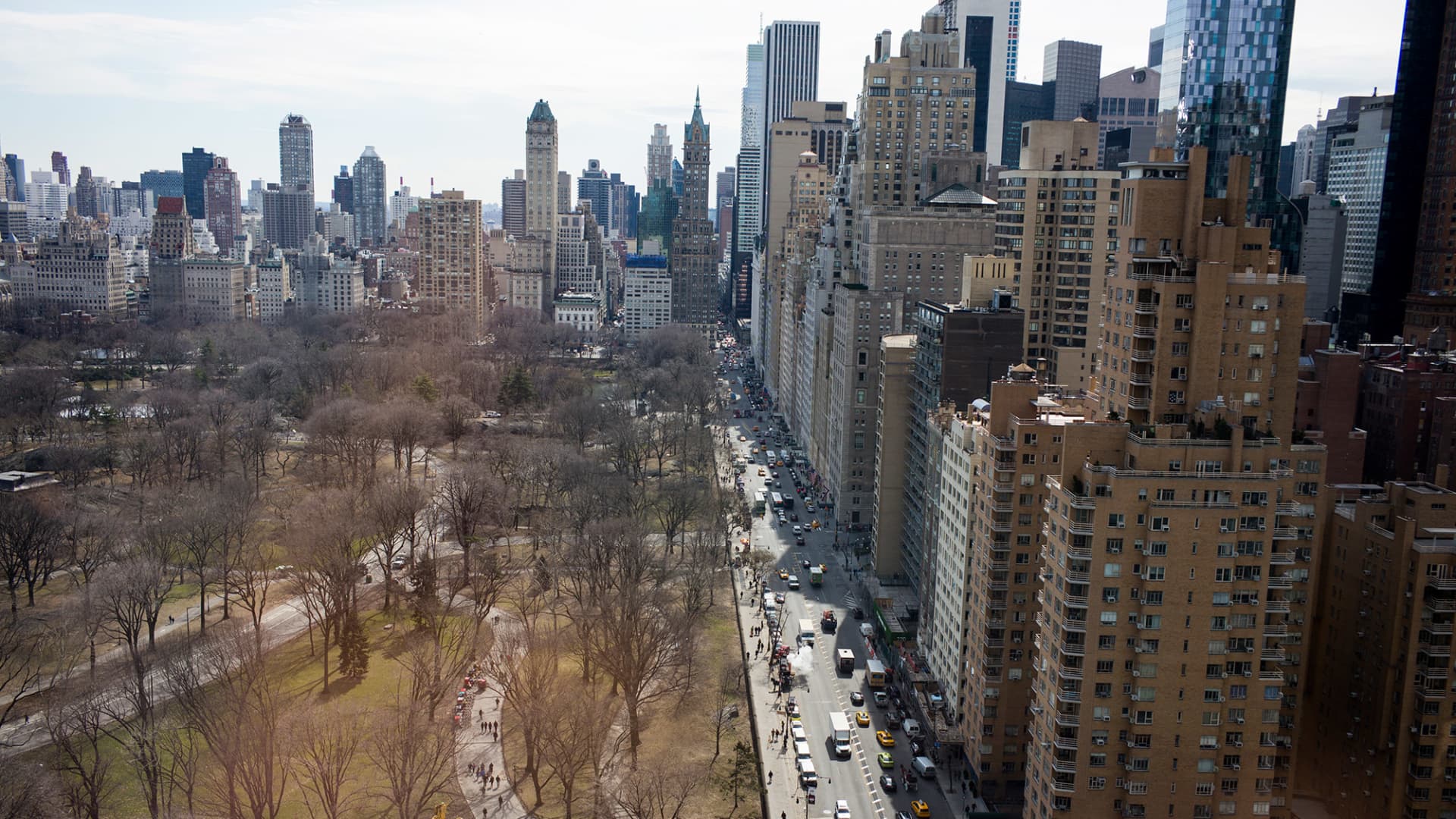
Luxurious higher-rise flats are considered throughout Central Park South near Columbus Circle in the Manhattan borough of New York.
Robert Nickelsberg | Getty Pictures
Manhattan residential actual estate income topped $7 billion in the first quarter, marking the strongest-ever commence to a calendar year as the marketplace reveals no indicators of slowing, according to new profits info.
There have been 3,585 profits in the 1st quarter, the highest amount at any time for a initial quarter, in accordance to a report from Miller Samuel and Douglas Elliman. Which is up 46{d4d1dfc03659490934346f23c59135b993ced5bc8cc26281e129c43fe68630c9} from the very first quarter of 2021. Total product sales quantity surged by 60{d4d1dfc03659490934346f23c59135b993ced5bc8cc26281e129c43fe68630c9} to in excess of $7.3 billion, as falling inventory also led to ongoing expansion in rates.
The common selling price of a Manhattan condominium jumped 19{d4d1dfc03659490934346f23c59135b993ced5bc8cc26281e129c43fe68630c9} over the former year’s period, to $2,042,113.
The energy arrived irrespective of soaring fascination prices, worries about a attainable recession and slipping stocks, which have a tendency to have an outsize impression on the Manhattan genuine-estate marketplace offered the city’s dependence on the fiscal marketplace.
It won’t glance like a force for a return to the workplace is driving the raise, possibly. Only about 36{d4d1dfc03659490934346f23c59135b993ced5bc8cc26281e129c43fe68630c9} of New York workers have returned to the office environment, according to facts from Kastle Devices.
Jonathan Miller, CEO of Miller Samuel, the appraisal and research corporation, reported the assumption that people dwell in Manhattan because of their jobs is now remaining challenged.
“You have a whole lot of people today who are doing work remote, but want to be in Manhattan,” he explained. “They’re captivated to the cultural offerings, the eating places, Broadway. Distant do the job isn’t going to just necessarily mean the suburbs. There could be as lots of people doing work remotely on the Upper East Facet of Manhattan as there are in Westchester.”
Rising desire rates also have significantly less impression on wealthy purchasers, who dominate the Manhattan sector. As prices go up, they just pay far more hard cash. Much more than 47{d4d1dfc03659490934346f23c59135b993ced5bc8cc26281e129c43fe68630c9} of all true-estate purchases in the quarter have been all-cash, up from the pandemic very low of 39{d4d1dfc03659490934346f23c59135b993ced5bc8cc26281e129c43fe68630c9}, and nearer to the historic norm.
A further explanation for Manhattan’s toughness at the get started of 2022 was source. Though the rest of the country grapples with a lack of households for sale, Manhattan continue to has ample inventory, even even though it is declining. Just about 5,000 listings strike the current market in the quarter, the most of any initially quarter on file, according to Corcoran. Nonetheless for the initial time in 5 many years, stock dipped below 6,000 units.
“With sturdy profits and strengthening charges, barring any unforeseen shocks, this stellar very first quarter should have everyone experience very optimistic about an additional momentous yr ahead,” said Pamela Liebman, Corcoran’s president & CEO.
The question is how much higher Manhattan rates can go before customers start backing down from bargains. The median cost of a Manhattan condominium hit an all-time file of $1,190,000 in the first quarter. The median value for new progress topped $2.3 million.
The most significant price tag gains are at the top rated. Rates for flats with 4 or a lot more bedrooms jumped 31{d4d1dfc03659490934346f23c59135b993ced5bc8cc26281e129c43fe68630c9} about past yr, to $6.5 million. As consumers droves costs greater, only 20{d4d1dfc03659490934346f23c59135b993ced5bc8cc26281e129c43fe68630c9} of residences bought went for fewer than $1,200 a square-foot, the least expensive percentage on report, according to Corcoran.
Manhattan’s luxurious true estate market has proven steady progress this month.
There were being 41 contracts signed for residences inquiring $4 million or extra in Manhattan in the 7 days ending Sunday, the identical amount as the prior week, tying for highest weekly complete so much this 12 months, according to Monday’s report from Olshan Realty.
The contracts bundled 25 condos, 11 co-ops and five townhouses. Even however the amount of contracts stayed the same from the former 7 days, the total gross sales quantity of the 7 days was $319.22 million, appreciably increased than the previous week’s $280.94 million.
“It was the year’s most important 7 days in co-op gross sales considering the fact that mid-December, with 7 of the 11 co-op offers on the Upper East Side,” the report famous.
“Up until eventually the pandemic, we had been advertising three instances as numerous condos as co-ops. And due to the fact the pandemic, it is been 4 to one particular,” explained Donna Olshan, president of Olshan Realty and the report’s writer. “Co-ops are advertising at a extremely big lower price in comparison to condos, and some individuals are getting captivated to the item when it’s discounted ample.”
The most high priced offer past week was a condominium at 15 Central Park West made by Robert A.M. Stern, inquiring $25 million. The 3,105-sq.-foot home has a few bedrooms and a few and a 50 {d4d1dfc03659490934346f23c59135b993ced5bc8cc26281e129c43fe68630c9} loos, featuring sights of Central Park from the main suite and the residing home.
The previous proprietor paid out $24.5 million for the dwelling in 2011. This was also the fourth time this 12 months that a device at 15 Central Park West was possibly the most or next-most high priced contract, according to the report.
The setting up amenities consist of a 14,000-square-foot physical fitness center with a 75-foot pool, a landscaped motor court and garage, a non-public restaurant for citizens, a sport area, a library, a business centre, a children’s playroom and an outdoor terrace.
The 2nd-most pricey deal was a duplex apartment in Tribeca with a terrace,inquiring nearly $20 million. The past operator acquired the 5,499-sq.-foot house for $12.728 million in 2011. The developing was created in 1931, and the unit was redesigned by Steven Harris Architects, that includes 4 bedrooms, five and a 50 {d4d1dfc03659490934346f23c59135b993ced5bc8cc26281e129c43fe68630c9} loos, a 35-foot residing space with a fuel fire and a 26-foot fantastic area. The initially floor is surrounded by the 1,345-sq.-foot terrace.
The boutique condominium making has a doorman and features facilities like a exercise home, a private storage and a prevalent roof deck.
The progress in Manhattan’s true estate sector was not restricted to luxurious homes. Final 7 days also marked the strongest week in total contracts in Manhattan this yr with 348 contracts signed, in accordance to Garrett Derderian, director of market intelligence at SERHANT. The weekly overall performance was up 17{d4d1dfc03659490934346f23c59135b993ced5bc8cc26281e129c43fe68630c9} from the weekly typical so far this yr.
“Perhaps undeterred by the Russian invasion of Ukraine, buyers proceed to scoop up Manhattan properties at an raising rate as U.S. genuine estate is considered as a secure expense,” Mr. Derderian explained.
Manhattan’s luxury sector had its ideal January in at least 16 a long time, even with the dearth of overseas potential buyers and a new wave Covid-19 slamming the town, according to the weekly Olshan report.
Capping the thirty day period have been 29 contracts signed at $4 million and above in Manhattan in the 7 days ending Sunday, in accordance to the report, unveiled Monday. The total volume for the week was $303 million, which was considerably increased than just about every of the 1st three weeks of January. There ended up 23 condominium and 6 co-op contracts signed, with a median inquiring price tag shut to $8 million.
“In contrast to final month’s lousy stock marketplace performance, Manhattan’s luxury serious estate sector recorded a total of 102 signed contracts at $4 million and earlier mentioned, the strongest January because we begun preserving keep track of in 2006,” wrote Donna Olshan, president of Olshan Realty and the report’s creator.
Past week’s most significant sale was a duplex condominium penthouse at 151 East 58th St. created by late architect Charles Gwathmey, with an asking rate of $36 million. The 9,000-square-foot dwelling features five bedrooms, six and a half loos and sights of Central Park, the East River and Hudson River.
The second most costly agreement was a penthouse at 15 East 69th St., inquiring $32 million, marketed by Broadway producer Terry Allen Kramer. The duplex condominium features 4 bedrooms, 5 loos, about 2,000 sq. toes of terraces, a greenhouse, a solarium and two fireplaces. The property was earlier outlined for $45 million in Could 2019.
The anticipations for Manhattan’s luxurious genuine estate current market in the start off of January have been reduced because of to the increasing Omicron instances in New York, Ms. Olshan instructed Mansion World. Even so, the new variant did not sluggish down the luxurious current market.
Far more: New York Penthouse Atop Chelsea’s Jardim Progress Asks $10.8 Million
In spite of journey restriction easing late past year, most buyers have been domestic considering that the starting of the pandemic, according to Ms. Olshan.
“Before the pandemic, the foreign sector contributed a large amount far more to the luxury current market. But once the pandemic hit, that was the stop of overseas marketplace,” Ms. Olshan reported. That explained, international traders are envisioned to arrive back to Manhattan’s most prestigious neighborhoods for their up coming massive investment as vacation raises.
“I am very optimistic that it will be a excellent calendar year. A single trouble we have is the inventories are on the lower side,” Ms. Olshan mentioned. “But as long as we can remain out of a inventory sector meltdown and some other world functions that could actually harm the financial system and the market, we really should be accomplishing fairly fantastic.”
The Large Apple was hit hard at the beginning of the pandemic. Costs dropped and income action slowed. But Manhattan came back strong in 2021, with the most gross sales of co-ops and condos in 32 several years, just about double that of 2020, in accordance to a report from brokerage organization Douglas Elliman and appraiser Miller Samuel.
The median gross sales price for a rental or co-op in 2021 rose 7{d4d1dfc03659490934346f23c59135b993ced5bc8cc26281e129c43fe68630c9} from the calendar year just before to $1,125,000, the next-maximum value in the report’s 32-year history. Manhattan selling prices peaked in 2017 at $1,140,000
The sturdy functionality is a indication persons are sensation improved about residing in the town, according to Jonathan Miller, president and CEO of Miller Samuel.
“2021 began with vaccine adoption costs being large, that despatched a signal that it was safe and sound to be in the city and income took off,” reported Miller.
He observed that the city’s housing industry is about 6 to nine months powering what has transpired in the suburbs. “The metropolis is now doing what the suburbs did forward of it, which is growth,” Miller said.
But contrary to markets across the country which have document low stock, Manhattan’s stock, is consistent with historical norms, with a 5.3 months’ provide of households.
Miller does not hope that degree of source to last, having said that. The high sales exercise in Manhattan is currently being fueled by customers racing versus the clock to lock in a lower house loan charge in advance of they increase even more, he reported.
“2021 set a lot of revenue documents and however office environment towers are continue to two-thirds vacant,” he explained. “The marketplace is expected to tighten up and which is ahead of we see more office environment staff returning. 2022 is heading to be a calendar year of large product sales volume, a larger share of bidding wars, a sharp drop in listing stock and better price ranges.”
Bidding wars are earning a comeback
The times of the “Covid bargains” and “pandemic pricing” in Manhattan are prolonged absent, stated Miller.
Manhattan noticed a a lot more modest rate increase last yr than red-sizzling housing markets like Austin or Boise, exactly where median calendar year-about-yr price ranges were being up 40{d4d1dfc03659490934346f23c59135b993ced5bc8cc26281e129c43fe68630c9} and 30{d4d1dfc03659490934346f23c59135b993ced5bc8cc26281e129c43fe68630c9}, respectively, in accordance to Zillow.
Selling prices in Manhattan had been drifting reduced or not seeing much appreciation from 2017 to 2020, in accordance to the report. Heading into the pandemic, the upper stop of the market place experienced become comfortable.
“Then we have this unanticipated boom immediately after a frozen sector,” he claimed. “And now the higher end [of the market] is way ahead of pre-pandmeic.”
In excess of the previous decade, product sales of much larger and pricier flats — those people with four bedrooms or more — rose at twice the amount or higher of any other sizing condominium, in accordance to the report.
“The driver for this was that the bigger the earnings, the bigger the mobility, and there was a large amount more motion in the upper close of the industry since these potential buyers and sellers are much more cellular than decreased wage earners, for whom the economic effect of the pandemic was far extra punishing,” explained Miller.
And competitors, as measured by bidding wars, is ramping up, said Miller.
“There is an intensity in the Manhattan market place, but it just isn’t at the concentrations we’ve seen in the suburbs,” explained Miller.
The variety of bidding wars in Manhattan experienced exceeded 9{d4d1dfc03659490934346f23c59135b993ced5bc8cc26281e129c43fe68630c9} by the stop of the yr, according to Miller.
“A usual volume is 5{d4d1dfc03659490934346f23c59135b993ced5bc8cc26281e129c43fe68630c9} to 7{d4d1dfc03659490934346f23c59135b993ced5bc8cc26281e129c43fe68630c9} of transactions have bidding wars. The significant was 31{d4d1dfc03659490934346f23c59135b993ced5bc8cc26281e129c43fe68630c9} in 2015,” he said. “Bidding wars are growing slowly but surely around New York. Large gross sales quantity is predicted and inventory will not be able to maintain up. That will press price ranges better this calendar year.”