A house price slump is coming. Rising unemployment could make it much worse

A house price slump is coming. Rising unemployment could make it much worse


London
CNN Business
 — 

Last year, Auckland’s largest real estate company couldn’t sell properties quickly enough to meet demand in New Zealand’s biggest city.

Houses were “flying out the door,” said Grant Sykes, a manager at real estate agency Barfoot & Thompson. “There were chin-dropping moments when agents stand around the room and are gobsmacked at the prices being achieved,” he told CNN Business.

In one example, a property sold for 1 million New Zealand dollars ($610,000) above the asking price in an auction that lasted all of eight minutes. (Most homes in New Zealand are sold at auction.)

That was in May 2021, when sales attracted thousands of bidders who drove prices ever higher. Since then, Barfoot & Thompson’s clearance rate at auction has plummeted, according to Sykes, prolonging sales times and sending prices lower.

The time it takes to sell a property in New Zealand has increased by around 10 days on average since October 2021, according to the Real Estate Institute of New Zealand. Sales have plunged nearly 35{d4d1dfc03659490934346f23c59135b993ced5bc8cc26281e129c43fe68630c9} and median house prices are down 7.5{d4d1dfc03659490934346f23c59135b993ced5bc8cc26281e129c43fe68630c9} over the past year.
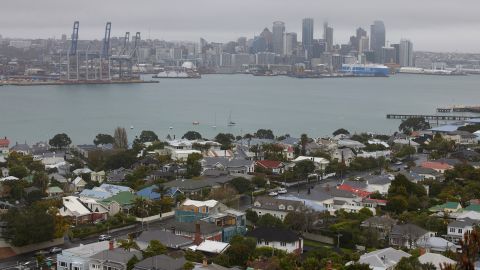
Houses in the suburb of Devonport across from the central business district of Auckland, New Zealand.

New Zealand is at the sharp end of a global housing market squeeze that has grim ramifications for the world economy.

The pandemic boom, which sent prices into the stratosphere, is running out of steam and house prices now are falling from Canada to China, setting the stage for the broadest housing market slowdown since the global financial crisis.

Rising interest rates are driving the dramatic change. Central banks on a warpath against inflation have taken rates to levels not seen for more than a decade, with ripple effects on the cost of borrowing.

US mortgage rates topped 7{d4d1dfc03659490934346f23c59135b993ced5bc8cc26281e129c43fe68630c9} last month for the first time since 2002, up from just over 3{d4d1dfc03659490934346f23c59135b993ced5bc8cc26281e129c43fe68630c9} a year ago, before pulling back slightly in November as inflation eased. In the European Union and United Kingdom, mortgage rates have more than doubled since last year, chasing would-be buyers from the market.

“Overall, this is the most worrying housing market outlook since 2007-2008, with markets poised between the prospect of modest declines and much steeper ones of 15{d4d1dfc03659490934346f23c59135b993ced5bc8cc26281e129c43fe68630c9}-20{d4d1dfc03659490934346f23c59135b993ced5bc8cc26281e129c43fe68630c9},” said Adam Slater, a lead economist at Oxford Economics, a consultancy.

One key factor determining how low prices go? Unemployment. A sharp increase in joblessness could lead to forced sales and foreclosures, “where steep discounts are common,” according to Slater.

But even if the correction in prices is mild, a housing market slowdown could have severe consequences because housing transactions in turn boost activity in other sectors of the economy.

“In an ideal world, you’ll get a bit of froth blown off the top [of house prices] and everything is fine. It isn’t impossible, but it’s more likely that housing downturns come with nastier consequences,” Slater told CNN Business.

House prices are already falling in more than half of the 18 advanced economies that Oxford Economics tracks, including the United Kingdom, Germany, Sweden, Australia and Canada, where prices dropped by around 7{d4d1dfc03659490934346f23c59135b993ced5bc8cc26281e129c43fe68630c9} from February to August.

“Data lags probably mean that most markets are now seeing falling prices,” said Slater. “We’re in the early period in quite a clear downturn now and the only real question is how steep and how long it’s going to be.”

House prices in the United States — which rose during the pandemic by the most since the 1970s — are falling too. Economists at Goldman Sachs expect a decline of around 5{d4d1dfc03659490934346f23c59135b993ced5bc8cc26281e129c43fe68630c9}-10{d4d1dfc03659490934346f23c59135b993ced5bc8cc26281e129c43fe68630c9} from the peak reached in June through to March 2024.

In a “pessimistic” scenario, US prices could plunge as much as 20{d4d1dfc03659490934346f23c59135b993ced5bc8cc26281e129c43fe68630c9}, Dallas Fed economist Enrique Martinez-Garcia wrote in a blog post recently.

Prices for new homes in China fell at the fastest pace in over seven years in October, according to official figures, reflecting a deepening property market slump that has gripped the country for months and is weighing heavily on its economy. Home sales have fallen by 43{d4d1dfc03659490934346f23c59135b993ced5bc8cc26281e129c43fe68630c9} this year, according to China Index Academy, a research firm.

Sales are sliding elsewhere too, as banks take a more cautious approach to lending and aspiring homebuyers delay purchases in the face of much higher borrowing costs and a deteriorating economic outlook.

House sales in Britain were 32{d4d1dfc03659490934346f23c59135b993ced5bc8cc26281e129c43fe68630c9} below the previous year’s level in September, according to official figures. A closely watched survey showed that new buyer inquiries fell for the sixth successive month in October to the lowest level since 2008, excluding the early months of 2020 when the market was largely shut because of the pandemic.

In the United States, sales of existing homes were down by more than 28{d4d1dfc03659490934346f23c59135b993ced5bc8cc26281e129c43fe68630c9} year-over-year in October, the ninth consecutive monthly decline, according to the National Association of Realtors.

Mortgage rates in 25 major cities around the world tracked by UBS have almost doubled on average since last year, making house purchases much less affordable.

“A skilled service sector worker can afford roughly one-third less housing space than before the pandemic,” according to the UBS Global Real Estate Bubble Index.
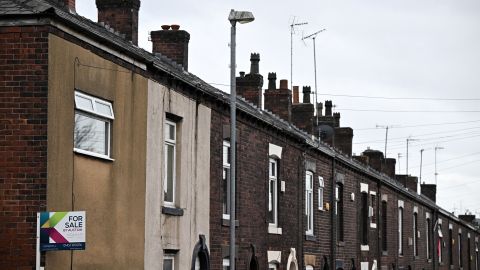
An estate agent's 'for sale' board is pictured on a house at the end of a row of terraced homes in northern England on November 2, 2022.

As well as putting off new buyers, the sharp increase in rates has shocked existing homeowners accustomed to more than a decade of ultra-low borrowing costs.

In Britain, more than 4 million mortgages have been issued to first-time buyers since 2009, when rates were near zero. “There’s a lot of people out there who don’t appreciate what it’s like when their monthly outgoings rise,” said Tom Bill, head of UK residential research at broker Knight Frank.

In countries with a larger share of variable rate mortgages, such as Sweden and Australia, the shock will be immediate and could increase the risk of forced sales that drive prices down faster.

But even in places where a large proportion of mortgages are fixed, such as New Zealand and the United Kingdom, the average maturity of these mortgages is quite short.

“This means much more debt will be subject to (often significantly) higher rates over the next year or so than might first appear to be the case,” Slater wrote in a report last month.

While interest rates have been the catalyst for the housing market slowdown, the jobs market will play a bigger role in determining how low prices ultimately plunge.

Modeling of past house price crashes by Oxford Economics shows that employment is the decisive factor in determining the severity of a downturn, because a spike in joblessness raises the number of forced sellers.

“History shows that if labor markets can remain strong, then the chances of a more benign correction are higher,” according to Innes McFee, chief global economist at Oxford Economics.

Employment levels in many advanced economies have recovered since falling at the start of the pandemic. But there are early signs that labor markets are starting to cool as weak economic growth hits demand for workers.

After recovering strongly at the beginning of the year, the number of hours worked was 1.5{d4d1dfc03659490934346f23c59135b993ced5bc8cc26281e129c43fe68630c9} below pre-pandemic levels in the third quarter, amounting to a deficit of 40 million full-time jobs, according to estimates by the International Labour Organization.

“The outlook for global labour markets has worsened in recent months and on current trends job vacancies will decline and global employment growth will deteriorate significantly in the final quarter of 2022,” the ILO said in an October report.

The unemployment rate in the United States ticked upwards in October to 3.7{d4d1dfc03659490934346f23c59135b993ced5bc8cc26281e129c43fe68630c9}. In the United Kingdom, job vacancies have fallen to the lowest level in a year. The UK Office for Budget Responsibility expects unemployment to rise by 505,000 to a peak of 1.7 million — an unemployment rate of 4.9{d4d1dfc03659490934346f23c59135b993ced5bc8cc26281e129c43fe68630c9} -— in the third quarter of 2024.

“A decisive increase in unemployment is a very big danger for housing markets,” said Slater of Oxford Economics.
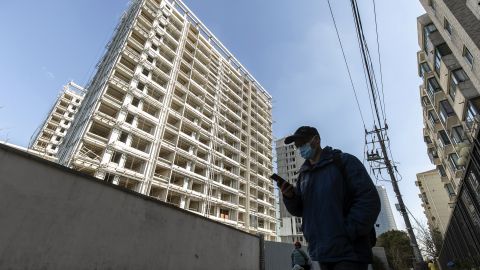
A pedestrian passes unfinished apartment buildings at the West Bund Park residential project in Shanghai, China, on Jan. 14, 2022.

Most market watchers are not expecting a repeat of the 2008 housing market crash. Banks and households are in better financial shape, and housing supply in some countries remains tight.

But even a modest a fall in house prices will knock confidence, causing homeowners to cut back on spending.

A slowdown in activity will also deal a blow to many other parts of the economy because of the housing market’s links to builders, lawyers, banks, moving companies and furniture stores, to name a few.

China’s property market accounts for about 28-30{d4d1dfc03659490934346f23c59135b993ced5bc8cc26281e129c43fe68630c9} of GDP because of these linkages. In the United States, housing’s broader contribution to GDP generally averages 15-18{d4d1dfc03659490934346f23c59135b993ced5bc8cc26281e129c43fe68630c9}, according to the National Association of Home Builders.

In a worst-case scenario — one in which house prices fall more sharply than anticipated and price declines are met with a slump in residential investment and tighter lending by banks — Oxford Economics forecasts that world GDP will expand by just 0.3{d4d1dfc03659490934346f23c59135b993ced5bc8cc26281e129c43fe68630c9} in 2023, rather than the 1.5{d4d1dfc03659490934346f23c59135b993ced5bc8cc26281e129c43fe68630c9} it currently expects.

“An additional negative factor, compared to the [global financial crisis], is that the Chinese housing market is also in a downturn,” according to Slater. “So rather than offsetting the impact on world output of a global housing downturn, as was the case after the GFC, the Chinese housing sector is contributing to the slump.”

— Laura He contributed to this report.

Could This U.S. Housing Market Crash Be Worse Than 2008?

Could This U.S. Housing Market Crash Be Worse Than 2008?

Could This U.S. Housing Market Crash Be Worse Than 2008?

Mauricio Graiki

In a matter of months, the pandemic housing boom has turned into a rapidly spreading bust. Incredibly, recent reporting shows that home prices are now falling faster than they did during the run-up to the 2008 financial crisis.

Economic models will tell you that compared with sluggish wages and skyrocketing interest rates, home prices are as much as 75{d4d1dfc03659490934346f23c59135b993ced5bc8cc26281e129c43fe68630c9} overvalued in formerly hot housing markets. And the Fed is telling you what’s about to happen if you read between the lines (and maybe even that they want/need it to happen).

The housing market was very overheated for a couple of years after the pandemic, as demand increased and rates were low. The market needs to get back into a balance between supply and demand (emphasis mine).

–Jerome Powell, Nov. 2 FOMC Meeting.

The developing crash in housing prices has profound implications for anyone looking to buy a house, as well as for investors in housing stocks. The iShares Home Construction ETF (BATS:ITB) is down a bit more than 30{d4d1dfc03659490934346f23c59135b993ced5bc8cc26281e129c43fe68630c9} for the year, but if the situation on the ground is as bad as it appears, then it might be headed a lot lower. ITB is the worst of the worst when it comes to this kind of interest rate shock, because homebuilders borrow a lot of money to build, and in turn, they sell to their customers who borrow a lot of money to buy. This crash has been a long time coming as prices got further and further from fair value. Now that huge declines are rolling down the tracks, there’s not much that can stop it. If you already own a house with a low mortgage rate and didn’t buy it during the bubble, then no worries. But if you’re looking to buy a house now, think twice!

A Tidal Wave Of Housing Supply Is Coming

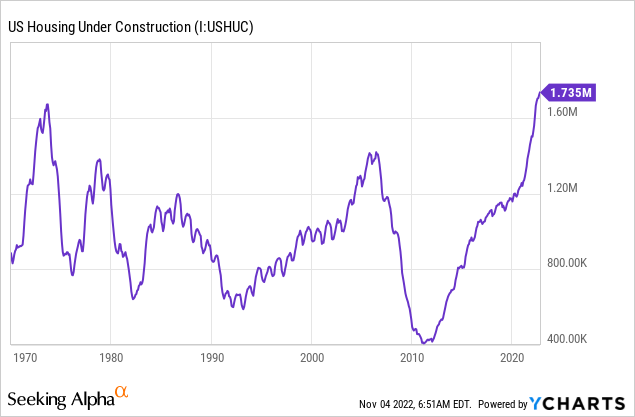
1.7 million homes are presently under construction in the US, the highest level ever. The peak in 2006 was around 1.4 million homes in various stages of construction. This obscures the fact that the US population was growing by nearly 3 million people per year in 2006, whereas the population now is only growing by somewhere between 500,000 and 1 million people per year.

Chart
Data by YCharts

At the average of roughly 2.5 people per household, that implies a need for nearly 1.2 million housing units built in 2006, but only 400,000 units in 2022 if we assume we gained a million people in population. There are reasons to believe that population growth could be even lower going forward, as declining inflation-adjusted wages and declining life expectancy (coronavirus, opiates, general malaise, etc.) take their toll. With mortgages over 7{d4d1dfc03659490934346f23c59135b993ced5bc8cc26281e129c43fe68630c9} now and population growth flatlining, who is going to buy all of these homes?

Of course, there’s a continual toll of obsolescence for homes (mostly homes in rural areas and the Rust Belt where people abandon them and move to greener pastures). This is thought to be about 300,000 homes per year. All-in, demographics imply the need for around 700,000 housing starts per year. We’re adding about twice as many houses as demographics imply we need to the construction pipeline on an annualized basis.

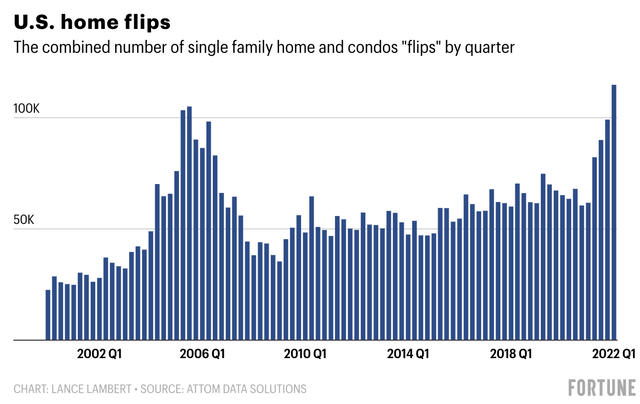
By contrast to the changing demographic picture, house flipping has been at an all-time high, with investors often selling to other investors.

House Flipping US

Flip or Flop? (Fortune)

The Rental Market Is Reversing

Interestingly, a much higher percentage of units under construction than in the last cycle are multifamily units, either as condos for sale or apartments for rent (about 50{d4d1dfc03659490934346f23c59135b993ced5bc8cc26281e129c43fe68630c9}). Rents went crazy during COVID, but there’s actually a simple explanation for why they did, and why things may be about to reverse.

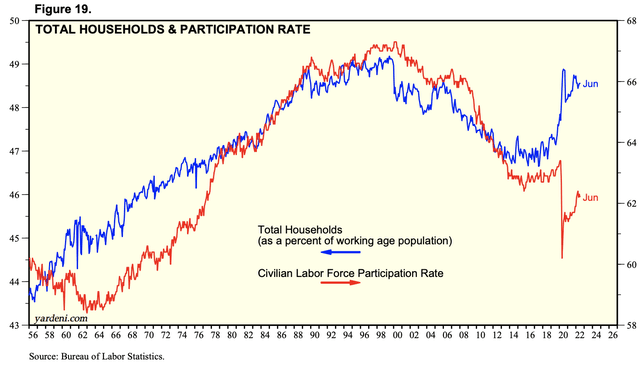
  1. The eviction and foreclosure moratoriums allowed millions of people to live rent-free, massively choking the supply of housing while they were in effect. As I’ve written previously, the pandemic was the first time in the post-WW II era when fewer people worked but more people were occupying housing. Not normal! This is bound to revert to the mean, either millions more people are going to have to start working, or they’re not going to be able to pay rent/mortgage payments. In the vast majority of cases, people with insufficient income to support their current housing situation will just ride out their current leases and then not renew. They’ll move in with family, get roommates, or move to cheaper accommodation until supply and demand are balanced. When this data is updated next, I expect to see a lot of demand destruction.

Labor Force Participation Vs. Occupied Housing

Labor Force Participation Vs. Occupied Housing (Yardeni Research)

2. Price-fixing in the rental market. What’s not widely known is the effect that software used by large landlords may have had on the pandemic rental market. A recent class-action lawsuit alleges that a ubiquitous leasing software called YieldStar allowed large landlords to effectively form a cartel by letting a common algorithm set rental and lease renewal prices for all users. The software essentially used an algorithm to automatically coordinate pricing with thousands of other landlords, largely to avoid competing on price. Of course, the founder of YieldStar previously was forced to settle a case with the Justice Department for creating illegal price-fixing software for airlines. You can’t make this stuff up!

The evidence presented in the lawsuit is quite damning, and the fact that the main class action is being filed in Southern California means that this has the potential to be one of the largest class action payouts in US history. It’s very fashionable for people and politicians to blame rising prices on “greedy corporations,” and in many cases, it’s off-base. Here though, there’s evidence that using this software truly gave large landlords sufficient control over certain rental markets to extract monopolistic profits from tenants.

However, the theory will tell you that the free market will eventually respond to this sort of oligopoly, which is why we’re now seeing a huge boom in multifamily construction to cover for this artificial shortage. With some antitrust enforcement and letting the free market work, rents should actually fall over the next few years, which will help cool runaway inflation, albeit not nearly enough to bring inflation back to 2{d4d1dfc03659490934346f23c59135b993ced5bc8cc26281e129c43fe68630c9} by itself. In fact, asking rents have already begun falling.

The Demographic-Driven Housing Shortage Was Mostly A Myth

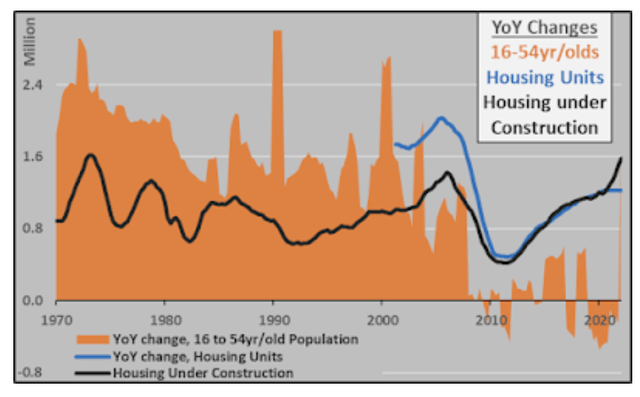
Though prices have skyrocketed, housing units per capita exceed the levels seen in 2008 in many markets. This doesn’t mean that housing isn’t scarce due to booming demand or too expensive, but what it does mean is that supply has easily kept up with demographics, albeit not speculative demand from investors, flippers, and second/third homeowners. The big spikes here below every 10 years are from one-off census adjustments, but the data shows that the US population aged 16-54 is actually falling.

Change In US Adult Population

Demographic Problems With Housing (Economica)

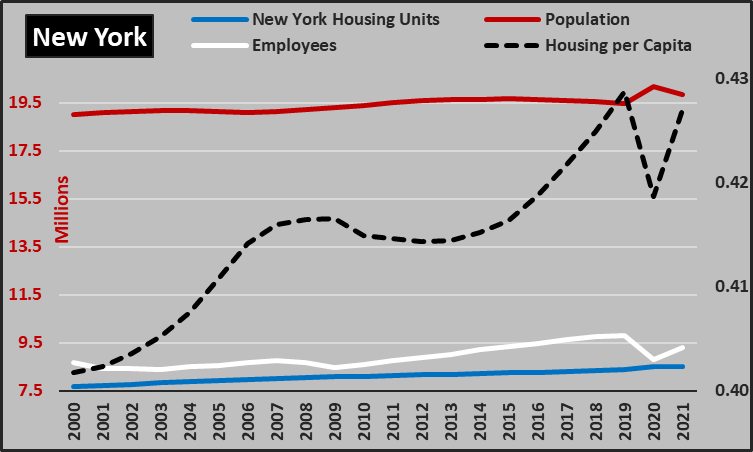
We see this when comparing the housing stock to the population. For example, construction in New York has continually increased the amount of housing stock available per capita (again note that the jagged lines in 2021 are from a census adjustment). This is the free market at work.

New York Housing Market

New York Housing Market (Economica)

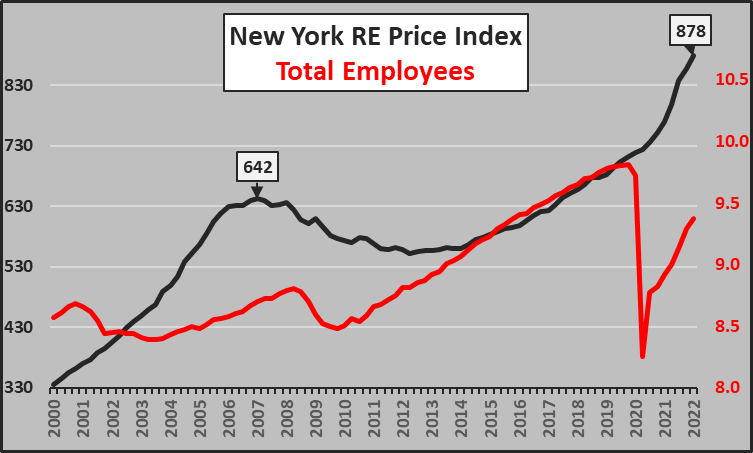
However, prices have surged, even while employment remains well below pre-pandemic levels. This is not the free market since 2019, instead, it was from interest rate suppression. Now that rates are skyrocketing, this is a huge shoe to drop.

New York Housing Prices

New York Housing Market (Economica)

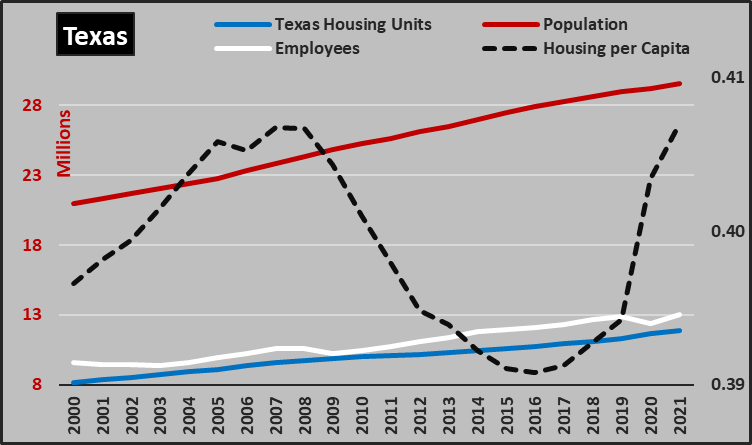
Texas also is an extremely interesting housing market to look at, because a lot of people are moving there, fueling the narrative that prices should automatically surge. But contrary to popular belief, construction in Texas has kept pace with migration trends, yet prices have skyrocketed. The most recent real-time data from Realtor.com shows that the Texas market is now among the leaders of the deepening housing market correction that started on the West Coast.

Texas Housing Market

Texas Housing Market (Economica)

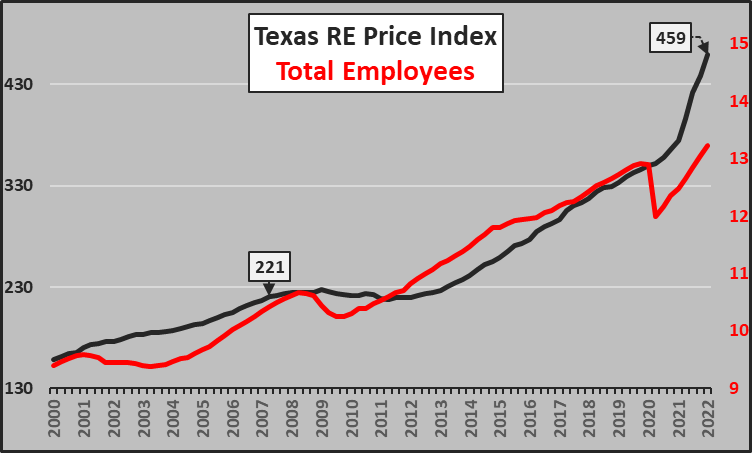
Surely prices should rise in line with supply and demand, but the degree of price rises while construction keeps pace with demographics should not happen. Note that while employment superficially looks better in Texas than in New York, median salaries are much lower while housing prices have surged far more.

Texas Housing Market

Texas Housing Market (Economica)

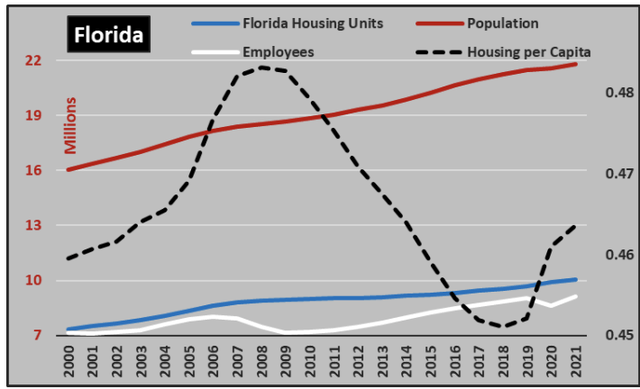
Construction hasn’t yet kept pace with migration in all markets. The author of the Economica blog noted that states like Florida, Nevada, and Washington had underlying demographic demand that could soak up homes if prices were to fall from their presently overvalued state. Still though, as hot as the real estate market is, Florida’s median income has increased something like 5{d4d1dfc03659490934346f23c59135b993ced5bc8cc26281e129c43fe68630c9} post-pandemic, while housing prices increased about 60{d4d1dfc03659490934346f23c59135b993ced5bc8cc26281e129c43fe68630c9}. Debt, debt, and more debt! Florida’s housing per capita has actually increased since bottoming in 2018 though when prices were almost half of where they are now. Also, a disproportionate amount of new housing supply will be coming online in sunbelt markets like Florida.

Florida Housing Market

Florida Housing Market (Economica)

Demographic reality (i.e. wages) doesn’t square with the enormous boom in home prices, which is why many economists believe home prices are substantially overvalued. What’s really at play here is that housing prices have done nothing but go up because interest rates have done nothing but go down, fueling round after round of speculative buying.

But with an ongoing construction boom well in excess of population growth, the question is who will live in all these homes – five years from now, 10 years from now, and 30 years from now? 2008 showed that even markets with good long-term fundamentals tend to see crashes just the same because they receive a disproportionate amount of speculative investment flows. Tarrant County, in the Dallas-Fort Worth metro area, saw 52{d4d1dfc03659490934346f23c59135b993ced5bc8cc26281e129c43fe68630c9} of all home sales go to investors in 2021! That’s the height of insanity.

These figures imply that in a county with over 2 million people, less than half of homebuyers actually intended to live in the houses they were buying. This is after in the last 10 years, median income in Texas rose 29{d4d1dfc03659490934346f23c59135b993ced5bc8cc26281e129c43fe68630c9}, while the median mortgage payment on a new home purchase rose 280{d4d1dfc03659490934346f23c59135b993ced5bc8cc26281e129c43fe68630c9}. Home price gains of this magnitude are created by borrowing, not actual wealth. And while this article focuses on the US, I’d be remiss not to mention the other enormous housing bubbles globally, chiefly in Canada, Australia, and New Zealand.

The 20th Century housing market was boosted by steady population growth and a steady pace of urbanization, so prices went up. But with the process of urbanization complete in Western countries and population growth effectively at zero, continually adding supply should continually lower prices. This already has happened in parts of Europe where prices are well below 2007 inflation-adjusted peaks. In the long run, this can actually be a good thing because it means consumers get more for less, but it’s bad if you went all-in on housing with debt too early.

And Mortgage Demand Is Tanking

In the 2000s housing market bubble, America and much of the world had a cultural moment where real estate was praised as the only real way to build wealth. And after the 2008 crash, many of these same people got disillusioned and decided the juice of being a homeowner wasn’t worth the squeeze. From late 2019 to early 2022, a similar frenzy took hold. Now, demand is truly tanking again.

With mortgage rates over 7{d4d1dfc03659490934346f23c59135b993ced5bc8cc26281e129c43fe68630c9} and prices up substantially since the pandemic, this is perhaps the worst time to buy a house in our lifetimes. This comes 10 years after the best time to buy a house in our lifetimes, and likely 2-3 years before a similar time may come again. Mortgage applications are down 42{d4d1dfc03659490934346f23c59135b993ced5bc8cc26281e129c43fe68630c9} year over year. That’s simply stunning, considering how people were getting into bidding wars mere months ago.

There’s a famous economics paper from 2007 called Housing IS The Business Cycle. In it, the author argues that by setting interest rates to manage inflation and unemployment, the Federal Reserve had inadvertently inflated a housing bubble and would be forced to cause a housing bust to keep inflation from spiraling out of control. Instead, the argument is that the Fed should start hiking rates earlier in the business cycle to keep the housing market from becoming speculative chaos. Does this sound familiar at all? The key idea here: The later the Fed is in hiking interest rates (or doing quantitative tightening) during the boom, the less ability they have to help during the inevitable downturn.

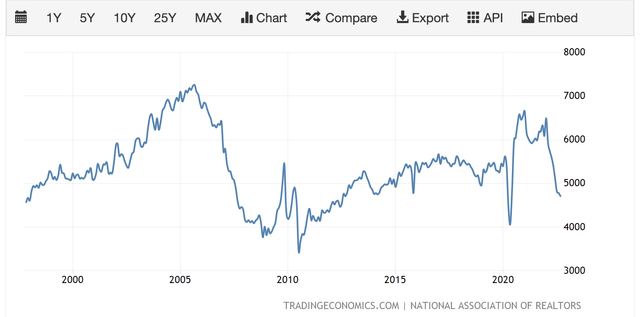
Notably, the paper was written in the middle of the 2000s crash at a point where buyers and sellers were in a similar standoff to today where sellers refused to sell and buyers could not or would not buy, so there also was a very interesting (wrong) prediction in the paper that prices would not crash but transactions would grind to a halt. Of course, prices went on shortly after to crash the most since the Great Depression. Here we are again, with leading indicators for future sales falling off a cliff.

US Existing Home Sales

US Existing Home Sales (Trading Economics)

One reason for this is – if I sell a house to buy another one, that’s not net housing supply. But if someone passes away and their kids put the house up for sale, or if a couple gets divorced and rents, or if investors sell because they realize that they’re not going to make money- that’s net supply. Unemployment is a huge driver of net supply over time, so if the unemployment rate begins to rise in the US, foreclosures and short sales hitting the market could have an unprecedented impact on the state of speculative demand.

The Fed May Need The Housing Market To Fall

The key difference between 2007 and now is that the Fed was far more behind the curve this time. In contrast to 2007-2008 when the government actively tried to help stabilize the housing market, the Fed is likely unable or unwilling to put a floor under housing prices, because they’re overpriced and they can’t waste money fighting the market. To this point, in light of the amount of arbitrary redistribution of wealth that the current housing boom has created, the housing market crashing from dizzying heights may be an intended feature of Fed policy, not a bug.

This isn’t my lifelong crusade. If housing prices fall 30{d4d1dfc03659490934346f23c59135b993ced5bc8cc26281e129c43fe68630c9} and you can get a mortgage under 5{d4d1dfc03659490934346f23c59135b993ced5bc8cc26281e129c43fe68630c9} (i.e. to historical norms vs. wages), I’d tell you that buying a house is a solid long-term investment. Similarly, if the stock market retreats to a more attractive valuation, you should buy it. If someone bought a house in 2017 and ends up being breakeven in price appreciation seven years later after the market crashes, that’s fine because they bought at fair prices and saved rent along the way in a similar fashion to investors getting dividends. But if someone bought a house in 2021 or 2022 for far above the house’s fundamental value, they’re in a ton of trouble, especially new construction buyers who locked in purchase prices at signing but had to wait to lock bank financing at completion (when mortgages soared from 3{d4d1dfc03659490934346f23c59135b993ced5bc8cc26281e129c43fe68630c9} to 7{d4d1dfc03659490934346f23c59135b993ced5bc8cc26281e129c43fe68630c9} or more). New buyers likely had no idea what they were getting into.

Buyers who are taking sellers’ asking prices right now are dramatically overpaying based on market fundamentals. This is why so few people are buying homes right now compared with the recent past, and why so many homebuyers are canceling their contracts with builders. Like it or not, the 21st Century real estate market has been a wild carnival ride – redistributing years and years of salary income to winners from losers. If you make a bad decision regarding housing, it can negate the earnings from a six-figure salary for a decade or longer. The market is speaking right now if you’re willing to listen, and what it’s telling you is that the unhealthy US housing market is in a twice-in-a-lifetime amount of trouble. Investors in housing-sensitive stocks like homebuilders should pay attention to the macro picture with the real estate market and consider selling their positions as well.

Bottom Line

Will this housing market crash outdo 2008? It’s yet to be seen. A key reason behind the 2008 housing crash was a rise in the rate of unemployment. If unemployment stays relatively low, then home prices may just grind downward. But if unemployment rises to 6{d4d1dfc03659490934346f23c59135b993ced5bc8cc26281e129c43fe68630c9}, 7{d4d1dfc03659490934346f23c59135b993ced5bc8cc26281e129c43fe68630c9}, or more, millions of motivated sellers will hit the market with relatively few takers due to the changing demographic reality of America and the amount of demand that was already pulled forward during the pandemic. And in 2008, houses were objectively cheap, drawing capital in from institutional investors. If home prices were to fall something 10{d4d1dfc03659490934346f23c59135b993ced5bc8cc26281e129c43fe68630c9}-20{d4d1dfc03659490934346f23c59135b993ced5bc8cc26281e129c43fe68630c9} from here, valuations would still be higher than fundamentals suggest they should be. Those declines would only take us back to 2021 prices, with rates dramatically higher. For these reasons, it’s very possible for this crash in housing prices to exceed 2008’s in magnitude.